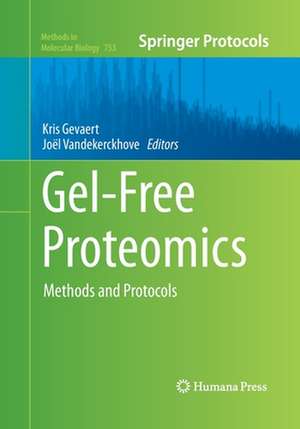
Gel-Free Proteomics
en Limba Engleză Paperback – 23 aug 2016
Authoritative and easily accessible, Gel-Free Proteomics: Methods and Protocols serves as a timely resource for both professionals and novices pursing research in this critical field.
Preț: 897.62 lei
Preț vechi: 1094.66 lei
-18%
Puncte Express: 1346
Carte disponibilă
Livrare economică 09-23 noiembrie
Livrare prin curier în România Termenul estimat este afișat lângă disponibilitate.
Transport gratuit pentru acest produs Plată online sau ramburs, în funcție de opțiunile comenzii.
Retur gratuit în 14 zile Comandă securizată și suport în română.
Specificații
ISBN-13: 9781493958191
ISBN-10: 1493958194
Pagini: 414
Ilustrații: XII, 400 p.
Dimensiuni: 178 x 254 x 23 mm
Greutate: 0.71 kg
Ediția:Softcover Reprint of the Original 1st 2011 edition
Editura: Springer Verlag GmbH
Locul publicării:Totowa, NJ, United States
ISBN-10: 1493958194
Pagini: 414
Ilustrații: XII, 400 p.
Dimensiuni: 178 x 254 x 23 mm
Greutate: 0.71 kg
Ediția:Softcover Reprint of the Original 1st 2011 edition
Editura: Springer Verlag GmbH
Locul publicării:Totowa, NJ, United States
Cuprins
1. Mass Spectrometry-driven Proteomics: An Introduction Kenny Helsens, Lennart Martens, Joël Vandekerckhove, and Kris Gevaert 2. Metabolic Labeling of Model Organisms using Heavy Nitrogen (15N) Joost W. Gouw, Bastiaan B.J. Tops, and Jeroen Krijgsveld 3. Trypsin-catalyzed Oxygen-18 Labeling for Quantitative Proteomics Brianne O. Petritis, Carrie D. Nicora, Wei-Jun Qian, and Richard D. Smith 4. ICPL Labeling Strategies for Proteome Research Friedrich Lottspeich and Josef Kellermann 5. Quantitative Proteome Analysis using Isobaric Peptide Termini Labeling (IPTL) Magnus Ø. Arntzen, Christian J. Koehler, Achim Treumann, and Bernd Thiede 6. Complete Chemical Modification of Amine and Acid Functional Groups of Peptides and Small Proteins Casey J. Krusemark, Brian L. Frey, Lloyd M. Smith, and Peter J. Belshaw 7. Production and Use of Stable-isotope-labeled Proteins for Absolute Quantitative Proteomics Dorothée Lebert, Alain Dupuis, Jérôme Garin, Christophe Bruley, and Virginie Brun 8. Organelle Proteomics Sophie Duclos and Michel Desjardins 9. Membrane Protein Digestion ¿ Comparison of LPI Hexalane with Traditional Techniques Ping Sui, Tasso Miliotis, Max Davidson, Roger Karlsson, and Anders Karlsson 10. GeLCMS for In-depth Protein Characterization and Advanced Analysis of Proteomes Alicia Lundby and Jesper V. Olsen 11. Exploring New Proteome Space: Combining Lys-N Proteolytic Digestion and Strong Cation Exchange (SCX) Separation in Peptide Centric MS-driven Proteomics Nadia Taouatas, Shabaz Mohammed, and Albert J.R. Heck 12. Quantitation of Newly Synthesized Proteins by Pulse-labeling with Azidohomoalanine Gertjan Kramer, Piotr T. Kasper, Luitzen de Jong, and Chris G. de Koster 13. Analytical Strategies in Mass Spectrometry Based Phosphoproteomics Heidi Rosenqvist, Juanying Ye, and Ole N. Jensen 14. A Protocol on the Use of Titanium Dioxide Chromatography for Phosphoproteomics Martijn W. H. Pinkse, Simone Lemeer, and Albert J.R. Heck 15. Positional Proteomis at the N-terminus as a Means of Proteome Simplification Gemma R. Davidson, Stuart D. Armstrong, and Robert J. Beynon 16. N-terminomics: A High-content Screen for Protease Substrates and their Cleavage Sites John C. Timmer and Guy S. Salvesen 17. Protease Specificity Profiling by Tandem Mass Spectrometry Using Proteome-derived Peptide Libraries Oliver Schilling, Ulrich auf dem Keller, and Christopher M. Overall 18. Identification of Proteolytic Products and Natural Protein N-termini by Terminal Amine Isotopic Labeling of Substrates (TAILS) Alain Doucet, Oded Kleifeld, Jayachandran N. Kizhakkedathu, and Christopher M. Overall 19. Lectins as Tools to Select for Glycosylated Proteins Els J. M. Van Damme 20. Strong Cation Exchange Chromatography for Analysis of Sialylated Glycopeptides Katharina Lohrig, Albert Sickmann, and Urs Lewandrowski 21. Titanium Dioxide Enrichment of Sialic Acid-containing Glycopeptides Giuseppe Palmisano, Sara E. Lendal, and Martin R. Larsen 22. Chemical de-O-Glycosylation of Glycoproteins for Applications in LC-based Proteomics Franz-Georg Hanisch 23. Ubiquitination and Degradation of Proteins Yelena Kravtsova-Ivantsiv and Aaron Ciechanover 24. Bioinformatics Challenges in Mass Spectrometry Driven Proteomics Lennart Martens 25. A Case Study on the Comparison of Different Software Tools for Automated Quantification of Peptides Niklaas Colaert, Joël Vandekerckhove, Lennart Martens, and Kris Gevaert
Textul de pe ultima copertă
Proteomics by means of mass spectrometry has rapidly changed the way that we analyze proteomes. Gel-Free Proteomics: Methods and Protocols addresses contemporary methods for gel-free proteome research with a special focus on differential analysis and protein modifications. Divided into twenty-five chapters, this detailed volume meticulously describes vital procedures needed to perform gel-free proteomics, ranging from sample preparation, isotope labeling for differential proteomics, enrichment technologies for modified proteins and peptides, and bioinformatics. Written in the successful Methods in Molecular Biology™ series format, chapters include introductions to their respective topics, lists of the necessary materials and reagents, step-by-step, readily reproducible protocols, and notes on troubleshooting and avoiding known pitfalls.
Authoritative and easily accessible, Gel-Free Proteomics: Methods and Protocols serves as a timely resource for both professionals and novices pursuing research in this critical field.
Authoritative and easily accessible, Gel-Free Proteomics: Methods and Protocols serves as a timely resource for both professionals and novices pursuing research in this critical field.
Caracteristici
Includes cutting-edge methods and protocols Provides step-by-step detail essential for reproducible results Contains key notes and implementation advice from the experts Includes supplementary material: sn.pub/extras