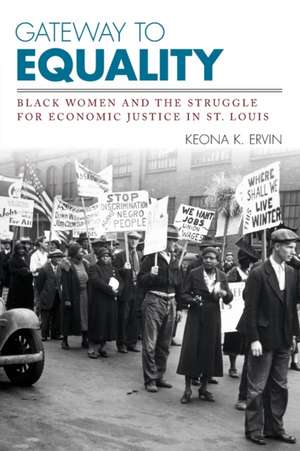
Gateway to Equality
Autor Keona K Ervinen Limba Engleză Paperback – 5 apr 2019
Gateway to Equality investigates black working-class women's struggle for economic justice from the rise of New Deal liberalism in the 1930s to the social upheavals of the 1960s. Author Keona K. Ervin explains that the conditions in twentieth-century St. Louis were uniquely conducive to the rise of this movement since the city's economy was based on light industries that employed women, such as textiles and food processing. As part of the Great Migration, black women migrated to the city at a higher rate than their male counterparts, and labor and black freedom movements relied less on a charismatic, male leadership model. This made it possible for women to emerge as visible and influential leaders in both formal and informal capacities.
In this impressive study, Ervin presents a stunning account of the ways in which black working-class women creatively fused racial and economic justice. By illustrating that their politics played an important role in defining urban political agendas, her work sheds light on an unexplored aspect of community activism and illuminates the complexities of the overlapping civil rights and labor movements during the first half of the twentieth century.
Preț: 192.51 lei
Puncte Express: 289
Carte tipărită la comandă
Livrare economică 24 noiembrie-08 decembrie
Livrare prin curier în România Termenul estimat este afișat lângă disponibilitate.
Transport gratuit de la 400.00 lei Plată online sau ramburs, în funcție de opțiunile comenzii.
Retur gratuit în 14 zile Comandă securizată și suport în română.
Specificații
ISBN-13: 9780813177540
ISBN-10: 0813177545
Pagini: 294
Dimensiuni: 152 x 226 x 23 mm
Greutate: 0.39 kg
Editura: University Press of Kentucky
ISBN-10: 0813177545
Pagini: 294
Dimensiuni: 152 x 226 x 23 mm
Greutate: 0.39 kg
Editura: University Press of Kentucky
Notă biografică
Keona K. Ervin is associate professor of history at the University of Missouri.
Descriere
As part of the Great Migration, black women migrated to the city at a higher rate than their male counterparts, and labor and black freedom movements relied less on a charismatic, male leadership model.