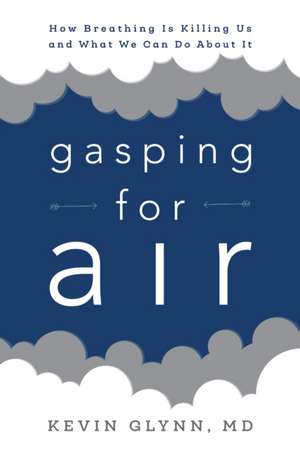
Gasping for Air: How Breathing Is Killing Us and What We Can Do about It
Autor Kevin Glynnen Limba Engleză Paperback – 18 ian 2019
We have powerful weapons to defend breathing. Medical science, public health, engineering, and business, all play important roles in the effort to support breathing. Yet, Gasping for Air also reminds readers how breathing support has been at the eye of the storm in many ethical dilemmas of modern healthcare. Here, Kevin Glynn, an experienced pulmonologist and lifelong asthma sufferer tells stories about the third most common cause of premature deaths in the developed world, describes lethal forces in Nature (infections, genetic predispositions) and from human activities (dusty occupations, tobacco smoking, chemical toxins, drug overdoses) that threaten to suffocate us, and offers sage advice for how to prevent and address those threats and the damage they cause.
Preț: 132.39 lei
Preț vechi: 168.96 lei
-22%
Puncte Express: 199
Preț estimativ în valută:
23.45€ • 27.38$ • 20.37£
23.45€ • 27.38$ • 20.37£
Carte tipărită la comandă
Livrare economică 21 februarie-07 martie
Preluare comenzi: 021 569.72.76
Specificații
ISBN-13: 9781538126011
ISBN-10: 153812601X
Pagini: 288
Ilustrații: 1 Table
Dimensiuni: 158 x 233 x 21 mm
Greutate: 0.43 kg
Editura: Bloomsbury Publishing
Colecția Rowman & Littlefield Publishers
Locul publicării:New York, United States
ISBN-10: 153812601X
Pagini: 288
Ilustrații: 1 Table
Dimensiuni: 158 x 233 x 21 mm
Greutate: 0.43 kg
Editura: Bloomsbury Publishing
Colecția Rowman & Littlefield Publishers
Locul publicării:New York, United States
V-ar putea interesa
-
 -27%Preț: 185.63 lei252.77 lei
 -
 -26%Preț: 130.99 lei178.06 lei
 -
 Cancer Has Its Privileges: Stories of Hope and LaughterChristine CliffordPreț: 123.39 lei
 -
 Strong Women and Men Beat ArthritisMiriam E. NelsonPreț: 131.34 lei
 -
 Bee Healthy Diabetic Log BookSharon B. BarkerPreț: 94.11 lei
 -
 Not Done YetLaurie KingstonPreț: 115.04 lei
 -
 Communications/Media/GeographiesPaul C. Adams-18%Preț: 1069.62 lei1304.42 lei
 -
 My Brother, Mps, and Me!Dawn A. LaneyPreț: 78.14 lei
 -
 Healing Cancer with the Power of Your MindRudy KachmannPreț: 64.07 lei
 -
 Healing the HealerG. Douglas Talbott M. D.Preț: 129.00 lei
 -
 Preț: 300.74 lei
 -
 Psoriasis Simple TreatmentGustavo SanchezPreț: 93.45 lei
 -
 Taming the BeastDr Katinka Van Der MerwePreț: 101.01 lei
 -
 Type 2 Diabetes CureMS Wendy OwenPreț: 44.99 lei
 -
 Cholesterol MythJohn McArthurPreț: 115.53 lei
 -
 Optimism for AutismSusan KingPreț: 101.01 lei
 -
 Preț: 71.50 lei
 -
 Exercises for Doing MindfullyRobert Rodgers PhdPreț: 60.83 lei
 -
 The Faith to Free-FallDr Heidi PetakPreț: 51.39 lei
 -
 Beyond Wheat & Weeds (Black & White)Claudia OrgillPreț: 261.27 lei
 -
 Raising Children with AutismKatherine SmileyPreț: 62.45 lei
 -
 Living with Congestive Heart FailureC. H. TruelovePreț: 47.32 lei
 -
 -22%Preț: 116.49 lei148.92 lei
 -
 Shifting Nicaraguan MediascapesJulie CupplesPreț: 379.58 lei
Cuprins
Timeline
Author's Note
Introduction
PART I. Worldwide Plagues
1. The Disease Medicine Never Cured(Tuberculosis)
2. Captains of the Men of Death(Bacterial Pneumonia)
3. They Stacked Caskets in the Halls(Influenza)
4. The Man in the Iron Lung(Polio)
5. Products of Parasitic Beings(Fungal Infections)
6. Some Like It Hot(Legionnaires' Disease)
7. The Virus with No Name(SARS, MERS)
PART II. Killer Air
8. Suffocating Work(Occupational Diseases)
9. Code Red(Fires and Disasters)
10. Cleopatra Reincarnate(Overdoses and Toxins)
11. Smoking Beagles(Tobacco Smoking)
12. Dad, and the Werewolf (Lung Cancer)
13. The Lethal Brown Cloud(Atmospheric Pollution)
PART III. Vulnerable Breathing
14. Panting for Air(Asthma)
15. Lungs That Do Not Collapse(COPD)
16. The Great Masquerader(Pulmonary Blood Clots)
17. Cells Like Elongated Crescents(Genetic Breathing Disorders)
18. The Pump and the Bellows(The Heart and the Lungs)
19. To Die To Sleep (Sleep Disordered Breathing)
20. The First Breaths(Newborn Respiratory Distress)
PART IV. Breathing Defends
21. Around the World on Oxygen(Respiratory Care)
22. Thank You For My Life(Ventilators)
PART V. Breathing Adapts
23. I Wouldn't Want That for Myself(Ethical Dilemmas)
24. A Science of Uncertainty(Closing)
Author's Note
Introduction
PART I. Worldwide Plagues
1. The Disease Medicine Never Cured(Tuberculosis)
2. Captains of the Men of Death(Bacterial Pneumonia)
3. They Stacked Caskets in the Halls(Influenza)
4. The Man in the Iron Lung(Polio)
5. Products of Parasitic Beings(Fungal Infections)
6. Some Like It Hot(Legionnaires' Disease)
7. The Virus with No Name(SARS, MERS)
PART II. Killer Air
8. Suffocating Work(Occupational Diseases)
9. Code Red(Fires and Disasters)
10. Cleopatra Reincarnate(Overdoses and Toxins)
11. Smoking Beagles(Tobacco Smoking)
12. Dad, and the Werewolf (Lung Cancer)
13. The Lethal Brown Cloud(Atmospheric Pollution)
PART III. Vulnerable Breathing
14. Panting for Air(Asthma)
15. Lungs That Do Not Collapse(COPD)
16. The Great Masquerader(Pulmonary Blood Clots)
17. Cells Like Elongated Crescents(Genetic Breathing Disorders)
18. The Pump and the Bellows(The Heart and the Lungs)
19. To Die To Sleep (Sleep Disordered Breathing)
20. The First Breaths(Newborn Respiratory Distress)
PART IV. Breathing Defends
21. Around the World on Oxygen(Respiratory Care)
22. Thank You For My Life(Ventilators)
PART V. Breathing Adapts
23. I Wouldn't Want That for Myself(Ethical Dilemmas)
24. A Science of Uncertainty(Closing)
Recenzii
Glynn, a medical doctor who specializes in respiratory care, makes it impossible to take breathing for granted. It's vital for life. Within five minutes of not doing it, our brains begin to die. Glynn accurately describes breathing in a narrative that is part history, part biography, and part science. He covers the history of tuberculosis, pneumonia, and polio. He talks about 'suffocating work.' More than 300 substances cause occupational asthma. And he looks at lung cancer, which kills 160,000 Americans per year, including his father, a heavy smoker. Who could blame him and his peers? Old ads featured physicians touting the refreshing power of cigarettes. Like two of his children and grandchildren, Glynn suffers from asthma. But his childhood condition came with a silver lining. Because sports were tricky for him as a child, he turned to books. And now he's written one that is well researched and thoughtful and that should appeal to a large audience, given that 36 million Americans live with respiratory impairment. Inhale, exhale, appreciate.
Gasping for Air is an extraordinary piece of scientific work which is more of an artistic masterpiece. It's thoroughly researched and extremely well written. Dr. Glynn has somehow managed to weave together history of pulmonary medicine, several anecdotes and personal experiences into an artfully written Novel of Pulmonary Medicine for the non-physician. Though, it's a must read for every practicing pulmonologists as well.
Kevin Glynn has written a behind-the-front-lines war chronicle, recounting in compelling detail our war against nature (influenza, tuberculosis, polio, fungi, Legionnaire's disease) and against ourselves (toxins, industrial pollutants, cigarette smoke). Filled with personal stories and dramatic historical accounts-like the Union Carbide disaster in Bhopal-Gasping for Air will take your breath away.
Dr. Glynn has a gift for tackling would-be elusive and complicated matters, and making them not only understandable, but a pleasant and engaging read. Indeed, I found this book to most engaging. But it's also informative enough to consider it as Recommended Reading for pulmonary/critical care fellows, perhaps even faculty, based on my experience is dealing with the former as a program director in an earlier life. Would other readers benefit? Sure. I think pulmonary Nurse Practitioners and Physician Assistants, Respiratory Therapists, air conservationists, medical students and college undergraduates who have not yet decided on their career vector - any of these could stand to benefit. In fact, anyone who'd like to learn more about respiration will find Gasping for Air worthwhile.
Well-written, clear, informative, humorous, but most of all-sensitive and compassionate.
This book is an easy read for those interested in becoming health professionals or for health professionals involved in caring for patients with pulmonary issues. The work offers discussions pertaining to various problems that cause pulmonary disease, such as pollution, infectious toxins, and carcinogens. Glynn, a pulmonary specialist and senior physician, suffers from severe asthma; as a result, he is able to provide a thorough account of how people who have difficulty breathing and obtaining air truly feel. He offers several anecdotes of patients with various respiratory diseases that he has treated throughout his long career. Glynn provides expert details of disorders such as sleep apnea, asthma, emphysema, and cystic fibrosis. He also offers advice for sufferers on how to prevent severe exacerbations of these diseases. Additionally, interesting statistics that illustrate the number of individuals in the US and worldwide with respiratory problems are cited, along with a historical perspective of how influenza, polio, tuberculosis, and fungal processes have caused serious health concerns over the years. Overall, Gasping for Air offers an interesting account for patients suffering from pulmonary diseases. Also, the work will be a useful resource for individuals involved in caring for those with breathing issues.
Gasping for Air is an extraordinary piece of scientific work which is more of an artistic masterpiece. It's thoroughly researched and extremely well written. Dr. Glynn has somehow managed to weave together history of pulmonary medicine, several anecdotes and personal experiences into an artfully written Novel of Pulmonary Medicine for the non-physician. Though, it's a must read for every practicing pulmonologists as well.
Kevin Glynn has written a behind-the-front-lines war chronicle, recounting in compelling detail our war against nature (influenza, tuberculosis, polio, fungi, Legionnaire's disease) and against ourselves (toxins, industrial pollutants, cigarette smoke). Filled with personal stories and dramatic historical accounts-like the Union Carbide disaster in Bhopal-Gasping for Air will take your breath away.
Dr. Glynn has a gift for tackling would-be elusive and complicated matters, and making them not only understandable, but a pleasant and engaging read. Indeed, I found this book to most engaging. But it's also informative enough to consider it as Recommended Reading for pulmonary/critical care fellows, perhaps even faculty, based on my experience is dealing with the former as a program director in an earlier life. Would other readers benefit? Sure. I think pulmonary Nurse Practitioners and Physician Assistants, Respiratory Therapists, air conservationists, medical students and college undergraduates who have not yet decided on their career vector - any of these could stand to benefit. In fact, anyone who'd like to learn more about respiration will find Gasping for Air worthwhile.
Well-written, clear, informative, humorous, but most of all-sensitive and compassionate.
This book is an easy read for those interested in becoming health professionals or for health professionals involved in caring for patients with pulmonary issues. The work offers discussions pertaining to various problems that cause pulmonary disease, such as pollution, infectious toxins, and carcinogens. Glynn, a pulmonary specialist and senior physician, suffers from severe asthma; as a result, he is able to provide a thorough account of how people who have difficulty breathing and obtaining air truly feel. He offers several anecdotes of patients with various respiratory diseases that he has treated throughout his long career. Glynn provides expert details of disorders such as sleep apnea, asthma, emphysema, and cystic fibrosis. He also offers advice for sufferers on how to prevent severe exacerbations of these diseases. Additionally, interesting statistics that illustrate the number of individuals in the US and worldwide with respiratory problems are cited, along with a historical perspective of how influenza, polio, tuberculosis, and fungal processes have caused serious health concerns over the years. Overall, Gasping for Air offers an interesting account for patients suffering from pulmonary diseases. Also, the work will be a useful resource for individuals involved in caring for those with breathing issues.