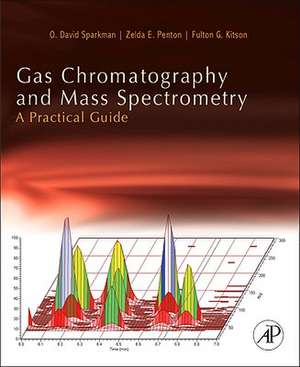
Gas Chromatography and Mass Spectrometry: A Practical Guide
Autor O. David Sparkman, Zelda Penton, Fulton G. Kitsonen Limba Engleză Paperback – 17 mai 2011
Descoperim aici un manual de referință tehnică, conceput ca un instrument de lucru indispensabil direct pe masa de laborator (benchtop reference). Gas Chromatography and Mass Spectrometry: A Practical Guide ajunge la a doua ediție, revizuită substanțial de O. David Sparkman, Zelda Penton și Fulton G. Kitson pentru a reflecta progresele tehnologice din chimia analitică modernă. Suntem de părere că această ediție reușește un echilibru rar: extinde rigoarea științifică a secțiunii de fundamente fără a sacrifica stilul didactic simplu care a consacrat prima ediție.
Structura volumului este organizată strategic pentru a facilita accesul rapid la informație. Prima parte acoperă bazele teoretice, de la instrumentație și interfața GC/MS până la cuantificare. Cea de-a doua parte, extrem de valoroasă pentru practicieni, analizează interpretarea spectrală pentru o gamă vastă de compuși, de la acizi și aminoacizi până la poluanți și medicamente. Apreciem în mod deosebit adăugarea informațiilor despre deconvolution (deconvoluția picurilor cromatografice) și utilizarea bazelor de date pentru identificarea substanțelor necunoscute.
Comparativ cu volumul Gas Chromatography de Colin Poole, care oferă o perspectivă enciclopedică asupra teoriei și coloanelor, acest manual se concentrează pe aplicabilitatea imediată și depanare (troubleshooting). Totodată, Gas Chromatography and Mass Spectrometry: A Practical Guide extinde cadrul propus de ediția anterioară semnată de Fulton G. Kitson cu date noi privind sistemele de injecție și tehnica fast GC. Cele 17 anexe oferă instrumente de calcul pentru compoziția elementară și rapoartele izotopice, transformând volumul într-un ghid complet pentru interpretarea datelor complexe în laborator.
Preț: 483.85 lei
Preț vechi: 609.89 lei
-21%
Carte tipărită la comandă
Livrare economică 08-22 iunie
Specificații
ISBN-10: 0123736285
Pagini: 632
Dimensiuni: 152 x 229 x 23 mm
Greutate: 0.66 kg
Ediția:2. Auflage.
Editura: Elsevier
V-ar putea interesa
-
 Forced-Flow Layer ChromatographyErno Tyihak-27%Preț: 946.60 lei1294.24 lei
 -
 Gas Chromatography and Mass Spectrometry: A Practical GuideFulton G. Kitson-30%Preț: 490.30 lei702.52 lei
 -
 -27%Preț: 1146.25 lei1570.21 lei
 -
 -9%Preț: 1207.08 lei1326.46 lei
 -
 Analysis of Substances in the Gaseous PhaseE. Smolkova-Keulemansova-27%Preț: 2445.73 lei3350.31 lei
 -
 Stationary Phases in Gas ChromatographyH. Rotzsche-27%Preț: 1429.70 lei1958.50 lei
 -
 High Performance Liquid ChromatographySandie Lindsay-8%Preț: 626.77 lei681.27 lei
 -
 -23%Preț: 636.02 lei826.00 lei
 -
 -18%Preț: 1431.92 lei1746.25 lei
 -
 Environmentally Friendly Syntheses Using Ionic LiquidsJairton Dupont-18%Preț: 1403.25 lei1711.29 lei
 -
 -15%Preț: 615.62 lei724.25 lei
 -
 -18%Preț: 1176.89 lei1435.23 lei
 -
 HIGH-PERFORMANCE LIQUID CHROMATOGR..(V2)Lim Chang Kee-15%Preț: 640.69 lei753.76 lei
Public țintă
The novice as well as the experienced GC/MS user who may not have the breadth of knowledge covered in this book.De ce să citești această carte
Recomandăm acest manual atât studenților, cât și chimiștilor analiști care operează echipamente GC/MS. Cititorul câștigă acces la o metodologie clară de interpretare a spectrelor de masă și la soluții practice pentru mentenanța sistemelor. Este o resursă esențială deoarece acoperă tranziția de la teorie la practica de laborator, oferind tabele de referință și proceduri pas-cu-pas care reduc timpul de analiză a probelor necunoscute.
Descriere scurtă
The section regarding GC Conditions, Derivatization, and Mass Spectral Interpretation of Specific Compound Types has the same number of compound types as the original edition, but the information in each section has been expanded to not only explain some of the spectra but to also explain why certain fragmentations take place. The number of Appendices has been increased from 12 to 17. The Appendix on Atomic Masses and Isotope Abundances has been expanded to provide tools to aid in determination of elemental composition from isotope peak intensity ratios. An appendix with examples on "Steps to follow in the determination of elemental compositions based on isotope peak intensities" has been added. Appendices on whether to use GC/MS or LC/MS, third-party software for use in data analysis, list of information required in reporting GC/MS data, X+1 and X+2 peak relative intensities based on the number of atoms of carbon in an ion, and list of available EI mass spectral databases have been added. Others such as the ones on derivatization, isotope peak patterns for ions with Cl and/or Br, terms used in GC and in mass spectrometry, and tips on setting up, maintaining and troubleshooting a GC/MS system have all been expanded and updated.
- Covers the practical instruction necessary for successful operation of GC/MS equipment
- Reviews the latest advances in instrumentation, ionization methods, and quantitation
- Includes troubleshooting techniques and a variety of additional information useful for the GC/MS practitioner
- A true benchtop reference
- A guide to a basic understanding of the components of a Gas Chromatograph-Mass Spectrometer (GC-MS)
- Quick References to data interpretation
- Ready source for information on new analyses
Cuprins
Acknowledgments
Section 1 THE FUNDAMENTALS OF GC/MS
1 Introduction and History
2 Gas Chromatography
3 The GC/MS Interface
4 Mass Spectrometry Instrumentation
5 Mass Spectral Data Interpretation
6 Quantitation with GC/MS
Section 2 GC CONDITIONS, DERIVATIZATION, AND MASS SPECTRAL INTERPRETATION OF SPECIFIC COMPOUND TYPES
7 Acids
8 Alcohols
9 Aldehydes
10 Amides
11 Amines
12 Amino Acids
13 Common Contaminants
14 Drugs and Their Metabolites
15 Esters
16 Ethers
17 Fluorinated Compounds
18 Gases
19 Glycols
20 Halogenated Compounds (Other Than Fluorinated Compounds)
21 Hydrocarbons
22 Isocyanates
23 Ketones
24 Nitriles
25 Nitroaromatics
26 Nitrogen-Containing Heterocyclic Compounds
27 Nucleosides (TMS Derivatives)
28 Pesticides
29 Phenols
30 Phosphorus Compounds
31 Plasticizers and Other Polymer Additives (Including Phthalates)
32 Prostaglandins (MO–TMS Derivatives)
33 Solvents and Their Impurities
34 Steroids
35 Sugars (Monosaccharides)
36 Sulfur Compounds
Section 3 APPENDICES
Appendix A Definitions of Terms Related to Gas Chromatography
Appendix B Definitions of Terms Related to Mass Spectrometry
Appendix C Atomic Masses and Isotope Abundances and Other Information for the Determination of an Elemental Composition from Isotope Peak Intensity Ratios
Appendix D X+1 and X+2 Values for Ions Containing Atoms of C and H Based on Isotope Contributions
Appendix E Isotope Peak Patterns for Ions Containing Atoms of Cl and/or Br
Appendix F Steps to Follow in the Determination of an Elemental Composition Based on Isotope Peak Intensity Ratios
Appendix G Derivatization in GC/MS
Appendix H Points of Comparison of LC/MS vs GC/MS
Appendix I List of Available EI Mass Spectral Databases
Appendix J Information Required for Reporting a GC/MS Analysis
Appendix K Third-Party Software for Use with GC/MS
Appendix L GC Installation and Maintenance
Appendix M Troubleshooting Common GC Problems
Appendix N Maintenance, Operating Tips, and Troubleshooting for Mass Spectrometers
Appendix O Mixtures for Determining Mass Spectral Resolution
Appendix P Cross-Index Chart for GC Stationary Phases
Appendix Q Ions for Determining Unknown Structures
Index
Recenzii
-- CHOICE