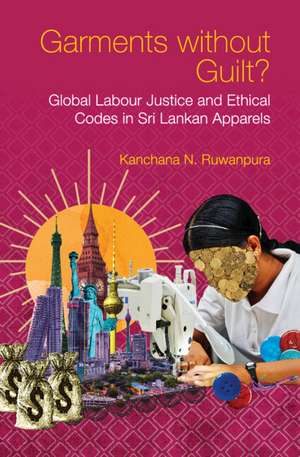
Garments Without Guilt?
Autor Kanchana N Ruwanpuraen Limba Engleză Hardback – 16 iun 2022
Problema centrală pe care o abordează Garments Without Guilt? este discrepanța dintre imaginea de „etică impecabilă” promovată de industria confecțiilor din Sri Lanka și realitatea dură a muncii pe teren. Observăm cum Kanchana N. Ruwanpura deconstruiește promisiunea unor produse realizate fără exploatare, investigând dacă aceste coduri de conduită sunt instrumente reale de justiție sau simple strategii de marketing într-o economie globală avidă de responsabilitate socială. Ne-a atras atenția modul în care autoarea integrează perspectivele feministe pentru a arăta cum genul și istoria politică a țării influențează dinamica din fabrici. Structura volumului este una riguroasă, ghidând cititorul de la geografia muncii și metodologiile de teren, până la analize specifice despre cum statul srilankez a răspuns revendicărilor muncitorilor. Capitolele dedicate tranziției „de la război la muncă” sunt esențiale pentru a înțelege cum traumele post-conflict sunt gestionate în spațiul industrial. Cititorul care a aplicat ideile din Clothed in Integrity despre responsabilitatea retailerilor transnaționali va găsi aici o analiză mult mai localizată și critică, ce completează viziunea teoretică cu date empirice despre rezistența muncitorilor în fața proceselor capitaliste. De asemenea, lucrarea intră într-un dialog fertil cu Juki Girls, Good Girls – Gender and Cultural Politics in Sri Lanka`s Global Garment Industry, oferind o actualizare necesară asupra modului în care identitatea feminină este negociată în noile zone economice. Apreciem rigoarea cu care Kanchana N Ruwanpura documentează istoriile muncii neglijate, oferind o voce celor care produc, sub eticheta sustenabilității, hainele pe care le purtăm zilnic. Este o lectură densă, academică, dar vitală pentru înțelegerea mecanismelor de guvernanță globală în sectorul privat.
Preț: 635.67 lei
Preț vechi: 714.24 lei
-11%
Carte disponibilă
Livrare economică 05-19 noiembrie
Specificații
ISBN-10: 1108832016
Pagini: 224
Dimensiuni: 160 x 236 x 17 mm
Greutate: 0.44 kg
Ediția:Nouă
Editura: Cambridge University Press
Locul publicării:Cambridge, United Kingdom
De ce să citești această carte
Această carte este esențială pentru specialiștii în economie politică, etică în afaceri și studii de gen. Cititorul va câștiga o înțelegere profundă a limitelor responsabilității sociale corporative (CSR) într-un context post-război. Este recomandată celor care doresc să treacă dincolo de discursul de suprafață al sustenabilității și să înțeleagă costul uman real al industriei textile globale.
Descriere scurtă
Cuprins
Recenzii
'How could Sri Lanka become a renown ethical sourcing destination in the global garment industry? And how could such reputation coexist with enduring exploitation of the workers, particularly in terms of overtime and low wage? Kanchana Ruwanpura builds on years of field research in Sri Lanka to develop a provocative and convincing answer to such questions, highlighting the role that local labor and social institutions actually played in creating conditions for the apparent success of global ethical governance. The contribution of labor and social development policies goes unacknowledged and is even threatened by the voluntary ethical regime, Ruwanpura argues, a regime which remains highly uneven and unstable in the social gains made by workers on the shop floor. Her book offers a thorough, inspiring reading for scholars concerned with the local developmental outcomes of economic globalization.' Florence Palpacuer, Montpellier Management Institute
'Garments without Guilt? is a scholarly tour de force. Ruwanpura has challenged prevailing analyses of voluntary ethical governance codes which foreground global and national level standards while ignoring the central role of the state in investing in human capital. Educated workers are central to the struggles for decent working conditions and wages, on which the Sri Lankan garments industry claims to be a world leading ethical producer. Using rich ethnographic data obtained over more than a decade talking to factory managers and garment workers Ruwanpura has produced a vivid picture of the agency of the workers and the limitations of voluntary industrial and national regulations, as well as the dangers posed by ethnic divisions and conflict which could undermine ethical standards.' Ruth Pearson, University of Leeds
'This book comes at a critical moment in the history of global garment production, with the utility of ethical corporate codes under renewed scrutiny in a pandemic ravaged industry. Ruwanpura argues that ethical codes do not simply travel to places, to be either vernacularized or forcibly imposed. Instead, global lexicons of ethicality are given meaning through their interpellation into 'local' mores and social/ethnic hierarchies. Outcomes are contingent on always shifting and contentious political terrains, including militarization and ethnic pacification in this instance, and corresponding spaces for contestation. Through fine-grained ethnographic and historical analysis, Ruwanpura argues that Sri Lanka's 'success' in implementing global governance regimes arises from its strong history of labor mobilization – including labor's ability to negotiate with the state and push back against tropes of sacrificing for factory, family and nation. Garments without Guilt is a significant and valuable addition to the scholarship on the global garment industry.' Dina M. Siddiqi, New York University
'This book is the antidote to the frustrating tendency for the garment industry to be treated as an amorphous mass of factories that exist in identical conditions and social frameworks … The years of factory research … are clear in Ruwanpura's authoritative account of the historical context and current conditions that lie behind "Made in Sri Lanka" clothing label. In deciphering the ethical claims … this book does a brilliant job of showing that successes are not due to benevolence … but vital social institutions …' Tansy Hoskins, Resurgence and Ecologist
'Ruwanpura's Garments Without Guilt? is a fruit of over a decade-long grounded fieldwork with apparel workers which puts in conversation their everyday realities in manufacturing with the industry's ethical standards. This book makes a significant contribution to scholarship on human geography and labour governance for its focus on the workers and their struggles (and victories) in a system that otherwise obscures the labour's role in shaping industries and their ethical and economic success. One of its key contributions is towards how the local social, political and economic realities determine the efficacy of globally enacted ethical regimes and how this translates into local industry efforts in devising and implementing their own standards. It is also significant that this book neatly compiles the labour histories of Sri Lanka from scattered sources, filling a gap in literature, while presenting the story of the apparel industry as told by the workers.' Achalie Kumarage, Competition and Change