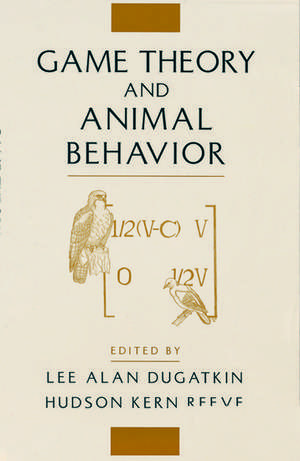
Game Theory and Animal Behavior
Lee Alan Dugatkin, Hudson Kern Reeveen Limba Engleză Paperback – 13 apr 2000
Găsim în această carte o demonstrație riguroasă a modului în care interdisciplinaritatea dintre biologia evoluționistă, matematică și economie a transformat înțelegerea etologiei moderne. Game Theory and Animal Behavior, coordonată de Lee Alan Dugatkin și Hudson Kern Reeve, investighează principiul fundamental conform căruia strategia unui individ este condiționată de acțiunile celorlalți, oferind un cadru analitic pentru comportamente care anterior păreau inexplicabile. Reținem că volumul nu se limitează la modele teoretice, ci explorează aplicații practice în ecologia aplicată, de la selecția habitatului la interacțiunile de nivel trofic și învățare.
Din punct de vedere al structurii, lucrarea debutează cu o introducere clară în scopul explicativ al teoriei jocurilor, fiind concepută special pentru a fi accesibilă studenților și biologilor care nu stăpânesc formalismul matematic dens. Putem afirma că acest volum extinde cadrul propus de Evolution and the Theory of Games de John Maynard Smith cu date noi din cercetările derulate între 1982 și 2000, integrând descoperiri recente despre rivalitatea între frați și structurile sociale complexe. Spre deosebire de textele strict matematice, această ediție publicată de Oxford University Press pune accent pe sinteza cercetării actuale, oferind diagrame și tabele care susțin argumentația teoretică. Volumul reușește să unifice perspectivele asupra geneticii cantitative cu modelele de optimalitate, oferind o viziune coerentă asupra forțelor care modelează viața socială a animalelor.
Preț: 645.00 lei
Preț vechi: 750.00 lei
-14%
Carte tipărită la comandă
Livrare economică 05-16 iunie
Specificații
ISBN-10: 0195137906
Pagini: 336
Ilustrații: line figures, tables
Dimensiuni: 229 x 152 x 19 mm
Greutate: 0.49 kg
Ediția:Revised
Editura: Oxford University Press
Colecția OUP USA
Locul publicării:New York, United States
V-ar putea interesa
-
 The Trials of LifeDavid AttenboroughPreț: 76.39 lei
 -
 -13%Preț: 580.25 lei666.95 lei
 -
 Game Theory: A Very Short IntroductionKen Binmore-21%Preț: 53.88 lei68.03 lei
 -
 Preț: 242.37 lei
 -
 The Winner's CurseRichard H. ThalerPreț: 183.69 lei
 -
 The Long GameAoife MoorePreț: 69.14 lei
 -
 Perspectives on Animal BehaviorBetty Mcguire-23%Preț: 1437.71 lei1867.15 lei
 -
 Game TheoryMorton D DavisPreț: 76.32 lei
 -
 Games and DecisionsHoward Raiffa-24%Preț: 139.84 lei184.75 lei
 -
 The ScoreC. Thi NguyenPreț: 181.19 lei
 -
 Game TheorySteven Tadelis-19%Preț: 477.74 lei589.81 lei
 -
 Doctors by NatureJaap de RoodePreț: 149.45 lei
 -
 Primer In Game Theory, ARobert Gibbons-13%Preț: 603.75 lei693.97 lei
 -
 The Animal and the ThinkerJohn DuncanPreț: 132.03 lei
 -
 Games, Strategies, and Decision MakingJoseph Harrington-41%Preț: 512.89 lei863.49 lei
 -
 The Expression of the Emotions in Man and AnimalsCharles DarwinPreț: 50.39 lei
 -
 -25%Preț: 983.55 lei1319.12 lei
 -
 Why Do We all Behave The Way We Do?S. S. O'ConnorPreț: 78.91 lei
 -
 Animal BehaviorJohn A ByersPreț: 68.56 lei
 -
 Game TheoryBrian CleggPreț: 74.37 lei
De ce să citești această carte
Această carte este esențială pentru studenții și profesioniștii în biologie care doresc să înțeleagă mecanismele evoluționiste din spatele interacțiunilor sociale. Cititorul câștigă o metodologie clară de analiză a comportamentului animal, fără a fi intimidat de jargonul matematic complex. Este resursa ideală pentru a trece de la observația empirică la modelarea predictivă în ecologie și etologie.
Recenzii
Describes many interesting examples of animal behaviour, including games between foraging producers and scroungers, reciprocal grooming in impala, territorial defence by birds and spiders, animal communication, parent-offspring conflict, and colony founding by ants. There are many accounts of experimental tests of game theory models, along with clear discussions of the limitations of the game theory approach. The quality of writing (often a problem in edited volumes) is uniformly good. The chapter by R. Gomulkiewicz is especially important, because it connects game theory, other optimization methods, and quantitative genetics with a focus on an empirical strategy for detecting adaptation and constraint. --Nature
The book is a worthwhile addition to graduate collections and some undergraduate collections emphasizing behavioral ecology, as most chapters are sufficiently general to be of use for a longer time than the typical symposium volume.--Choice
Listed in Wildlife Activist