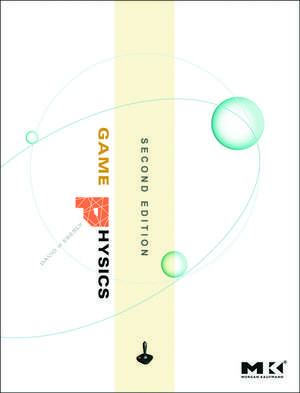
Game Physics
Autor David H. Eberlyen Limba Engleză Hardback – 5 apr 2010
Preț: 927.58 lei
Preț vechi: 1159.48 lei
-20%
Puncte Express: 1391
Carte disponibilă
Livrare economică 06-20 noiembrie
Livrare express 23-29 octombrie pentru 85.95 lei
Livrare prin curier în România Termenul estimat este afișat lângă disponibilitate.
Transport gratuit pentru acest produs Plată online sau ramburs, în funcție de opțiunile comenzii.
Retur gratuit în 14 zile Comandă securizată și suport în română.
Specificații
ISBN-13: 9780123749031
ISBN-10: 0123749034
Pagini: 944
Ilustrații: black & white illustrations, figures, colour plates
Dimensiuni: 191 x 235 x 41 mm
Greutate: 1.94 kg
Ediția:Revizuită
Editura: CRC Press
Colecția CRC Press
ISBN-10: 0123749034
Pagini: 944
Ilustrații: black & white illustrations, figures, colour plates
Dimensiuni: 191 x 235 x 41 mm
Greutate: 1.94 kg
Ediția:Revizuită
Editura: CRC Press
Colecția CRC Press
V-ar putea interesa
-
 Mathematical Methods for Physicists: A Comprehensive GuideGeorge B. Arfken-31%Preț: 668.40 lei969.76 lei
 -
 -28%Preț: 585.31 lei816.83 lei
 -
 -18%Preț: 527.45 lei646.10 lei
 -
 Seven Brief Lessons on Physics. Anniversary EditionCarlo RovelliPreț: 92.41 lei
 -
 Preț: 90.15 lei
 -
 Mathematical PhysicsDonald H. MenzelPreț: 110.74 lei
 -
 Real-Time Rendering, Fourth EditionTomas Akenine-Möller-20%Preț: 777.90 lei972.37 lei
 -
 BEGINNING C++ THROUGH GAME-3EMichael Dawson-22%Preț: 379.53 lei484.04 lei
 -
 Math for ProgrammingRonald T. Kneusel-35%Preț: 244.36 lei373.43 lei
 -
 The Nature of Code: Simulating Natural Systems with JavaScriptDaniel Shiffman-34%Preț: 215.83 lei326.00 lei
 -
 Classical Mechanics with Mathematica®Antonio RomanoPreț: 502.86 lei
 -
 Engineering DynamicsKeith D. Hjelmstad-15%Preț: 591.60 lei695.99 lei
 -
 Select Ideas in Partial Differential EquationsPeter J. Costa-15%Preț: 566.78 lei666.80 lei
 -
 Understanding Mathematical Concepts in PhysicsSanjeev Dhurandhar-15%Preț: 568.48 lei668.80 lei
 -
 General Physics IMehdi Rahmani-AndebiliPreț: 377.42 lei
 -
 MechanicsStefan Roth-11%Preț: 401.93 lei451.60 lei
 -
 Relativity: The Special and the General TheoryAlbert EinsteinPreț: 39.70 lei
Public țintă
Academic and Professional Practice & DevelopmentCuprins
Game Physics
1st edition
1 A Brief History of the World: A Summary of the Topics
2 Basic Concepts
3 Rigid Body Motion
4 Deformable Bodies
5 Physics Engines
6 Physics and Shader Programs
7 Linear Complementarity and Mathematical Programming
8 Differential Equations
9 Numerical Methods
10 Quaternions
Appendices
A Linear Algebra
B Affine Algebra
C Calculus
D Ordinary Difference Equations
A Summary of the Changes for the 2nd Edition:
Naturally, Chapter 1 (Introduction) will be rewritten based on the contents for the second edition.
The chapter on Physics Engines needs a significant rewrite. The goal will be to describe how to implement a classic rigid-body physics engine. And there will be source code to go with it, illustrating a generic collision detection system to go with the collision response people seem to associate with a physics engine. I will also include a new section on ragdoll physics, and there will be source code to go with this.
I plan on inserting a new chapter (chapter 6 below) that will contain descriptions of various papers of interest in game physics. In particular, I will review publications by Ronald Fedkiw, Jos Stam, and James O'Brien, choosing a few of each to describe and to implement in source code and include on the CDROM for the book. This new material fills the void in the 1st edition - not much discussion of applications of particle systems, fluids, or gases. The chapter on shader programs (old Chapter 6) will be discarded in its entirety.
Chapters 7 through 10 and Appendices A through D form the mathematical heart of the book. The appendices are effectively background material that a reader will be exposed to at a university. The chapters 7 through 10 are more advanced topics. I believe it is reasonable to break the book into two parts:
Part I -The Physics
1 Introduction
2 Basic Concepts
3 Rigid Bodies
4 Deformable Bodies
5 Physics Engines [rigid body concepts]
6 Particles, Fluids, and Gases [deformable body concepts]
Part II -The Mathematics
7 Linear Algebra
8 Affine Algebra
9 Calculus
10 Quaternions
11 Differential Equations
12 Difference Equations
13 Numerical Methods
14 Linear Complementarity and Mathematical Programming
The idea is that Part I is readable immediately by anyone having a reasonable mathematics background. Portions of Part II can be read, as needed.
The chapter on Linear Complementarity will be rewritten to omit the Lemke algorithm, replacing it by a discussion of iterative methods to solve LCP.
The 2nd edition will contain a lot more source code. And, as mentioned previously, we should include CD-ROM icons in the margins to let readers know that there is source code to illustrate the concepts.
1st edition
1 A Brief History of the World: A Summary of the Topics
2 Basic Concepts
3 Rigid Body Motion
4 Deformable Bodies
5 Physics Engines
6 Physics and Shader Programs
7 Linear Complementarity and Mathematical Programming
8 Differential Equations
9 Numerical Methods
10 Quaternions
Appendices
A Linear Algebra
B Affine Algebra
C Calculus
D Ordinary Difference Equations
A Summary of the Changes for the 2nd Edition:
Naturally, Chapter 1 (Introduction) will be rewritten based on the contents for the second edition.
The chapter on Physics Engines needs a significant rewrite. The goal will be to describe how to implement a classic rigid-body physics engine. And there will be source code to go with it, illustrating a generic collision detection system to go with the collision response people seem to associate with a physics engine. I will also include a new section on ragdoll physics, and there will be source code to go with this.
I plan on inserting a new chapter (chapter 6 below) that will contain descriptions of various papers of interest in game physics. In particular, I will review publications by Ronald Fedkiw, Jos Stam, and James O'Brien, choosing a few of each to describe and to implement in source code and include on the CDROM for the book. This new material fills the void in the 1st edition - not much discussion of applications of particle systems, fluids, or gases. The chapter on shader programs (old Chapter 6) will be discarded in its entirety.
Chapters 7 through 10 and Appendices A through D form the mathematical heart of the book. The appendices are effectively background material that a reader will be exposed to at a university. The chapters 7 through 10 are more advanced topics. I believe it is reasonable to break the book into two parts:
Part I -The Physics
1 Introduction
2 Basic Concepts
3 Rigid Bodies
4 Deformable Bodies
5 Physics Engines [rigid body concepts]
6 Particles, Fluids, and Gases [deformable body concepts]
Part II -The Mathematics
7 Linear Algebra
8 Affine Algebra
9 Calculus
10 Quaternions
11 Differential Equations
12 Difference Equations
13 Numerical Methods
14 Linear Complementarity and Mathematical Programming
The idea is that Part I is readable immediately by anyone having a reasonable mathematics background. Portions of Part II can be read, as needed.
The chapter on Linear Complementarity will be rewritten to omit the Lemke algorithm, replacing it by a discussion of iterative methods to solve LCP.
The 2nd edition will contain a lot more source code. And, as mentioned previously, we should include CD-ROM icons in the margins to let readers know that there is source code to illustrate the concepts.
Notă biografică
Dave Eberly is the president of Geometric Tools, Inc. (www.geometrictools.com), a company that specializes in software development for computer graphics, image analysis, and numerical methods. Previously, he was the director of engineering at Numerical Design Ltd. (NDL), the company responsible for the real-time 3D game engine, NetImmerse. He also worked for NDL on Gamebryo, which was the next-generation engine after NetImmerse. His background includes a BA degree in mathematics from Bloomsburg University, MS and PhD degrees in mathematics from the University of Colorado at Boulder, and MS and PhD degrees in computer science from the University of North Carolina at ChapelHill. He is the author of 3D Game Engine Design, 2nd Edition (2006), 3D Game Engine Architecture (2005), Game Physics (2004), and coauthor with Philip Schneider of Geometric Tools for Computer Graphics (2003), all published by Morgan Kaufmann. As a mathematician, Dave did research in the mathematics of combustion, signal and image processing, and length-biased distributions in statistics. He was an associate professor at the University of Texas at San Antonio with an adjunct appointment in radiology at the U.T. Health Science Center at San Antonio. In 1991, he gave up his tenured position to re-train in computer science at the University of North Carolina. After graduating in 1994, he remained for one year as a research associate professor in computer science with a joint appointment in the Department of Neurosurgery, working in medical image analysis. His next stop was the SAS Institute, working for a year on SAS/Insight, a statistical graphics package. Finally, deciding that computer graphics and geometry were his real calling, Dave went to work for NDL (which is now Emergent Game Technologies), then to Magic Software, Inc., which later became Geometric Tools, Inc. Dave's participation in the newsgroup comp.graphics.algorit
Recenzii
"I keep at most a dozen reference texts within easy reach of my workstation computer. This book will replace two of them."--Ian Ashdown, President, byHeart Consultants Limited
"I keep at most a dozen reference texts within easy reach of my workstation computer. This book will replace two of them."--Ian Ashdown, President, byHeart Consultants Limited
"Dave has yet again produced a must-have book for game technology programmers everywhere." -Christer Ericson, Technology Lead, Sony Computer Entertainment
"Game Physics is a comprehensive reference of physical simulation techniques relevant to games and also contains a clear presentation of the mathematical background concepts fundamental to most types of game programming. I wish I had this book years ago." -Naty Hoffman, Senior Software Engineer, Naughty Dog, Inc.
"Eppur si muove . . . and yet it moves. From Galileo to game development, this book will surely become a standard reference for modeling movement." -Ian Ashdown, President, byHeart Consultants Limited
"This book, especially when coupled with Dave's 3D Game Engine Design, provides the most complete resource of the mathematics relevant to modern 3D games that I can imagine." -Peter Lipson, Senior Programmer, Toys For Bob
"This comprehensive introduction to the field of game physics will be invaluable to anyone interested in the increasingly more important aspect of video game production, namely, striving to achieve realism. Drawing from areas such as robotics, dynamic simulation, mathematical modeling, and control theory, this book succeeds in presenting the material in a concise and cohesive way. As a matter of fact, it can be recommended not only to video game professionals but also to students and practitioners of the above-mentioned disciplines." -Pål-Kristian Engstad, Senior Software Engineer, Naughty Dog, Inc.
"Increases in processor power now make it feasible to run complex physical simulations in real time, which greatly increases their practical importance. Thus there is an increasing need for books like David Eberly's Game Physics that can give graphics programmers a grounding in the physical principles that underlie realistic computer animation." - W.Lewis Johnson --Physics Today
"I keep at most a dozen reference texts within easy reach of my workstation computer. This book will replace two of them."--Ian Ashdown, President, byHeart Consultants Limited
"Dave has yet again produced a must-have book for game technology programmers everywhere." -Christer Ericson, Technology Lead, Sony Computer Entertainment
"Game Physics is a comprehensive reference of physical simulation techniques relevant to games and also contains a clear presentation of the mathematical background concepts fundamental to most types of game programming. I wish I had this book years ago." -Naty Hoffman, Senior Software Engineer, Naughty Dog, Inc.
"Eppur si muove . . . and yet it moves. From Galileo to game development, this book will surely become a standard reference for modeling movement." -Ian Ashdown, President, byHeart Consultants Limited
"This book, especially when coupled with Dave's 3D Game Engine Design, provides the most complete resource of the mathematics relevant to modern 3D games that I can imagine." -Peter Lipson, Senior Programmer, Toys For Bob
"This comprehensive introduction to the field of game physics will be invaluable to anyone interested in the increasingly more important aspect of video game production, namely, striving to achieve realism. Drawing from areas such as robotics, dynamic simulation, mathematical modeling, and control theory, this book succeeds in presenting the material in a concise and cohesive way. As a matter of fact, it can be recommended not only to video game professionals but also to students and practitioners of the above-mentioned disciplines." -Pål-Kristian Engstad, Senior Software Engineer, Naughty Dog, Inc.
"Increases in processor power now make it feasible to run complex physical simulations in real time, which greatly increases their practical importance. Thus there is an increasing need for books like David Eberly's Game Physics that can give graphics programmers a grounding in the physical principles that underlie realistic computer animation." - W.Lewis Johnson --Physics Today
Descriere
Dave Eberly's much anticipated sequel to his cornerstone resource on the mathematics associated with game physics