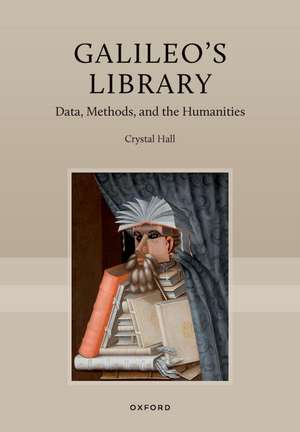
Galileo's Library: Data, Methods, and the Humanities
Autor Crystal Hallen Limba Engleză Hardback – 10 sep 2026
Preț: 827.26 lei
Preț vechi: 1191.88 lei
-31% Nou
Puncte Express: 1241
Carte tipărită la comandă
Livrare economică 03-09 decembrie
Livrare prin curier în România Termenul estimat este afișat lângă disponibilitate.
Transport gratuit pentru acest produs Plată online sau ramburs, în funcție de opțiunile comenzii.
Retur gratuit în 14 zile Comandă securizată și suport în română.
Specificații
ISBN-13: 9780197911174
ISBN-10: 019791117X
Pagini: 418
Ilustrații: 48
Dimensiuni: 138 x 25 x 216 mm
Greutate: 0.69 kg
Editura: OUP OXFORD
Colecția OUP Oxford
Locul publicării:Oxford, United Kingdom
ISBN-10: 019791117X
Pagini: 418
Ilustrații: 48
Dimensiuni: 138 x 25 x 216 mm
Greutate: 0.69 kg
Editura: OUP OXFORD
Colecția OUP Oxford
Locul publicării:Oxford, United Kingdom
Notă biografică
Crystal Hall is Associate Professor of Digital Humanities in Digital and Computational Studies and an affiliated faculty member of Italian Studies at Bowdoin College in Brunswick, Maine. She has spent almost two decades studying the relationships between Galileo and the literature of his time. Her broader research and teaching in Digital Humanities explore the relationships between technology, textual expression, and the creation of knowledge with specializations in pre-modern Italy and the digital and computational artifacts of the twenty-first-century United States.