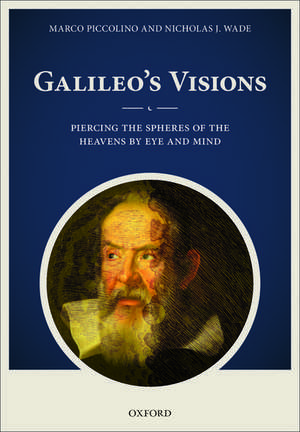
Galileo's Visions: Piercing the spheres of the heavens by eye and mind
Autor Marco Piccolino, Nicholas J. Wadeen Limba Engleză Hardback – 5 dec 2013
Notăm cu interes o abordare care transcende granițele tradiționale ale istoriei astronomiei, propunând o perspectivă de o interdisciplinaritate rară: fuziunea dintre fizica secolului al XVII-lea, filozofia cunoașterii și neuroștiința contemporană. Galileo's Visions nu se limitează la a reitera triumfurile mecanicii galileene, ci investighează modul în care Marco Piccolino și Nicholas J. Wade definesc procesul de observație prin prisma fiziologiei senzoriale. Considerăm că miza principală a volumului este demonstrarea modului în care Galileo a înțeles că datele senzoriale sunt intrinsec ambigue, necesitând o interpretare critică pentru a penetra complexitatea realității.
Autorii analizează riguros modul în care utilizarea telescopului a impus o reevaluare a fenomenelor de contrast și a rezoluției vizuale. Merită menționat că viziunea lui Galileo asupra simțurilor, descrisă de autori ca un precursor al psihofizicii moderne, postulează absența calităților precum sunetul sau culoarea în lumea obiectivă, acestea fiind produse ale sistemului nostru nervos. Comparabil cu Galileo, Human Knowledge, and the Book of Nature de Joseph C. Pitt în rigurozitatea analizei metodologice, lucrarea de față este actualizată pentru progresele recente din științele viziunii, oferind o bază fiziologică intuițiilor filozofice ale lui Galileo.
Această lucrare se integrează coerent în opera autorilor, continuând explorările din Shocking Frogs sau Dante’s Visions, unde Marco Piccolino a investigat intersecția dintre istoria științei și funcționarea sistemului biologic. Structura volumului, susținută de un aparat ilustrativ bogat, facilitează înțelegerea modului în care „mintea” lui Galileo a ghidat „ochiul” său în descifrarea cerurilor, transformând un act de observație într-o revoluție a cunoașterii umane.
Preț: 543.27 lei
Preț vechi: 812.92 lei
-33%
Carte tipărită la comandă
Livrare economică 07-12 august
Specificații
ISBN-10: 0199554358
Pagini: 338
Dimensiuni: 181 x 253 x 25 mm
Greutate: 0.84 kg
Editura: Oxford University Press
Colecția OUP Oxford
Locul publicării:Oxford, United Kingdom
V-ar putea interesa
-
 The Feeling Of What HappensAntonio Damasio-19%Preț: 75.68 lei93.48 lei
 -
 Conversations on ConsciousnessSusan Blackmore-20%Preț: 80.39 lei100.01 lei
 -
 The Brain: A Very Short IntroductionMichael O'Shea-33%Preț: 46.81 lei70.00 lei
 -
 The Study of Instinct: with a new PrefaceNikolaas Tinbergen-34%Preț: 529.74 lei797.68 lei
 -
 -33%Preț: 532.59 lei799.43 lei
 -
 The Handbook of Clinical NeuropsychologyJennifer Gurd-24%Preț: 583.33 lei766.16 lei
 -
 -21%Preț: 782.42 lei988.80 lei
 -
 -14%Preț: 707.70 lei822.91 lei
 -
 The Self and Its Brain: An Argument for InteractionismJohn C. Eccles-15%Preț: 547.43 lei644.03 lei
 -
 Barrel CortexKevin Fox-5%Preț: 988.54 lei1040.57 lei
 -
 Computing Brain Activity Maps from fMRI Time-Series ImagesGordon E. Sarty-5%Preț: 764.58 lei804.82 lei
 -
 Spiking Neuron ModelsWulfram Gerstner-19%Preț: 613.14 lei756.96 lei
 -
 The Plastic MindSharon Begley-27%Preț: 67.17 lei92.44 lei
De ce să citești această carte
Această ediție publicată de Oxford University Press este esențială pentru cercetătorii din neuroștiințe și istoria ideilor. Cititorul va câștiga o înțelegere profundă a modului în care mecanismele vederii au influențat marile descoperiri astronomice. Este o recomandare certă pentru cei care doresc să descopere un Galileo mai puțin cunoscut: nu doar astronomul, ci și finul observator al limitărilor și capacităților percepției umane.
Despre autor
Marco Piccolino este un distins neurobiolog și istoric al științei, cunoscut pentru cercetările sale asupra istoriei electrofiziologiei, explorând în lucrări precum The Shocking History of Electric Fishes bazele biologice ale electricității. Nicholas J. Wade este profesor emerit de psihologie vizuală, expert în istoria percepției și a instrumentelor optice. Împreună, cei doi autori combină rigoarea analizei științifice cu erudiția istorică, oferind o perspectivă unică asupra modului în care evoluția cunoașterii umane este strâns legată de înțelegerea propriilor noastre simțuri, temă recurentă în volumele semnate de aceștia la edituri de prestigiu.