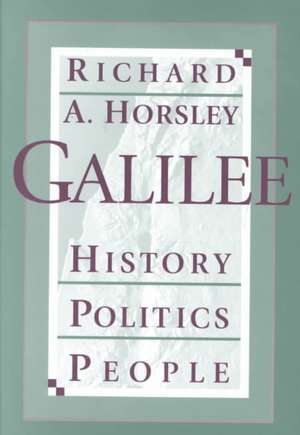
Galilee: History, Politics, People
Autor Richard A. Horsleyen Limba Engleză Hardback – oct 1995
Throughout the past fifteen to twenty years a great deal of attention has been devoted to Galilee by those interested in the synoptic Gospels and the historical Jesus, and by American and Israeli archaeologists. This intense focus on Galilee has produced a number of interesting and important results, such as the development of a more sophisticated critical reading of rabbinic sources and increased maturity in how we understand the limited literary and archaeological evidence available. More important for an understanding of Galilee or Roman Palestine generally, however, has been the opening toward greater awareness of social structure and analysis.
Richard Horsley takes all these developments into account in this commanding study of the basic political and economic relations that prevailed in Roman Palestine-with particular reference to Galilee, and with particular sensitivity to the implications for the resident's lives. The purpose of his meticulous research, analysis, and reconstruction is ultimately to provide a more complete and precise sense of the historical Jesus and the synoptic Gospel traditions.
Richard A. Horsley is Professor of Classics and Religion at the University of Massachusetts in Boston. He is the author of many books, including Sociology and the Jesus Movement.
Preț: 377.60 lei
Preț vechi: 534.18 lei
-29%
Puncte Express: 566
Carte tipărită la comandă
Livrare economică 30 noiembrie-14 decembrie
Livrare prin curier în România Termenul estimat este afișat lângă disponibilitate.
Transport gratuit de la 400.00 lei Plată online sau ramburs, în funcție de opțiunile comenzii.
Retur gratuit în 14 zile Comandă securizată și suport în română.
Specificații
ISBN-13: 9781563381331
ISBN-10: 1563381338
Pagini: 366
Dimensiuni: 160 x 237 x 29 mm
Greutate: 0.76 kg
Editura: Bloomsbury Publishing
Colecția Trinity Press International
Locul publicării:New York, United States
ISBN-10: 1563381338
Pagini: 366
Dimensiuni: 160 x 237 x 29 mm
Greutate: 0.76 kg
Editura: Bloomsbury Publishing
Colecția Trinity Press International
Locul publicării:New York, United States
V-ar putea interesa
-
 Preț: 117.96 lei
 -
 Preț: 78.85 lei
 -
 Enemy on the EuphratesIan RutledgePreț: 80.86 lei
 -
 Ottoman Navy Warships 1914–18Ryan K. Noppen-32%Preț: 67.60 lei99.37 lei
 -
 SudanJok Madut JokPreț: 112.89 lei
 -
 Letters to PalestineVijay PrashadPreț: 171.75 lei
 -
 Preț: 362.29 lei
 -
 From Deep State to Islamic StateJean-Pierre Filiu-24%Preț: 160.11 lei209.55 lei
 -
 Persian Gulf: Muscat City, Society & TradeWillem FloorPreț: 335.00 lei
Recenzii
"Richard Horsley's book is a very thorough and thoughtful exploration of the state of Galilee during Roman and Hasmonean rule. It is an important addition to the research and study of the political, economic, and social history of this much neglected territory north of Israel." -- Philip R. Drey, Andrews University, reviewing for Andrews University Seminary Studies 36, Spring 1998
"Horsley provides helpful models for the use of social sciences for the study of ancient Galilee..." --Joshua Schwartz, reviewing for Journal of Jewish Studies
"Richard Horsley once again forces us to think differently about what we thought we already knew...The main virtue of Horsley's book is its perspective. It almost completely reconstructs the basis for understanding the context of Jesus, Christianity and early Judaism. He writes economics right into the picture, not as a gloss illustrative of "environment," but as a factor to be reckoned with and to be integrated directly into social, political and religious phenomena. The development of Rabbinic Judaism in particular gains by this new treatment, and is presented in an entirely novel and quite compelling way." -- William E. Arnal, Centre for the Study of Religion, University of Toronto
"Horsley's analyses of the ancient documents are always illuminating, he asks interesting questions, and he puts things together in interesting ways. This work should be in every college and seminary library, as well as in the collections of biblical scholars." -- K.C. Hanson, St. Olaf College, reviewing for Catholic Biblical Quarterly
"An ambitious attempt to offer a comprehensive picture of the Galilean society during the late Second Temple and early post-Temple centuries...a remarkable synthesis of scholarship that illumines all aspects of Galilean society from the family and village up through the broader bureaucratic and administrative institutions... Crucial for researchers in classics, ancient history and the origins of rabbinical Judaism and Christianity." -- Martin S. Jaffee, University of Washington, reviewing for Religious Studies Review, January 1997
"...offers a wealth of detailed data which helps give a thicker description of the social matrix out of which both early Judaism and early Christianity arose in Galilee... Horsley brings a sophistication to the discussion which includes a realization that all the sources, both ancient and modern must be evaluated critically... Horsley has written an important and stimulating book that gathers together much relevant and helpful data about Galilee." -- Ben Witherington, III, Asbury Theological Seminary, reviewing for Theological Studies, March 1997
"Drawing extensively on extrabiblical sources, (Horsley's) study of the history of Galilee, its rulers in Roman times, and its social stratification and village communities, show that there are many discrepancies between the dominant scholarly paradigm and the historical realities."--Theology Digest, Winter 1996
"...a good overview of the political history of Galilee...There is much valuable information in Horsley's study of urban and village life in Galilee... This book provides a wealth of information about life in Galilee." -- John F. Brug, reviewing for Wisconsin Lutheran Quarterly, Spring 1997
"Horsley provides helpful models for the use of social sciences for the study of ancient Galilee..." --Joshua Schwartz, reviewing for Journal of Jewish Studies
"Richard Horsley once again forces us to think differently about what we thought we already knew...The main virtue of Horsley's book is its perspective. It almost completely reconstructs the basis for understanding the context of Jesus, Christianity and early Judaism. He writes economics right into the picture, not as a gloss illustrative of "environment," but as a factor to be reckoned with and to be integrated directly into social, political and religious phenomena. The development of Rabbinic Judaism in particular gains by this new treatment, and is presented in an entirely novel and quite compelling way." -- William E. Arnal, Centre for the Study of Religion, University of Toronto
"Horsley's analyses of the ancient documents are always illuminating, he asks interesting questions, and he puts things together in interesting ways. This work should be in every college and seminary library, as well as in the collections of biblical scholars." -- K.C. Hanson, St. Olaf College, reviewing for Catholic Biblical Quarterly
"An ambitious attempt to offer a comprehensive picture of the Galilean society during the late Second Temple and early post-Temple centuries...a remarkable synthesis of scholarship that illumines all aspects of Galilean society from the family and village up through the broader bureaucratic and administrative institutions... Crucial for researchers in classics, ancient history and the origins of rabbinical Judaism and Christianity." -- Martin S. Jaffee, University of Washington, reviewing for Religious Studies Review, January 1997
"...offers a wealth of detailed data which helps give a thicker description of the social matrix out of which both early Judaism and early Christianity arose in Galilee... Horsley brings a sophistication to the discussion which includes a realization that all the sources, both ancient and modern must be evaluated critically... Horsley has written an important and stimulating book that gathers together much relevant and helpful data about Galilee." -- Ben Witherington, III, Asbury Theological Seminary, reviewing for Theological Studies, March 1997
"Drawing extensively on extrabiblical sources, (Horsley's) study of the history of Galilee, its rulers in Roman times, and its social stratification and village communities, show that there are many discrepancies between the dominant scholarly paradigm and the historical realities."--Theology Digest, Winter 1996
"...a good overview of the political history of Galilee...There is much valuable information in Horsley's study of urban and village life in Galilee... This book provides a wealth of information about life in Galilee." -- John F. Brug, reviewing for Wisconsin Lutheran Quarterly, Spring 1997