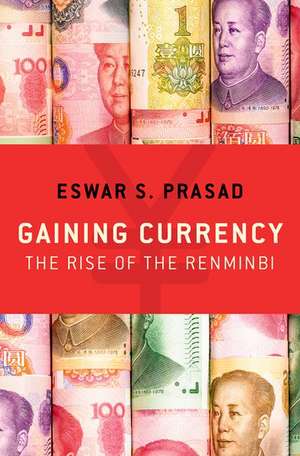
Gaining Currency: The Rise of the Renminbi
Autor Eswar S. Prasaden Limba Engleză Hardback – 24 noi 2016
Preț: 325.66 lei
Preț vechi: 400.54 lei
-19%
Puncte Express: 488
Carte tipărită la comandă
Livrare economică 27 noiembrie-08 decembrie
Livrare prin curier în România Termenul estimat este afișat lângă disponibilitate.
Transport gratuit de la 400.00 lei Plată online sau ramburs, în funcție de opțiunile comenzii.
Retur gratuit în 14 zile Comandă securizată și suport în română.
Specificații
ISBN-13: 9780190631055
ISBN-10: 0190631058
Pagini: 344
Dimensiuni: 155 x 236 x 33 mm
Greutate: 0.52 kg
Editura: Oxford University Press
Colecția OUP USA
Locul publicării:New York, United States
ISBN-10: 0190631058
Pagini: 344
Dimensiuni: 155 x 236 x 33 mm
Greutate: 0.52 kg
Editura: Oxford University Press
Colecția OUP USA
Locul publicării:New York, United States
V-ar putea interesa
-
 -28%Preț: 428.33 lei595.77 lei
 -
 -31%Preț: 711.90 lei1031.70 lei
 -
 -32%Preț: 4099.20 lei5999.96 lei
 -
 -22%Preț: 476.03 lei607.39 lei
 -
 -14%Preț: 128.78 lei149.62 lei
 -
 Government and the Enterprise since 1900Jim Tomlinson-30%Preț: 483.62 lei686.55 lei
 -
 -33%Preț: 1152.21 lei1716.74 lei
 -
 The State of Welfare: The Economics of Social SpendingHoward Glennerster-24%Preț: 555.94 lei731.11 lei
 -
 -30%Preț: 391.60 lei559.28 lei
 -
 -31%Preț: 713.80 lei1032.86 lei
 -
 -15%Preț: 430.16 lei506.07 lei
 -
 The Trade Winds: A Study of British Overseas Trade During the French Wars 1793-1815C.Northcote ParkinsonPreț: 319.06 lei
 -
 The Scientific and Industrial Revolution of TimeM.E. Beggs HumpreysPreț: 299.53 lei
 -
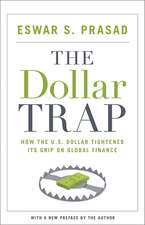 The Dollar TrapEswar S PrasadPreț: 213.64 lei
 -
 Emerging Markets: Resilience and Growth amid Global TurmoilEswar S. Prasad-24%Preț: 180.28 lei235.94 lei
 -
 Economics and Interdisciplinary ExchangeGuido Erreygers-15%Preț: 430.16 lei506.07 lei
 -
 A History of Indian Economic ThoughtAjit K. Dasgupta-15%Preț: 460.99 lei542.35 lei
 -
 An Economic History of Indonesia: 1800-2010Jan Luiten van Zanden-15%Preț: 465.33 lei547.45 lei
Recenzii
A clear and even fascinating account of the structures and quirks of China's financial markets. Stylistically, along with concision, Prasad has a knack for storytelling that makes his account highly readable.
Investment managers planning to enter the Chinese financial markets will find an excellent guide in Eswar Prasad, author of Gaining Currency: The Rise of the Renminbi, a clear and even fascinating account of the structures and quirks of China's financial markets. Prasad, a former research economist at the IMF (International Monetary Fund) and now a professor at Cornell University, combines a practitioner's technical grasp of the subject with a nonacademic clarity of style that will enlighten novices as well as professionals experienced in Chinese finance.
Investment managers planning to enter the Chinese financial markets will find an excellent guide in Eswar Prasad, author of Gaining Currency: The Rise of the Renminbi, a clear and even fascinating account of the structures and quirks of China's financial markets. Prasad, a former research economist at the IMF (International Monetary Fund) and now a professor at Cornell University, combines a practitioner's technical grasp of the subject with a nonacademic clarity of style that will enlighten novices as well as professionals experienced in Chinese finance.
Notă biografică
Eswar S. Prasad is Tolani Senior Professor of Trade Policy at Cornell University, Senior Fellow and New Century Chair in International Economics at the Brookings Institution, and Research Associate at the National Bureau of Economic Research. He is a former head of the IMF's China Division and author of The Dollar Trap: How the U.S. Dollar Tightened Its Grip on Global Finance.