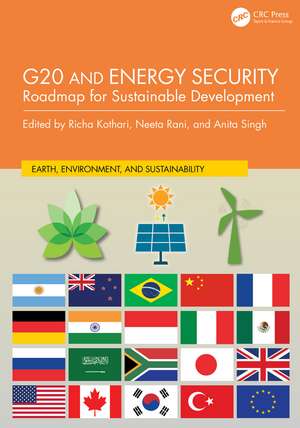
G20 and Energy Security: Roadmap for Sustainable Development: Earth, Environment, and Sustainability
Editat de Richa Kothari, Neeta Rani, Anita Singhen Limba Engleză Hardback – 15 ian 2026
- Discusses sustainable energy security in G20 countries
- Covers the long-term and comprehensive Agenda 2030 of the United Nations
- Includes global energy efficiency and research/commercial activities used in promoting the road map on energy
- Addresses energy security, policies, and clean energy production by viewpoints of experts from different countries
- Helps in reviewing energy crisis with solutions and clean energy transition for pathway to achieve net-zero emissions


Preț: 1317.44 lei
Preț vechi: 1606.64 lei
-18%
Puncte Express: 1976
Carte tipărită la comandă
Livrare economică 19 noiembrie-03 decembrie
Livrare prin curier în România Termenul estimat este afișat lângă disponibilitate.
Transport gratuit pentru acest produs Plată online sau ramburs, în funcție de opțiunile comenzii.
Retur gratuit în 14 zile Comandă securizată și suport în română.
Specificații
ISBN-13: 9781032703978
ISBN-10: 1032703970
Pagini: 374
Ilustrații: 204
Dimensiuni: 178 x 254 mm
Greutate: 0.85 kg
Ediția:1
Editura: CRC Press
Colecția CRC Press
Seria Earth, Environment, and Sustainability
ISBN-10: 1032703970
Pagini: 374
Ilustrații: 204
Dimensiuni: 178 x 254 mm
Greutate: 0.85 kg
Ediția:1
Editura: CRC Press
Colecția CRC Press
Seria Earth, Environment, and Sustainability
V-ar putea interesa
-
 Renewable Energy: Power for a Sustainable FutureStephen Peake-19%Preț: 515.40 lei635.09 lei
 -
 -32%Preț: 692.53 lei1023.64 lei
 -
 The Oxford Handbook on the Greening of Economic DevelopmentJohn A. Mathews-32%Preț: 1056.52 lei1551.54 lei
 -
 Preț: 124.26 lei
 -
 Preț: 217.26 lei
 -
 Energy SecurityRoland DannreutherPreț: 85.26 lei
 -
 Preț: 343.46 lei
 -
 The Energy FixKarina Antram-35%Preț: 59.39 lei91.20 lei
 -
 Global Energy PoliticsBenjamin K. SovacoolPreț: 158.18 lei
 -
 -26%Preț: 79.92 lei107.30 lei
 -
 -27%Preț: 1219.50 lei1660.83 lei
 -
 World in Transition 3: Towards Sustainable Energy SystemsGerman Advisory Council On Global Change (Wbgu)Preț: 452.86 lei
 -
 The Future of EnergyRichard Black-20%Preț: 50.41 lei63.39 lei
 -
 Preț: 187.55 lei
 -
 -18%Preț: 2409.92 lei2938.92 lei
 -
 Preț: 162.83 lei
 -
 Preț: 396.17 lei
 -
 Global Energy Transition and Sustainable Development Challenges, Vol. 1Tessaleno Devezas-18%Preț: 795.66 lei970.32 lei
 -
 Handbook on Sustainability Transition and Sustainable PeaceHans Günter Brauch-18%Preț: 1404.33 lei1712.60 lei
 -
 Axes of Sustainable Development and Growth in IndiaPiyush Tiwari-18%Preț: 919.29 lei1121.09 lei
Public țintă
Academic and PostgraduateCuprins
1. Energy Security and Green Transition Policies in Argentina: Starting Point Towards a Liberal Future 2. Key Trends for Sustainable Energy Security in Australia 3. Depicting Different Dimensions of Energy Security in Brazil Through the Lens of Energy Transition 4. Restructuring Canada's Energy System for a Sustainable, Energy Secure Future 5. Sustainability Through the Lens of Energy Security and Transition in China 6. Recent Advancements in Security of Clean Energy Transition in France 7. Key Trends for Sustainable Energy Security in Germany for Addressing Economic Complexity and Geopolitical Risk Resilience 8. Eco-Centric Approaches for Energy Transition: Attaining Sustainable Energy Security Against a G20 Backdrop 9. Sustainable Energy Security in India: Trends, Government Initiatives, and Successful Stories 10. Sustainable Energy Security in Indonesia: An In-Depth Investigation for a Sustainable Future 11. Evaluation of Green Energy Transition in Indonesia—Implications for Peace and Sustainable Development 12. Prospects for Sustainable Energy Security in Italy: Realizing the Potential of Energy Transition at Global Context 13. Non-Governmental Organizations and Their Contribution to Achieving Long-term Development for Energy Transition and Waste Management: Successful Case Studies from Indore to Jammu and Kashmir, India 14. Strategic Shift Towards Sustainable Energy Security in Japan: State of the Art 15. Key Trends for Sustainable Energy Security in Mexico From an Energy Justice Approach 16. Sustainable Energy Security in the Republic of Korea—Key trends 17. Sustainable Energy Security in Russia 18. Renewable Energy Trends and Opportunities in Saudi Arabia 19. Key Trends and Progressive Roadmap for Sustainable Energy Security in South Africa 20. Forecasting Turkey's Energy Landscape Using a SARIMA Model: Key Trends for Sustainable Energy Security in Turkey 21. Assessment of Key Trends and Policies for Achieving Sustainable Energy Security in the UK: A Systematic Review and Future Outlook 22. From Vision to Action: Strategies for Sustainable Energy Security in the United States 23. Decoding the Roadmap for Energy Security Strategies in the European Union
Notă biografică
Richa Kothari (M.Phil., Ph.D.) is Professor and currently Head of the Department, Department of Environmental Sciences, Central University of Jammu, Jammu and Kashmir, India. She is a Water Advanced Research and Innovation (WARI) Fellow, Indo-U.S. Science and Technology Forum at the University of Nebraska-Lincoln, USA, with over 20 years of teaching and research experience. Recognized among Stanford University’s World’s top 2% scientists (2020–2025), her research interests include algal-based biofuels, bio-hydrogen, and renewable energy for wastewater treatment. She was presented with the Women Scientist’s Award, 2025, by the Central University of Rajasthan, Ajmer, Rajasthan, India, in March 2025 and the ASSOCHAM J&K Women’s Achiever Award on March 10, 2023. She has authored more than 140 journal articles, holds five patents, has gained approximately 9805 citations, and holds an h-index of 49 and an i10-index of 114. She has also worked as a guest editor for special issues in the Journal of Biofuels, Journal of Biomass Conversion and Biorefinery, Environmental Sustainability, Renewable and Sustainable Energy Reviews. She has guided 9 Ph.D./M.Phil., 65 M.Sc. and approximately 40 M.Tech. students. She has also delivered a number of invited lectures at national and international levels.
Neeta Rani is Associate Professor and currently Head of the Department, Department of National Security Studies at Central University of Jammu, Jammu and Kashmir, India. She has work experience of more than 14 years. She completed her post-graduation in defense and strategic studies and earned her doctorate (Ph.D.) from Panjab University, Chandigarh. She specializes in Central Asian security affairs, with a special focus on energy security. Her areas of interest include energy security, border management, Central Asia, South Asian security affairs, and human security. She has published papers in several reputed journals. She has completed an ICSSR-sponsored research project on the Village Defence Guards Scheme in Jammu and Kashmir (J&K).
Anita Singh is currently working as Associate Professor and currently Head of the Department, Department of Environmental Studies, Central University of Haryana, Haryana. She has more than 14 years of teaching and research experience. Dr. Singh did her Ph.D. on bioethanol production from lignocellulosic biomass from Guru Jambheshwar University of Science & Technology, Hisar. She did her post-doctoral research at the University of Georgia, U.S.A., on selective removal of inhibitors from lignocellulosic biomass. Dr. Singh has published 50 papers in international journals and six book chapters in various edited books. She has published three edited books with reputed publishers. Dr. Singh completed two sponsored projects from UGC and DST-SERB (ECR). She has guided 44 master’s students’ dissertations and supervised two Ph.D. students. Dr. Singh was awarded CSIR-SRF and CSIR-RA fellowships for research during and after her Ph.D. Dr. Singh was awarded a UGC Raman Post doctoral fellowship for doing research in the U.S.A. Dr. Singh was recognized among Stanford University’s World’s top 2% scientists (2025).
Neeta Rani is Associate Professor and currently Head of the Department, Department of National Security Studies at Central University of Jammu, Jammu and Kashmir, India. She has work experience of more than 14 years. She completed her post-graduation in defense and strategic studies and earned her doctorate (Ph.D.) from Panjab University, Chandigarh. She specializes in Central Asian security affairs, with a special focus on energy security. Her areas of interest include energy security, border management, Central Asia, South Asian security affairs, and human security. She has published papers in several reputed journals. She has completed an ICSSR-sponsored research project on the Village Defence Guards Scheme in Jammu and Kashmir (J&K).
Anita Singh is currently working as Associate Professor and currently Head of the Department, Department of Environmental Studies, Central University of Haryana, Haryana. She has more than 14 years of teaching and research experience. Dr. Singh did her Ph.D. on bioethanol production from lignocellulosic biomass from Guru Jambheshwar University of Science & Technology, Hisar. She did her post-doctoral research at the University of Georgia, U.S.A., on selective removal of inhibitors from lignocellulosic biomass. Dr. Singh has published 50 papers in international journals and six book chapters in various edited books. She has published three edited books with reputed publishers. Dr. Singh completed two sponsored projects from UGC and DST-SERB (ECR). She has guided 44 master’s students’ dissertations and supervised two Ph.D. students. Dr. Singh was awarded CSIR-SRF and CSIR-RA fellowships for research during and after her Ph.D. Dr. Singh was awarded a UGC Raman Post doctoral fellowship for doing research in the U.S.A. Dr. Singh was recognized among Stanford University’s World’s top 2% scientists (2025).
Descriere
This book covers acceleration of energy transition and low-carbon growth with emphasis on G20 countries. It covers inclusive energy transition with the use of renewable energy sources including energy balances, production/consumption sectors, energy efficiency, energy related environmental emissions and so forth.