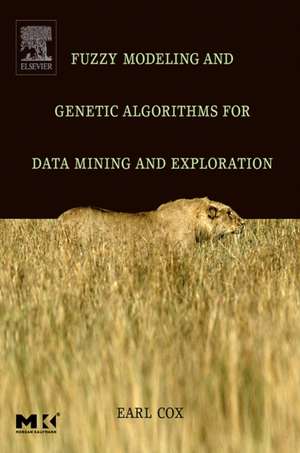
Fuzzy Modeling and Genetic Algorithms for Data Mining and Exploration
Autor Earl Coxen Limba Engleză Paperback – 2005
You don’t need a background in fuzzy modeling or genetic algorithms to benefit, for this book provides it, along with detailed instruction in methods that you can immediately put to work in your own projects. The author provides many diverse examples and also an extended example in which evolutionary strategies are used to create a complex scheduling system.
- Written to provide analysts, engineers, and managers with the background and specific instruction needed to develop and implement more effective data mining systems
- Helps you to understand the trade-offs implicit in various models and model architectures
- Provides extensive coverage of fuzzy SQL querying, fuzzy clustering, and fuzzy rule induction
- Lays out a roadmap for exploring data, selecting model system measures, organizing adaptive feedback loops, selecting a model configuration, implementing a working model, and validating the final model
- In an extended example, applies evolutionary programming techniques to solve a complicated scheduling problem
- Presents examples in C, C++, Java, and easy-to-understand pseudo-code
- Extensive online component, including sample code and a complete data mining workbench
Preț: 514.10 lei
Preț vechi: 642.62 lei
-20%
Puncte Express: 771
Carte tipărită la comandă
Livrare economică 19 noiembrie-03 decembrie
Livrare prin curier în România Termenul estimat este afișat lângă disponibilitate.
Transport gratuit pentru acest produs Plată online sau ramburs, în funcție de opțiunile comenzii.
Retur gratuit în 14 zile Comandă securizată și suport în română.
Specificații
ISBN-13: 9780121942755
ISBN-10: 0121942759
Pagini: 556
Dimensiuni: 190 x 234 x 37 mm
Greutate: 1.12 kg
Editura: Elsevier Inc
ISBN-10: 0121942759
Pagini: 556
Dimensiuni: 190 x 234 x 37 mm
Greutate: 1.12 kg
Editura: Elsevier Inc
V-ar putea interesa
-
 -20%Preț: 758.55 lei948.20 lei
 -
 Categorization by Humans and Machines: Advances in Research and TheoryGlenn V. Nakamura-20%Preț: 633.83 lei792.30 lei
 -
 Advanced Machine Vision Paradigms for Medical Image AnalysisTapan K. Gandhi-47%Preț: 692.20 lei1307.08 lei
 -
 Practical Machine Learning for Data Analysis Using PythonAbdulhamit Subasi-37%Preț: 586.40 lei938.04 lei
 -
 Soft Numerical Computing in Uncertain Dynamic SystemsTofigh Allahviranloo-38%Preț: 694.21 lei1115.91 lei
 -
 -39%Preț: 1018.37 lei1676.26 lei
 -
 The Young Lawyer in CourtDean W. KorsakPreț: 68.53 lei
 -
 The Kbmt ProjectKenneth S. Goodman-20%Preț: 269.52 lei336.90 lei
 -
 Machine Learning: A Theoretical ApproachBalas K. Natarajan-20%Preț: 520.82 lei651.03 lei
 -
 Blondie24: Playing at the Edge of AIDavid B. Fogel-13%Preț: 142.81 lei164.75 lei
 -
 -20%Preț: 620.69 lei775.86 lei
 -
 -20%Preț: 678.15 lei847.70 lei
 -
 Tecnomatix Plant SimulationSteffen Bangsow-20%Preț: 1939.13 lei2423.91 lei
 -
 Behavioral Predictive Modeling in EconomicsSongsak Sriboonchitta-20%Preț: 1131.60 lei1414.51 lei
 -
 Intelligent Algorithms in Software EngineeringRadek Silhavy-20%Preț: 1009.57 lei1261.96 lei
 -
 -20%Preț: 1011.45 lei1264.32 lei
 -
 -20%Preț: 1010.41 lei1263.01 lei
 -
 Soft Computing ApplicationsValentina Emilia Balas-20%Preț: 1285.99 lei1607.49 lei
 -
 Advances in Artificial Intelligence and Data EngineeringNiranjan N. Chiplunkar-20%Preț: 1772.38 lei2215.48 lei
 -
 Advances in Smart System TechnologiesP. Suresh-20%Preț: 1278.18 lei1597.72 lei
 -
 New Developments of IT, IoT and ICT Applied to AgricultureKazumi Nakamatsu-20%Preț: 2102.46 lei2628.08 lei
 -
 Smart Innovations in Communication and Computational SciencesShailesh Tiwari-20%Preț: 994.01 lei1242.50 lei
 -
 Intelligent System DesignSuresh Chandra Satapathy-20%Preț: 1316.93 lei1646.15 lei
 -
 Intelligent Data Engineering and AnalyticsSuresh Chandra Satapathy-20%Preț: 1280.54 lei1600.68 lei
 -
 Advances in Automated NegotiationsTakayuki Ito-20%Preț: 1225.14 lei1531.42 lei
 -
 Fog Data Analytics for IoT ApplicationsSudeep Tanwar-20%Preț: 1294.19 lei1617.75 lei
 -
 -20%Preț: 1300.68 lei1625.85 lei
Public țintă
Researchers and technicians in organisations with large databases.Cuprins
Preface
Acknowledgements
Introduction
PART ONE – CONCEPTS AND ISSUES
Chapter 1. Foundations and Ideas
Chapter 2. Principal Model Types
Chapter 3. Approaches to Model Building
PART TWO – FUZZY SYSTEMS
Chapter 4. Fundamental Concepts of Fuzzy Logic
Chapter 5. Fundamental Concepts of Fuzzy Systems
Chapter 6. FuzzySQL and Intelligent Queries
Chapter 7. Fuzzy Clustering
Chapter 8. Fuzzy Rule Induction
PART THREE – EVOLUTIONARY STRATEGIES
Chapter 9. Fundamental Concepts of Genetic Algorithms
Chapter 10. Genetic Resource Scheduling Optimization
Chapter 11. Genetic Tuning of Fuzzy Models
Acknowledgements
Introduction
PART ONE – CONCEPTS AND ISSUES
Chapter 1. Foundations and Ideas
Chapter 2. Principal Model Types
Chapter 3. Approaches to Model Building
PART TWO – FUZZY SYSTEMS
Chapter 4. Fundamental Concepts of Fuzzy Logic
Chapter 5. Fundamental Concepts of Fuzzy Systems
Chapter 6. FuzzySQL and Intelligent Queries
Chapter 7. Fuzzy Clustering
Chapter 8. Fuzzy Rule Induction
PART THREE – EVOLUTIONARY STRATEGIES
Chapter 9. Fundamental Concepts of Genetic Algorithms
Chapter 10. Genetic Resource Scheduling Optimization
Chapter 11. Genetic Tuning of Fuzzy Models
Notă biografică
Earl founded and serves as President of, Scianta Intelligence, a next generation machine intelligence and knowledge exploration company. He is a futurist, author, management consultant, and educator involved in discovering the epistemology of advanced intelligent systems, the redefinition of the machine mind, and, as a pioneer of Internet-based technologies, the way in which evolving inter-connected virtual worlds will affect the sociology of business and culture in the near and far future. Earl has over thirty years experience in managing and participating in the software development process at the system as well as tightly integrated application level. In the area of advanced machine intelligence technologies, Earl is a recognized expert in fuzzy logic, and adaptive fuzzy systems as they are applied to information and decision theory. He has pioneered the integration of fuzzy neural systems with genetic algorithms and case-based reasoning. As an industry observer and futurist, Earl has written and talked extensively on the philosophy of the Response to Change, the nature of Emergent Intelligence, and the Meaning of Information Entropy in Mind and Machine.