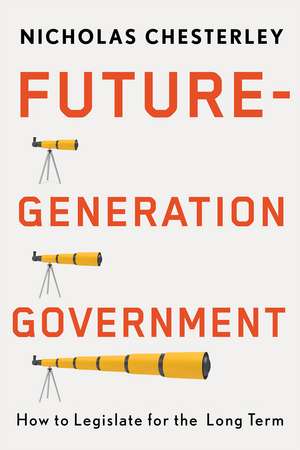
Future-Generation Government: How to Legislate for the Long Term
Autor Nicholas Chesterleyen Limba Engleză Hardback – 20 mai 2025
In the decades preceding COVID-19 there were nine pandemics or near-pandemics, from SARS to Ebola. Despite this turbulent recent history, many governments were unprepared for the recent pandemic and remain ill-equipped for the next. Our impact on future generations has never been greater, and the challenges we face will increasingly play out over the long term. Climate change is accelerating, antibiotic resistance is rising, underground aquifers are depleting, natural disasters catch us off guard, fish stocks are dwindling, and automation and population aging may transform our economies. Drawing on insights from behavioural science, Future-Generation Government offers a fresh perspective on short-termism and proposes clear, practical reforms that can help leaders respond to tomorrow’s challenges without compromising today’s democratic rights and freedoms. People value the present over the future, research shows, so governments balance the scales by rewarding future-planning behaviours: granting tax deductions for retirement savings or supporting educational savings, for example. Future-Generation Government explains how individuals, in turn, should reward our governments for making durable policy decisions that anticipate future crises.
Preț: 257.16 lei
Puncte Express: 386
Carte disponibilă
Livrare economică 09-23 noiembrie
Livrare express 23-29 octombrie pentru 55.62 lei
Livrare prin curier în România Termenul estimat este afișat lângă disponibilitate.
Transport gratuit de la 400.00 lei Plată online sau ramburs, în funcție de opțiunile comenzii.
Retur gratuit în 14 zile Comandă securizată și suport în română.
Specificații
ISBN-13: 9780228024750
ISBN-10: 0228024757
Pagini: 300
Ilustrații: 1 diagram
Dimensiuni: 152 x 229 x 30 mm
Greutate: 0.58 kg
Editura: McGill-Queen's University Press
Colecția McGill-Queen's University Press
ISBN-10: 0228024757
Pagini: 300
Ilustrații: 1 diagram
Dimensiuni: 152 x 229 x 30 mm
Greutate: 0.58 kg
Editura: McGill-Queen's University Press
Colecția McGill-Queen's University Press
Recenzii
“Future-Generation Government compellingly outlines the negative impact and future risk posed by short-term thinking while offering some persuasive ideas for tackling long-term social and political challenges. Chesterley’s argument is novel and informed by a keen understanding of organizational and individual behaviour. Highly recommended!” Sasha Tregebov, Behavioural Insights Team
“An engaging, carefully crafted, and convincing book. Chesterley uses storytelling to illustrate his rich arguments, showing how the tools of behavioural science, such as ‘nudging’ strategies, could be better used in contexts of power and politics to help make our governments more future-regarding.” Michael K. MacKenzie, author of Future Publics: Democracy, Deliberation, and Future-Regarding Collective Action
“Chesterley wrestles directly and engagingly with the gnawing question of how to square human short-termism with the long-term problems we face. Given that our lives and those of our children depend on the answer, this is a book we should all read.” David Halpern, author of Inside the Nudge Unit: How Small Changes Can Make a Big Difference
"[Future-Generation Government] is incredibly timely, necessary, and fundamental if we are to prepare for the next (and inevitable) pandemic. Chesterley offers a fresh perspective on short-termism and proposes clear, practical reforms that can help leaders respond to tomorrow's challenges without compromising today's democratic rights and freedoms." Midwest Book Review
“Chesterley’s subject is, specifically, developing incentives to encourage public officials to think about the future. He mines the literature on ‘behaviorally informed governance’ to ‘nudge’ policymakers to ‘measure what matters,’ perceive ‘long-term planning as the easy option,’ make commitments to improve future generations’ quality of life, and experiment with different policy solutions before taking definitive action. Chesterley acknowledges the political obstacles his recommendations confront. Many of these obstacles are likely insuperable. Nevertheless, it is refreshing to read an optimistic take on how the lessons of cognitive science can be harnessed to move the future out of the background and into the foreground of public officials’ thinking. Highly Recommended.” Choice
Notă biografică
Nicholas Chesterley is a behavioural economist and public servant. He completed his PhD in behavioural economics at the University of Oxford as a Clarendon Scholar and SSHRC Doctoral Fellow and has held a range of leadership roles in government. He lives in Ottawa.
Descriere
Our impact on future generations has never been greater, and the challenges we face are increasingly long-term. Future-Generation Government proposes ways that we can reward our governments for making durable policy decisions that anticipate future crises.