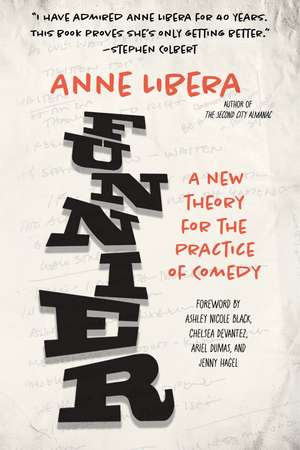
Funnier: A New Theory for the Practice of Comedy
Autor Anne Libera Cuvânt înainte de Ashley Nicole Black, Chelsea Devantez, Ariel Dumas, Jenny Hagelen Limba Engleză Paperback – 15 oct 2025
Great comedy can feel ineffable—and unlearnable. Debunking the myth that “either you are funny, or you aren’t,” Libera breaks the magic of comedy down into an innovative theory and practical toolkit. Developed over the course of thirty years as a director for The Second City and professor of comedy studies in their training center, Libera’s approach is effective across stand-up, sketch, film, and television comedy, as evidenced by her powerhouse students: Amy Poehler, Kristen Schaal, Steven Yeun, and many more of your favorites.
This book starts with a way to think about comedy and then guides you through concrete strategies for making your work smarter, richer, funnier. Libera covers everything from generating material to revising and performing to fostering social connection through comedy. In the book’s final section, Libera draws from her personal life to make a profound case for why future comedy writers should consider the ethics of their art and their responsibility to their fellow human beings in the audience. Readers won’t just be funnier because of this book—they’ll be better people.
Preț: 181.39 lei
Puncte Express: 272
Carte disponibilă
Livrare economică 06-20 noiembrie
Livrare express 22-28 octombrie pentru 52.10 lei
Livrare prin curier în România Termenul estimat este afișat lângă disponibilitate.
Transport gratuit de la 400.00 lei Plată online sau ramburs, în funcție de opțiunile comenzii.
Retur gratuit în 14 zile Comandă securizată și suport în română.
Specificații
ISBN-13: 9780810149366
ISBN-10: 0810149362
Pagini: 333
Dimensiuni: 152 x 229 x 25 mm
Greutate: 0.48 kg
Editura: Northwestern University Press
Colecția Northwestern University Press
ISBN-10: 0810149362
Pagini: 333
Dimensiuni: 152 x 229 x 25 mm
Greutate: 0.48 kg
Editura: Northwestern University Press
Colecția Northwestern University Press
Notă biografică
ANNE LIBERA is an associate professor at Columbia College Chicago, where she created the first program in comedy writing and performance in the country. She teaches and directs for The Second City in Chicago and across the globe, and is the author of The Second City Almanac of Improvisation, also published by Northwestern University Press.
Cuprins
Foreword by Ashley Nicole Black, Chelsea Devantez, Ariel Dumas, and Jenny Hagel
Introduction
Part I: Thinking About Comedy
A Theory of Comedy
Recognition
Pain
Distance
Comedy is Relative
The Five Components of Comedy
Jokes
Physical Comedy
Character
Narrative
Point of View
Thick and Thin Comedy
Taste, Hack, and Watching Comedy as a Comedian
Analyzing Comedy That Someone Else Has Created
Humor Theory
Superiority Theory
Incongruity Theory
Tension and Release Theory
Benign Violation Theory
Evolutionary Theories
Comedy and Your Brain
Biases and Heuristics
Context
Putting the Frog Back Together
Part 2: Making It Funny
Generating Comedy Materials and Ideas
Material Generation Prompts
Tool: List Ideas
Prompts that Work with Pain and Distance
Tool: Truth
Writing a Joke
What Is a Joke?
How to Write a Joke
How to Write a News Joke
Creating Original Jokes
Joke Filters
How to Rewrite a Joke
Jokes That Use Other Comedy Components
Revising Jokes That Use More Than One Component
Tool—Novelty and Surprise
Performing Comedy
Discovery
Tool — Explore and Heighten
What is Physical Comedy?
Making Physical Comedy
Props
Slapstick
Skill
Tool — Status
Comedy and Status
Creating Comic Characters
Starting with Recognition
Starting with Pain
Tool—Character Space Walk
Taking Embodied Characters into Relationship with Others
More Ways to Create or Practice With Embodied Characters
Playing With Character Point of View For Writers
Good Comedy Hygiene: Character
Useful Definitions: Archetypes, Stereotypes, Iconic Representations, Roles
Persona
Creating Your Comic Persona
Tool—Persona Worksheet
Point of View
Point of View 101: You Already Have a Point of View
Comedic Opinion
Useful Definitions — Irony, Sarcasm, and Wit
Parody and Satire
Useful Definitions — Satire and Parody
Creating Comedic Narratives
Story and Narrative
Comedic Narrative
Useful Definitions — Farce
Comic Premise
Starting With a Comic Idea
Writing a Short Comedy Piece
Sketch
Useful Definitions — Parts of a Sketch
Tool — Game of the Scene
Building Your Premise Muscles
Tool—Thinking About Structure
Sitcom
Creating a Premise and Breaking Story for a Plot Sitcom
Tool—Putting Characters Into Comedic Stories
Variety Narratives
How to Write a Simple Standup Set
Sketch Running Order
Running Order Outlines
Running Order Hierarchy of Needs
Part 3: Making It Funnier and Better
Making It Funnier
Working with Expectations
Tool—Risk and Failure
Next Steps of Revising
Tool — Taking a Comedy Class
Making It Better
Good Comedy Hygiene for Collaboration and Originality
Thinking About Comedy Ethics
Making Your Comedy More Ethical
Appendix: Comedy to Watch
Acknowledgements
Notes
Introduction
Part I: Thinking About Comedy
A Theory of Comedy
Recognition
Pain
Distance
Comedy is Relative
The Five Components of Comedy
Jokes
Physical Comedy
Character
Narrative
Point of View
Thick and Thin Comedy
Taste, Hack, and Watching Comedy as a Comedian
Analyzing Comedy That Someone Else Has Created
Humor Theory
Superiority Theory
Incongruity Theory
Tension and Release Theory
Benign Violation Theory
Evolutionary Theories
Comedy and Your Brain
Biases and Heuristics
Context
Putting the Frog Back Together
Part 2: Making It Funny
Generating Comedy Materials and Ideas
Material Generation Prompts
Tool: List Ideas
Prompts that Work with Pain and Distance
Tool: Truth
Writing a Joke
What Is a Joke?
How to Write a Joke
How to Write a News Joke
Creating Original Jokes
Joke Filters
How to Rewrite a Joke
Jokes That Use Other Comedy Components
Revising Jokes That Use More Than One Component
Tool—Novelty and Surprise
Performing Comedy
Discovery
Tool — Explore and Heighten
What is Physical Comedy?
Making Physical Comedy
Props
Slapstick
Skill
Tool — Status
Comedy and Status
Creating Comic Characters
Starting with Recognition
Starting with Pain
Tool—Character Space Walk
Taking Embodied Characters into Relationship with Others
More Ways to Create or Practice With Embodied Characters
Playing With Character Point of View For Writers
Good Comedy Hygiene: Character
Useful Definitions: Archetypes, Stereotypes, Iconic Representations, Roles
Persona
Creating Your Comic Persona
Tool—Persona Worksheet
Point of View
Point of View 101: You Already Have a Point of View
Comedic Opinion
Useful Definitions — Irony, Sarcasm, and Wit
Parody and Satire
Useful Definitions — Satire and Parody
Creating Comedic Narratives
Story and Narrative
Comedic Narrative
Useful Definitions — Farce
Comic Premise
Starting With a Comic Idea
Writing a Short Comedy Piece
Sketch
Useful Definitions — Parts of a Sketch
Tool — Game of the Scene
Building Your Premise Muscles
Tool—Thinking About Structure
Sitcom
Creating a Premise and Breaking Story for a Plot Sitcom
Tool—Putting Characters Into Comedic Stories
Variety Narratives
How to Write a Simple Standup Set
Sketch Running Order
Running Order Outlines
Running Order Hierarchy of Needs
Part 3: Making It Funnier and Better
Making It Funnier
Working with Expectations
Tool—Risk and Failure
Next Steps of Revising
Tool — Taking a Comedy Class
Making It Better
Good Comedy Hygiene for Collaboration and Originality
Thinking About Comedy Ethics
Making Your Comedy More Ethical
Appendix: Comedy to Watch
Acknowledgements
Notes
Recenzii
“I have admired Anne Libera as a teacher and a director for 40 years. This new book proves to me she’s only gotten better.” —Stephen Colbert, American comedian, writer, and television host
“As a student of Anne's in my early days of comedy, she opened up a world of comedic history that helps me in my writing to this day. With Funnier, she continues to demystify and examine comedy for a whole new generation of students.” —Aidy Bryant, American actress and comedian
“A trove of practical advice for anyone thinking about going pro.” —Chicago Tribune
“Some say comedy can't be taught, but Columbia College professor and Second City director Anne Libera is proving you can. Libera's new book Funnier is both a textbook on the fundamentals of building a career in comedy and a toolkit for developing anyone's sense of humor.” —WBEZ
“I wish I had written Funnier. I might tell people that I did. No, I won’t. I mean, maybe? But I wish I had. But you’re lucky that Anne Libera wrote it because it’s brilliant. Funnier will quickly become your go-to book for creating and analyzing comedy. It expertly weaves together comic theory and practical exercises, allowing the reader to both analyze and create comedy. Whether you’re funny or not (and this book will definitely make you funnier), you’re going to love this book.” —Matt Fotis, Albright College
“As a student of Anne's in my early days of comedy, she opened up a world of comedic history that helps me in my writing to this day. With Funnier, she continues to demystify and examine comedy for a whole new generation of students.” —Aidy Bryant, American actress and comedian
“A trove of practical advice for anyone thinking about going pro.” —Chicago Tribune
“Some say comedy can't be taught, but Columbia College professor and Second City director Anne Libera is proving you can. Libera's new book Funnier is both a textbook on the fundamentals of building a career in comedy and a toolkit for developing anyone's sense of humor.” —WBEZ
“I wish I had written Funnier. I might tell people that I did. No, I won’t. I mean, maybe? But I wish I had. But you’re lucky that Anne Libera wrote it because it’s brilliant. Funnier will quickly become your go-to book for creating and analyzing comedy. It expertly weaves together comic theory and practical exercises, allowing the reader to both analyze and create comedy. Whether you’re funny or not (and this book will definitely make you funnier), you’re going to love this book.” —Matt Fotis, Albright College