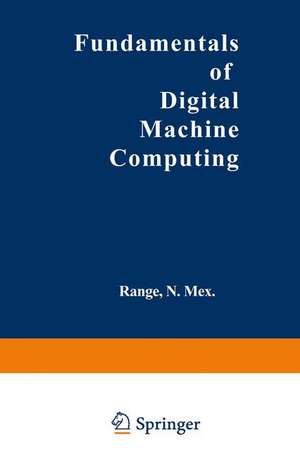
Fundamentals of Digital Machine Computing
Autor G. Hintzede Limba Germană Paperback – 12 iun 2012
Preț: 305.93 lei
Puncte Express: 459
Carte tipărită la comandă
Livrare economică 01-15 octombrie
Livrare prin curier în România Termenul estimat este afișat lângă disponibilitate.
Transport gratuit de la 400.00 lei Plată online sau ramburs, în funcție de opțiunile comenzii.
Retur gratuit în 14 zile Comandă securizată și suport în română.
Specificații
ISBN-13: 9783642490316
ISBN-10: 364249031X
Pagini: 240
Ilustrații: IX, 225 S.
Dimensiuni: 152 x 229 x 13 mm
Greutate: 0.33 kg
Ediția:Softcover reprint of the original 1st ed. 1966
Editura: Springer Berlin, Heidelberg
Colecția Springer
Locul publicării:Berlin, Heidelberg, Germany
ISBN-10: 364249031X
Pagini: 240
Ilustrații: IX, 225 S.
Dimensiuni: 152 x 229 x 13 mm
Greutate: 0.33 kg
Ediția:Softcover reprint of the original 1st ed. 1966
Editura: Springer Berlin, Heidelberg
Colecția Springer
Locul publicării:Berlin, Heidelberg, Germany
V-ar putea interesa
-
 Sensors for MechatronicsPaul P.L. Regtien-25%Preț: 447.84 lei595.52 lei
 -
 Engineering: A Very Short IntroductionDavid Blockley-21%Preț: 54.95 lei69.80 lei
 -
 -19%Preț: 463.04 lei571.65 lei
 -
 The Art of Systems ArchitectingMark W. Maier-20%Preț: 946.52 lei1183.15 lei
 -
 Carbon Footprint Analysis: Concepts, Methods, Implementation, and Case StudiesMatthew John Franchetti-18%Preț: 923.73 lei1126.49 lei
 -
 Preț: 367.01 lei
Public țintă
ResearchCuprins
1 The Role and Principal Attributes of Digital Computers.- 1-1. The Universality of Digital Computers.- 1-2. Digital Computers as Logical Machines.- 1-3. Large Memory Capacity.- 1-4. Computational Rapidity.- 1-5. General Systems Configuration.- 1-6. The Computer Family Tree.- 2 Binary Numbers and Codes and their Machine Representation.- 2-1. The Binary Number System.- 2-2. The Octal System as Bridge between Decimal and Binary.- 2-3. Number Conversion.- 2-4. Binary Codes.- 2-5. Representation of Negative Numbers.- 2-6. Fixed Point Number Ranges.- 2-7. Scale Factoring.- 2-8. Floating Point Numbers.- 2-9. Initial Computer Input.- 3 The Principles of Logic in Computers.- 3-1. Relationship of Logical Concepts to Computer Circuits.- 3-2. Boolean Algebra as Symbolic Logic.- 3-3. Some Useful Theorems of Boolean Algebra.- 3-4. Basic Elements of the Computer.- 3-5. Logical Description of Basic Elements.- 3-6. Minimization of Logical Functions.- 3-7. Logical Synthesis of Combinational Circuits.- 3-8. Logical Analysis of Combinational Circuits.- 3-9. The Logic of Combinational Circuits with Several Outputs.- 3-10. Logical Synthesis of Sequential Circuits.- 3-11. Design of an Odd-Sequence Counter.- 3-12. The Logic of the Entire Computer.- 4 Arithmetic Operations of the Machine.- 4-1. The Logic of Binary Addition and Subtraction.- 4-2. Serial and Parallel Binary Addition.- 4-3. Addition with Accumulators.- 4-4. Machine Subtraction.- 4-5. BCD Addition and Complementation.- 4-6. Considerations for Machine Multiplication.- 4-7. Serial Binary Multiplication.- 4-8. Parallel Binary Multiplication.- 4-9. BCD Multiplication.- 4-10. Considerations for Machine Division.- 5 The Instruction Code of the Computer.- 5-1. Basic Computer Operations.- 5-2. Instruction Format.- 5-3. Coding of Instructions.- 5-4. General Classes of Instructions.- 5-5. Operational Instructions.- 5-6. Control Instructions.- 5-7. Instruction Modification.- 5-8. Editing Instructions.- 5-9. Instruction Execution.- 6 Principles and Examples of Programming.- 6-1. Mathematical Methods for Digital Computers.- 6-2. Diagramming the Program.- 6-3. Writing the Code.- 6-4. Simple Arithmetic Problems.- 6-5. Iterative Processes.- 6-6. Polynomial Evaluation.- 6-7. Solution of Simultaneous Linear Equations.- 6-8. Matrix Operations.- 6-9. Searching and Sorting.- 6-10. Numerical Solution of Differential Equations.- 6-11. A Complete Program for a Rocket Trajectory.- 7 Automatic Programming.- 7-1. Meaning of Automatic Programming.- 7-2. Principles of Language Design.- 7-3. The Structure of ALGOL.- 7-4. Basic Considerations for Compilers.- 7-5. The IT Compiler.- 7-6. The Listing Process.- 7-7. The Decomposition Process.- 7-8. Compiler Summary.- Appendix A. Summary of Instructions by Alphabetic Code.- Appendix B. Powers of Two.- List of References.