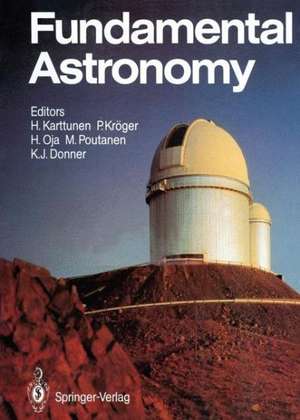
Fundamental Astronomy: Springer Study Edition
Editat de Hannu Karttunen, Pekka Kröger, Heikki Oja, Markku Putanen, Karl J. Donneren Limba Engleză Paperback – 18 apr 1991
Din seria Springer Study Edition
-
 Preț: 407.51 lei
 -
 Preț: 514.01 lei
 - 23%
 Preț: 1085.75 lei
 -
 Preț: 403.65 lei
 -
 Preț: 401.39 lei
 -
 Preț: 375.57 lei
 -
 Preț: 356.75 lei
 -
 Preț: 287.95 lei
 - 15%
 Preț: 548.52 lei
 -
 Preț: 377.99 lei
 - 5%
 Preț: 1094.07 lei
 - 5%
 Preț: 356.31 lei
 -
 Preț: 410.62 lei
 - 15%
 Preț: 533.84 lei
 -
 Preț: 387.03 lei
 - 5%
 Preț: 371.55 lei
 - 15%
 Preț: 608.59 lei
 -
 Preț: 396.08 lei
 - 15%
 Preț: 566.01 lei
 - 20%
 Preț: 665.58 lei
 - 20%
 Preț: 668.20 lei
 - 15%
 Preț: 616.15 lei
 - 15%
 Preț: 629.18 lei
 -
 Preț: 378.64 lei
 -
 Preț: 379.89 lei
 - 15%
 Preț: 617.25 lei
 - 18%
 Preț: 770.56 lei
 - 15%
 Preț: 617.57 lei
 - 15%
 Preț: 610.63 lei
 -
 Preț: 400.24 lei
 -
 Preț: 429.02 lei
 - 20%
 Preț: 362.86 lei
 - 18%
 Preț: 714.21 lei
 - 15%
 Preț: 650.32 lei
 - 20%
 Preț: 323.23 lei
 -
 Preț: 398.76 lei
Preț: 425.19 lei
Puncte Express: 638
Carte tipărită la comandă
Livrare economică 28 noiembrie-12 decembrie
Livrare prin curier în România Termenul estimat este afișat lângă disponibilitate.
Transport gratuit pentru acest produs Plată online sau ramburs, în funcție de opțiunile comenzii.
Retur gratuit în 14 zile Comandă securizată și suport în română.
Specificații
ISBN-13: 9780387975672
ISBN-10: 0387975675
Pagini: 516
Ilustrații: XIII, 478 p.
Dimensiuni: 210 x 280 x 28 mm
Greutate: 1.15 kg
Ediția:1987
Editura: Springer
Colecția Springer Study Edition
Seria Springer Study Edition
Locul publicării:New York, NY, United States
ISBN-10: 0387975675
Pagini: 516
Ilustrații: XIII, 478 p.
Dimensiuni: 210 x 280 x 28 mm
Greutate: 1.15 kg
Ediția:1987
Editura: Springer
Colecția Springer Study Edition
Seria Springer Study Edition
Locul publicării:New York, NY, United States
V-ar putea interesa
-
 The KnowledgeLewis Dartnell-30%Preț: 65.80 lei93.86 lei
 -
 The Age of EarthquakesDouglas CouplandPreț: 106.59 lei
 -
 The Perfect Theory: A Century of Geniuses and the Battle over General RelativityProfessor Pedro G. FerreiraPreț: 94.57 lei
 -
 Network GeeksBrian E. CarpenterPreț: 144.49 lei
 -
 -15%Preț: 586.45 lei689.94 lei
 -
 Lessons from the MastersRobert GendlerPreț: 350.36 lei
 -
 -19%Preț: 58.60 lei71.98 lei
 -
 -45%Preț: 50.47 lei92.51 lei
 -
 -25%Preț: 71.21 lei94.83 lei
 -
 The Hidden Power of SmellPaul A. MoorePreț: 224.92 lei
 -
 Murder on the Einstein Express and Other StoriesHarun ¿IljakPreț: 104.76 lei
 -
 Algorithms UnpluggedBerthold Vöcking-24%Preț: 688.78 lei906.29 lei
 -
 Chemicals for Life and LivingEiichiro OchiaiPreț: 187.87 lei
Public țintă
ResearchCuprins
1. Introduction.- 1.1 The Role of Astronomy.- 1.2 Astronomical Objects of Research.- 1.3 The Scale of the Universe.- 2. Spherical Astronomy.- 2.1 Spherical Trigonometry.- 2.2 The Earth.- 2.3 The Celestial Sphere.- 2.4 The Horizontal System.- 2.5 The Equatorial System.- 2.6 The Ecliptic System.- 2.7 The Galactic Coordinates.- 2.8 Perturbations of Coordinates.- 2.9 Constellations.- 2.10 Star Catalogues and Maps.- 2.11 Positional Astronomy.- 2.12 Time Reckoning.- 2.13 Astronomical Time Systems.- 2.14 Calendars.- 2.15 Exercises.- 3. Observations and Instruments.- 3.1 Observing Through the Atmosphere.- 3.2 Optical Telescopes.- 3.3 Detectors.- 3.4 Radio Telescopes.- 3.5 Other Wavelength Regions.- 3.6 Instruments of the Future.- 3.7 Other Forms of Energy.- 3.8 Exercises.- 4. Photometric Concepts and Magnitudes.- 4.1 Intensity, Flux Density and Luminosity.- 4.2 Apparent Magnitudes.- 4.3 Magnitude Systems.- 4.4 Absolute Magnitudes.- 4.5 Extinction and Optical Thickness.- 4.6 Exercises.- 5. Radiation Mechanisms.- 5.1 Radiation of Atoms and Molecules.- 5.2 The Hydrogen Atom.- 5.3 Quantum Numbers, Selection Rules, Population Numbers.- 5.4 Molecular Spectra.- 5.5 Continuous Spectra.- 5.6 Blackbody Radiation.- 5.7 Other Radiation Mechanisms.- 5.8 Radiative Transfer.- 5.9 Exercises.- 6. Temperatures.- 6.1 Exercises.- 7. Celestial Mechanics.- 7.1 Equations of Motion.- 7.2 Solution of the Equation of Motion.- 7.3 Equation of the Orbit and Kepler’s First Law.- 7.4 Orbital Elements.- 7.5 Kepler’s Second and Third Law.- 7.6 Orbit Determination.- 7.7 Position in the Orbit.- 7.8 Escape Velocity.- 7.9 Virial Theorem.- 7.10 The Jeans Limit.- 7.11 Exercises.- 8. The Solar System.- 8.1 An Overview.- 8.2 Planetary Configurations.- 8.3 Orbit of the Earth.- 8.4 Orbit of the Moon.- 8.5 Eclipsesand Occultations.- 8.6 Albedos.- 8.7 Planetary Photometry, Polarimetry and Spectroscopy.- 8.8 Thermal Radiation of the Planets.- 8.9 The Structure of Planets.- 8.10 Planetary Surfaces.- 8.11 Atmospheres and Magnetospheres.- 8.12 Mercury.- 8.13 Venus.- 8.14 The Earth and the Moon.- 8.15 Mars.- 8.16 Asteroids.- 8.17 Jupiter.- 8.18 Saturn.- 8.19 Uranus, Neptune and Pluto.- 8.20 Minor Bodies of the Solar System.- 8.21 Cosmogony.- 8.22 Other Solar Systems.- 8.23 Exercises.- 9. Stellar Spectra.- 9.1 Measuring Spectra.- 9.2 The Harvard Spectral Classification.- 9.3 The Yerkes Spectral Classification.- 9.4 Peculiar Spectra.- 9.5 The Hertzsprung-Russell Diagram.- 9.6 Model Atmospheres.- 9.7 What Do the Observations Tell Us.- 10. Binary Stars and Stellar Masses.- 10.1 Visual Binaries.- 10.2 Astrometric Binary Stars.- 10.3 Spectroscopic Binaries.- 10.4 Photometric Binary Stars.- 10.5 Exercises.- 11. Stellar Structure.- 11.1 Internal Equilibrium Conditions.- 11.2 Physical State of the Gas.- 11.3 Stellar Energy Sources.- 11.4 Stellar Models.- 11.5 Exercises.- 12. Stellar Evolution.- 12.1 Evolutionary Time Scales.- 12.2 The Contraction of Stars Towards the Main Sequence.- 12.3 The Main Sequence Phase.- 12.4 The Giant Phase.- 12.5 The Final Stages of Evolution.- 12.6 The Evolution of Close Binary Stars.- 12.7 Comparison with Observations.- 12.8 The Origin of the Elements.- 13. The Sun.- 13.1 Internal Structure.- 13.2 The Atmosphere.- 13.3 Solar Activity.- 14. Variable Stars.- 14.1 Classification.- 14.2 Pulsating Variables.- 14.3 Eruptive Variables.- 14.4 Exercises.- 15. Compact Stars.- 15.1 White Dwarfs.- 15.2 Neutron Stars.- 15.3 Black Holes.- 16. The Interstellar Medium.- 16.1 Interstellar Dust.- 16.2 Interstellar Gas.- 16.3 Interstellar Molecules.- 16.4 The Formation of Protostars.- 16.5 Planetary Nebulae.- 16.6 Supernova Remnants.- 16.7 The Hot Corona of the Milky Way.- 16.8 Cosmic Rays and the Interstellar Magnetic Field.- 17. Star Clusters and Associations.- 17.1 Associations.- 17.2 Open Star Clusters.- 17.3 Globular Star Clusters.- 18. The Milky Way.- 18.1 Methods of Distance Measurement.- 18.2 Stellar Statistics.- 18.3 The Rotation of the Milky Way.- 18.4 The Structure and Evolution of the Milky Way.- 18.5 Exercises.- 19. Galaxies.- 19.1 The Classification of Galaxies.- 19.2 Elliptical Galaxies.- 19.3 Spiral Galaxies.- 19.4 Lenticular Galaxies.- 19.5 Luminosities of Galaxies.- 19.6 Masses of Galaxies.- 19.7 Systems of Galaxies.- 19.8 Distances of Galaxies.- 19.9 Active Galaxies and Quasars.- 19.10 The Origin and Evolution of Galaxies.- 20. Cosmology.- 20.1 Cosmological Observations.- 20.2 The Cosmological Principle.- 20.3 Homogeneous and Isotropic Universes.- 20.4 The Friedmann Models.- 20.5 Cosmological Tests.- 20.6 History of the Universe.- 20.7 The Future of the Universe.- Appendices.- A. Mathematics.- A.1 Geometry.- A.2 Taylor Series.- A.3 Vector Calculus.- A.4 Conic Sections.- A.5 Multiple Integrals.- A.6 Numerical Solution of an Equation.- B. Quantum Mechanics.- B.1 Quantum Mechanical Model of Atoms. Quantum Numbers.- B.2 Selection Rules and Transition Probabilities.- B.3 Heisenberg’ Uncertainty Principle.- B.4 Exclusion Principle.- C. Theory of Relativity.- C.1 Basic Concepts.- C.2 Lorentz Transformation. Minkowski Space.- C.3 General Relativity.- C.4 Tests of General Relativity.- D. Radio Astronomy Fundamentals.- D.1 Antenna Definitions.- D.2 Antenna Temperature and Flux Density.- E. Tables.- Further Reading.- Photograph Credits.
Recenzii
"No one involved in astronomy teaching or research would want to be without a copy." #The Physics Teacher#"Offers a range of expertise and authority impossible for a single-author text..." #Nature# "Fundamental ideas are developed clearly and applied to real problems, and solutions are worked out; this is the book's strength." #Sky & Telescope#