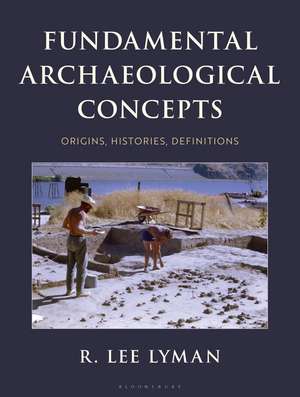
Fundamental Archaeological Concepts: Origins, Histories, Definitions
Autor R. Lee Lymanen Limba Engleză Hardback – 8 ian 2026
Modern archaeology includes a number of fundamental concepts. This volume compiles in one place the origins, developmental histories, and definitions of more than two dozen of archaeology's most fundamental concepts. Concepts discussed include artifact, assemblage, association, context, ecofact, feature, industry, in situ, period, provenience, site, stage, tool kit, and type/index fossil.
The volume is neither a dictionary nor an encyclopedia. Its goals are:
1) to document the origin and history of each of the terms/concepts,
2) to present many of the definitions of each of the terms/concepts, and
3) to document the variability in definitions of each term/concept. Two sources of 'formal' data are reviewed.
All sources were searched for the 27 concepts, and data recorded regarding (1) whether or not a term/concept appeared in each piece of literature, (2) the appearance of a particular concept without its associated term in each piece of literature, (3) the appearance of a particular term without definition or discussion of its associated concept in each piece of literature, and (4) the appearance of a particular term with an included definition and presenting the definition from each piece of literature. These formal data are supplemented with information on concepts encountered while reading other literature not included in the 'formal' samples of early literature and introductory textbooks.
This book is unique among the archaeological literature for its synopses of much of the literature, coverage of the history and meanings of archaeological concepts used in fieldwork and analysis is thorough, and the varied definitions of concepts are summarized and easily consulted.
Preț: 498.60 lei
Preț vechi: 885.03 lei
-44%
Puncte Express: 748
Carte tipărită la comandă
Livrare economică 07-21 decembrie
Livrare express 31 octombrie-06 noiembrie pentru 277.52 lei
Livrare prin curier în România Termenul estimat este afișat lângă disponibilitate.
Transport gratuit pentru acest produs Plată online sau ramburs, în funcție de opțiunile comenzii.
Retur gratuit în 14 zile Comandă securizată și suport în română.
Specificații
ISBN-13: 9798216196228
Pagini: 272
Ilustrații: 26 bw illus
Dimensiuni: 222 x 280 x 30 mm
Greutate: 1 kg
Editura: Bloomsbury Publishing
Colecția Bloomsbury Academic
Locul publicării:New York, United States
Pagini: 272
Ilustrații: 26 bw illus
Dimensiuni: 222 x 280 x 30 mm
Greutate: 1 kg
Editura: Bloomsbury Publishing
Colecția Bloomsbury Academic
Locul publicării:New York, United States
Cuprins
Preface
Part I. Why a Book on Archaeological Concepts?
Introduction
Part II. The Fundamental Concepts
A. Activity area
B. Archaeological culture
C. Artifact
D. Assemblage
E. Association
F. Cache
G. Component
H. Context
I. Cultural process
J. Ecofact
K. Feature
L. Horizon
M. In situ
N. Industry
O. Manuport
P. Material culture
Q. Mental template
R. Midden
S. Period
T. Phase
U. Provenience
V. Site
W. Site structure
X. Stage
Y. Tool kit
Z. Tradition
AA. Type/index fossil
Appendix 1. List of introductory archaeology textbooks surveyed.
Appendix 2. List of dictionaries and encyclopedias surveyed.
Appendix 3. Early archaeological literature examined for occurrence of terms used.
Part I. Why a Book on Archaeological Concepts?
Introduction
Part II. The Fundamental Concepts
A. Activity area
B. Archaeological culture
C. Artifact
D. Assemblage
E. Association
F. Cache
G. Component
H. Context
I. Cultural process
J. Ecofact
K. Feature
L. Horizon
M. In situ
N. Industry
O. Manuport
P. Material culture
Q. Mental template
R. Midden
S. Period
T. Phase
U. Provenience
V. Site
W. Site structure
X. Stage
Y. Tool kit
Z. Tradition
AA. Type/index fossil
Appendix 1. List of introductory archaeology textbooks surveyed.
Appendix 2. List of dictionaries and encyclopedias surveyed.
Appendix 3. Early archaeological literature examined for occurrence of terms used.
Recenzii
With characteristic rigor and thoroughness, R. Lee Lyman examines the shifting meanings of concepts archaeologists work with every day. Much more than a dictionary, this book examines the evolution of, and ongoing uncertainties about, the basic ideas that underpin our discipline.
This is a book that should be on every archaeologist's shelves. It provides a synthesis of the origins and contemporary uses of key archaeological terms. In doing so, the book challenges us to move beyond our often unexamined 'common sense' definitions.
In Fundamental Archaeological Concepts, Lyman offers an impressively clear, meticulously researched examination of the key terms that underpin archaeological thought and practice. The book goes back to basics - but it is far from basic. Drawing on decades of teaching and scholarship and with a strong focus on Anglo-American archaeology, Lyman traces the origins, definitions, and shifting meanings of concepts central to the discipline, providing both historical depth and analytical rigor. The result is an indispensable reference that will sharpen the interpretive tools of students and seasoned researchers alike. This book fills a surprisingly long-standing gap in the archaeological literature, and encourages more precise communication and deeper reflection on the very basal concepts we use to study the past.
This is a book that should be on every archaeologist's shelves. It provides a synthesis of the origins and contemporary uses of key archaeological terms. In doing so, the book challenges us to move beyond our often unexamined 'common sense' definitions.
In Fundamental Archaeological Concepts, Lyman offers an impressively clear, meticulously researched examination of the key terms that underpin archaeological thought and practice. The book goes back to basics - but it is far from basic. Drawing on decades of teaching and scholarship and with a strong focus on Anglo-American archaeology, Lyman traces the origins, definitions, and shifting meanings of concepts central to the discipline, providing both historical depth and analytical rigor. The result is an indispensable reference that will sharpen the interpretive tools of students and seasoned researchers alike. This book fills a surprisingly long-standing gap in the archaeological literature, and encourages more precise communication and deeper reflection on the very basal concepts we use to study the past.