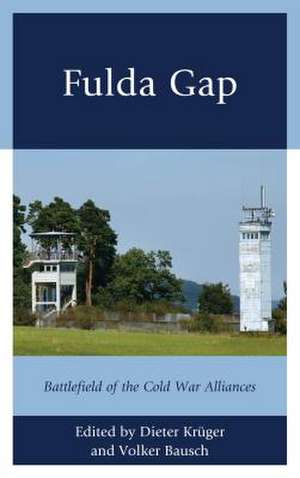
Fulda Gap: Battlefield of the Cold War Alliances
Editat de Dieter Krüger, Volker Bausch Traducere de David R. Dorondo Cuvânt înainte de Gordon R. Sullivan Contribuţii de Roger Cirillo, Torsten Diedrich, Helmut H. Hammerich, Helge Hansen, Albin F. Irzyk, Siegfried Lautsch, Gregory W. Pedlow, Michael Poppe, Detlef Rotha, Mathias Rupp, Crosbie E. Saint, Matthias Uhlen Limba Engleză Hardback – 20 noi 2017
Preț: 681.03 lei
Preț vechi: 1055.29 lei
-35%
Puncte Express: 1022
Carte tipărită la comandă
Livrare economică 08-22 decembrie
Livrare prin curier în România Termenul estimat este afișat lângă disponibilitate.
Transport gratuit pentru acest produs Plată online sau ramburs, în funcție de opțiunile comenzii.
Retur gratuit în 14 zile Comandă securizată și suport în română.
Specificații
ISBN-13: 9781498569484
ISBN-10: 149856948X
Pagini: 380
Dimensiuni: 162 x 232 x 26 mm
Greutate: 0.84 kg
Editura: Bloomsbury Publishing
Colecția Lexington Books
Locul publicării:New York, United States
ISBN-10: 149856948X
Pagini: 380
Dimensiuni: 162 x 232 x 26 mm
Greutate: 0.84 kg
Editura: Bloomsbury Publishing
Colecția Lexington Books
Locul publicării:New York, United States
Cuprins
Foreword, Gordon R. Sullivan
Introduction, Dieter Krüger and Volker Bausch
Translator's Note, David R. Dorondo
Chapter 1: Fulda Gap: A Flashpoint of the Cold War between Myth and Reality, Helmut H. Hammerich
Chapter 2: The Eighth Guards Army of the Group of Soviet Forces in Germany and the Fulda Gap, Matthias Uhl
Chapter 3: The Strategic and Operational Considerations of NATO in Europe since the 1970s, Helge Hansen
Chapter 4: The Development of the Military Conceptions of the Warsaw Pact in the Last Two Decades of the East-West Conflict, Siegfried Lautsch
Chapter 5: The Development of NATO Defense Plans for Central Europe in the Final Decades of the Cold War, Gregory W. Pedlow
Chapter 6: The Defense of Highway 84: Recollections of the Commander, B Troop, 11th Armored Cavalry Regiment, 1978-1980, Roger Cirillo
Chapter 7: The Fulda Gap: A Personal Perspective from Platoon Leader to Army Group, Crosbie E. Saint
Chapter 8: The GDR and its Mission in the Warsaw Pact, Torsten Diedrich
Chapter 9: The Wartime Mission of the Border Troops of the GDR, Detlef Rotha
Chapter 10: Brinkmanship in the Cold War: Theoretical Foundation and Application, Mathias Rupp
Chapter 11: When the Cold War Almost Turned Hot, Albin F. Irzyk
Chapter 12: When the World Stood at the Abyss-and No One Knew It, Volker Bausch
Chapter 13: The Military Relationship of Forces between the North Atlantic Alliance and the Warsaw Pact, Michael Poppe
Chapter 14: The Alliances and the Fulda Gap: A Balance between Ideology, Politics, Strategy, and Operational Plans, Dieter Krüger
Introduction, Dieter Krüger and Volker Bausch
Translator's Note, David R. Dorondo
Chapter 1: Fulda Gap: A Flashpoint of the Cold War between Myth and Reality, Helmut H. Hammerich
Chapter 2: The Eighth Guards Army of the Group of Soviet Forces in Germany and the Fulda Gap, Matthias Uhl
Chapter 3: The Strategic and Operational Considerations of NATO in Europe since the 1970s, Helge Hansen
Chapter 4: The Development of the Military Conceptions of the Warsaw Pact in the Last Two Decades of the East-West Conflict, Siegfried Lautsch
Chapter 5: The Development of NATO Defense Plans for Central Europe in the Final Decades of the Cold War, Gregory W. Pedlow
Chapter 6: The Defense of Highway 84: Recollections of the Commander, B Troop, 11th Armored Cavalry Regiment, 1978-1980, Roger Cirillo
Chapter 7: The Fulda Gap: A Personal Perspective from Platoon Leader to Army Group, Crosbie E. Saint
Chapter 8: The GDR and its Mission in the Warsaw Pact, Torsten Diedrich
Chapter 9: The Wartime Mission of the Border Troops of the GDR, Detlef Rotha
Chapter 10: Brinkmanship in the Cold War: Theoretical Foundation and Application, Mathias Rupp
Chapter 11: When the Cold War Almost Turned Hot, Albin F. Irzyk
Chapter 12: When the World Stood at the Abyss-and No One Knew It, Volker Bausch
Chapter 13: The Military Relationship of Forces between the North Atlantic Alliance and the Warsaw Pact, Michael Poppe
Chapter 14: The Alliances and the Fulda Gap: A Balance between Ideology, Politics, Strategy, and Operational Plans, Dieter Krüger
Recenzii
Overall this book provides a valuable contribution to the study of the Cold War. . . the operational, strategic, and theoretical examinations of both alliances provide an excellent and compact contribution to the literature.
Fulda Gap: Battlefield of the Cold War Alliances, which brings together both scholars and veterans, moves deftly from the strategic context to the on-the-ground reality of serving at the front lines of a cold war that did not erupt (at least there) for some four decades. These essays and recollections illustrate what was real and what was imagined about the Soviet threat, the NATO response, and vice versa. Chief among the particular delights are insights into Soviet and East German planning and force structure-as well as into the American experience at the border-and new evidence in advancing the historical narrative well into the 1970s and 1980s. Above all, Fulda Gap demonstrates how much we can gain from situating a specific place in its context and by placing the operational level at the heart of military history.
The Fulda Gap remains a catch word for the dilemma of Cold War deterrence in the crises of forward defense at the level below the Single Integrated Operational Plan and the Indochina War. The authors in this volume comprise veterans as well as scholars of the US Army, the Bundeswehr, the Soviet Group of Forces in Germany, and the East German Nationale Volksarmee as found in no comparable work. My praise of this work arises from my own personal experience of this task in the 1980s, my advanced study and graduate instruction in this material in the US and Central Europe ever since, and my active participation today in the reconstitution of NATO's deterrence posture in an unsettled Europe. Scholars will find what they need here, as will those in the here and now in search of the context of an old nightmare that has reappeared in the twenty-first century.
Fulda Gap: Battlefield of the Cold War Alliances, which brings together both scholars and veterans, moves deftly from the strategic context to the on-the-ground reality of serving at the front lines of a cold war that did not erupt (at least there) for some four decades. These essays and recollections illustrate what was real and what was imagined about the Soviet threat, the NATO response, and vice versa. Chief among the particular delights are insights into Soviet and East German planning and force structure-as well as into the American experience at the border-and new evidence in advancing the historical narrative well into the 1970s and 1980s. Above all, Fulda Gap demonstrates how much we can gain from situating a specific place in its context and by placing the operational level at the heart of military history.
The Fulda Gap remains a catch word for the dilemma of Cold War deterrence in the crises of forward defense at the level below the Single Integrated Operational Plan and the Indochina War. The authors in this volume comprise veterans as well as scholars of the US Army, the Bundeswehr, the Soviet Group of Forces in Germany, and the East German Nationale Volksarmee as found in no comparable work. My praise of this work arises from my own personal experience of this task in the 1980s, my advanced study and graduate instruction in this material in the US and Central Europe ever since, and my active participation today in the reconstitution of NATO's deterrence posture in an unsettled Europe. Scholars will find what they need here, as will those in the here and now in search of the context of an old nightmare that has reappeared in the twenty-first century.