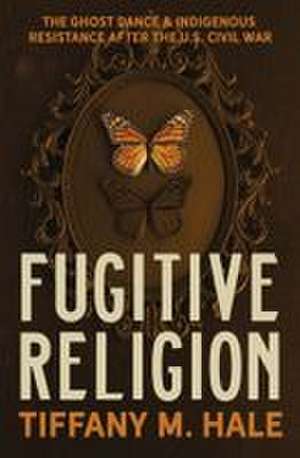
Fugitive Religion: The Ghost Dance and Indigenous Resistance After the U.S. Civil War: The Henry Roe Cloud Series on American Indians and Modernity
Autor Tiffany M. Haleen Limba Engleză Hardback – 16 iun 2026
From the Sand Creek Massacre (1864) to the Massacre at Wounded Knee (1890), Indigenous religious practices—legally banned after 1883—took on new meanings as acts of defiance against colonialism and white supremacy. By reexamining the familiar story of the Ghost Dance and Wounded Knee Massacre and placing it into the context of resistance by Black and Native peoples during Reconstruction and Redemption, historian Tiffany M. Hale explains the Ghost Dance not just as a religious movement but also as a complex social phenomenon that enabled Indigenous people to maintain their identities and communities despite the pervasive force of colonialism and the challenges of modernity.
Chronicling how individual Native people, their families, and communities navigated the fraught post–Civil War conditions of the United States, Hale suggests that Ghost Dances hold something in common with blues traditions of working-class African Americans. By giving Ghost Dance participants a chance to reflect on their lived experiences of warfare, deracination, and diplomacy, “fugitive religion” helped create modern racial self-consciousness in the United States.









Preț: 307.44 lei
Puncte Express: 461
Carte disponibilă
Livrare economică 06-20 noiembrie
Livrare express 23-29 octombrie pentru 41.98 lei
Livrare prin curier în România Termenul estimat este afișat lângă disponibilitate.
Transport gratuit de la 400.00 lei Plată online sau ramburs, în funcție de opțiunile comenzii.
Retur gratuit în 14 zile Comandă securizată și suport în română.
Specificații
ISBN-13: 9780300257526
ISBN-10: 030025752X
Pagini: 296
Ilustrații: 13 b-w illus.
Dimensiuni: 156 x 235 mm
Editura: Yale University Press
Colecția Yale University Press
Seria The Henry Roe Cloud Series on American Indians and Modernity
ISBN-10: 030025752X
Pagini: 296
Ilustrații: 13 b-w illus.
Dimensiuni: 156 x 235 mm
Editura: Yale University Press
Colecția Yale University Press
Seria The Henry Roe Cloud Series on American Indians and Modernity
Recenzii
“In this rigorous, well-researched book, Tiffany M. Hale reintroduces the reader to the postbellum Indigenous practice of the Ghost Dance. By underscoring how this fugitive religious movement shaped a kind of racial consciousness among Indigenous communities in response to settler violence, Hale connects the Ghost Dance to the blues impulse within African American culture.”—Joseph Winters, Rutgers University
“This wonderfully original and generative book completely revises and transforms understanding of racism’s centrality to past and present political structures and cultural imaginaries in the United States. With extraordinary erudition, insight, and eloquence, Tiffany M. Hale shows how the Ghost Dance challenged white supremacism at a time when Indigenous dispossession and Jim Crow segregation were responsible for reorganizing and reconsolidating the nation-state. In the face of a settler colonialism that threatened to eliminate or absorb them, Native peoples deployed religious traditions and practices that allowed them to maintain spiritual composure and a sense of freedom in the midst of deadly conflict.”—George Lipsitz, author of Ethnic Studies at the Crossroads
“By listening carefully to Indigenous voices, Tiffany Hale has given us a brilliant and beautiful book. Fugitive Religion bursts with new insights about Ghost Dances, white supremacy, the Blues, and Indigenous lives at the crossroads of empire.”—Jeffrey Ostler, author of Surviving Genocide: Native Nations and the United States from the American Revolution to Bleeding Kansas
“Fugitive Religion is an outstanding contribution to the study of race and religion in America grounded in impressive archival research and offering sophisticated theoretical frames. Hale’s compelling account of the Ghost Dance foregrounds the lived experiences of Native peoples to show how they produced fugitive religion and forged a new ‘racial self-consciousness’ in the post–Civil War United States.”—Judith Weisenfeld, author of Black Religion in the Madhouse: Race and Psychiatry in Slavery’s Wake
“Placing Black and Native ways of knowing in a revelatory dialogue, Fugitive Religion reimagines the nineteenth century as an entangled and prophetic world, a reservoir of spiritual possibilities easily misread or ignored. Tiffany Hale reveals a series of Ghost Dances, distinct in location and practice but kin in impetus and import, and so transports readers from the painful terrain of Wounded Knee to a history longer, wider, and deeper.”—Philip J. Deloria, Harvard University
“This wonderfully original and generative book completely revises and transforms understanding of racism’s centrality to past and present political structures and cultural imaginaries in the United States. With extraordinary erudition, insight, and eloquence, Tiffany M. Hale shows how the Ghost Dance challenged white supremacism at a time when Indigenous dispossession and Jim Crow segregation were responsible for reorganizing and reconsolidating the nation-state. In the face of a settler colonialism that threatened to eliminate or absorb them, Native peoples deployed religious traditions and practices that allowed them to maintain spiritual composure and a sense of freedom in the midst of deadly conflict.”—George Lipsitz, author of Ethnic Studies at the Crossroads
“By listening carefully to Indigenous voices, Tiffany Hale has given us a brilliant and beautiful book. Fugitive Religion bursts with new insights about Ghost Dances, white supremacy, the Blues, and Indigenous lives at the crossroads of empire.”—Jeffrey Ostler, author of Surviving Genocide: Native Nations and the United States from the American Revolution to Bleeding Kansas
“Fugitive Religion is an outstanding contribution to the study of race and religion in America grounded in impressive archival research and offering sophisticated theoretical frames. Hale’s compelling account of the Ghost Dance foregrounds the lived experiences of Native peoples to show how they produced fugitive religion and forged a new ‘racial self-consciousness’ in the post–Civil War United States.”—Judith Weisenfeld, author of Black Religion in the Madhouse: Race and Psychiatry in Slavery’s Wake
“Placing Black and Native ways of knowing in a revelatory dialogue, Fugitive Religion reimagines the nineteenth century as an entangled and prophetic world, a reservoir of spiritual possibilities easily misread or ignored. Tiffany Hale reveals a series of Ghost Dances, distinct in location and practice but kin in impetus and import, and so transports readers from the painful terrain of Wounded Knee to a history longer, wider, and deeper.”—Philip J. Deloria, Harvard University
Notă biografică
Tiffany M. Hale is assistant professor in the Department of Religion at Barnard College of Columbia University.