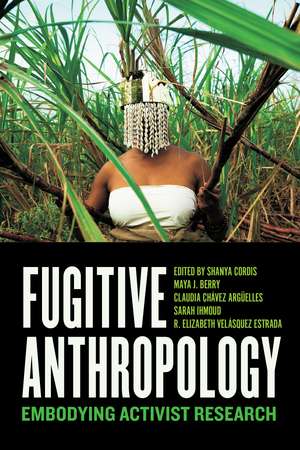
Fugitive Anthropology: Embodying Activist Research
Editat de Shanya Cordis, Maya J. Berry, Claudia Chávez Argüelles, Sarah Ihmoud, R. Elizabeth Velásquez Estradaen Limba Engleză Hardback – 6 ian 2026
Observăm în literatura academică actuală o lacună semnificativă în ceea ce privește documentarea riscurilor și tensiunilor emoționale la care sunt expuși cercetătorii ce aparțin minorităților atunci când desfășoară muncă de teren în comunități aflate în conflict. Fugitive Anthropology vine să umple acest gol, oferind o perspectivă provocatoare asupra modului în care identitățile de gen, rasă și sexualitate ale cercetătorului interacționează cu structurile de putere coloniale și patriarhale. Remarcăm o trecere de la antropologia observațională clasică spre o metodologie a angajamentului politic radical, ancorată în luptele comunităților de culoare și indigene.
Comparabil cu Activist Scholarship în rigurozitate, volumul de față este actualizat pentru noile realități ale universității neoliberale, unde cercetarea nu mai poate fi separată de activismul pentru eliberare colectivă. Structura cărții este organizată progresiv, începând cu deconstrucția violenței politice în munca de teren, continuând cu studii de caz despre arheologia fugară și geografiile supraviețuirii migranților trans, și culminând cu reflecții despre furia feministă indigenă ca sursă de cunoaștere. Descoperim aici un efort colectiv de a defini o etică feministă care îmbrățișează cunoașterea întrupată, respingând obiectivitatea detașată în favoarea unei solidarități profunde cu subiecții cercetați. Este o resursă esențială care extinde limitele teoriei feministe și ale metodologiilor de cercetare colaborativă prin analize tăioase și onestitate intelectuală.
Preț: 574.45 lei
Preț vechi: 746.04 lei
-23%
Carte indisponibilă temporar
Specificații
ISBN-10: 1477332731
Pagini: 344
Ilustrații: 3 b&w photos, 1 b&w illustration
Dimensiuni: 152 x 229 x 30 mm
Greutate: 0.45 kg
Editura: University of Texas Press
Colecția University of Texas Press
De ce să citești această carte
Această carte este indispensabilă pentru cercetătorii din științele sociale care doresc să practice o antropologie etică și angajată politic. Cititorul câștigă o înțelegere profundă a modului în care vulnerabilitatea cercetătorului poate deveni un instrument metodologic puternic. Recomandăm acest volum pentru curajul de a chestiona regimurile coloniale din interiorul academiei, oferind în schimb modele practice de solidaritate și rezistență prin cercetare.
Despre autor
Volumul este coordonat de un colectiv de editoare remarcabile, printre care Shanya Cordis, Maya J. Berry, Claudia Chávez Argüelles, Sarah Ihmoud și R. Elizabeth Velásquez Estrada. Acestea sunt voci de frunte în antropologia contemporană, specializate în intersecția dintre feminismul de culoare, studiile indigene și drepturile omului. Expertiza lor combinată reflectă o angajare pe termen lung în metodologii de cercetare activistă, militând pentru transformarea disciplinei antropologice într-un instrument de justiție socială și decolonizare, atât în America Latină, cât și în Statele Unite.
Descriere scurtă
Fugitive Anthropology is a transnational, intergenerational engagement that extends feminist theory, activist research methodologies, and the discipline of anthropology in new directions. Contributors examine the tensions that arise from conducting politically engaged, collaborative research alongside communities in struggle, in particular theorizing from the experiences of racialized women, queer, trans, and gender nonconforming researchers across distinct geographies. Essays contend with the matrices of colonial, imperial, and patriarchal violence that afflict the researchers and communities with which they seek political alignment.
Articulating an ethnographic practice grounded in Black and Indigenous political struggles and committed to collective liberation, the volume reflects on what it means to navigate violent relations of power, systemic inequities, and current onslaughts shaping field research and US academia. Ultimately, Fugitive Anthropology argues that a feminist ethos—one that embraces embodied knowledges and fugitive sensibilities—forges liberatory spaces that break from dominant masculinist frames of the “political” and challenge colonial regimes within and beyond the neoliberal university.
Notă biografică
Maya J. Berry is an associate professor of African, African American, and Diaspora Studies at the University of North Carolina at Chapel Hill.
Claudia Chávez Argüelles is a Mexican mestiza lawyer, anthropologist, and assistant professor of anthropology at Tulane University.
Sarah Ihmoud is a Chicana Palestinian anthropologist and assistant professor of anthropology at the College of the Holy Cross.
R. Elizabeth Velásquez Estrada is a Salvadoran Nicaraguan immigrant, mestiza, anthropologist and assistant professor of Latina/Latino studies and anthropology at University of Illinois, Urbana-Champaign.
Cuprins
- List of Illustrations
- Introduction (Shanya Cordis, Maya J. Berry, Claudia Chávez Argüelles, Sarah Ihmoud, and R. Elizabeth Velásquez Estrada)
- Artist Statement, Soil (2016) (Courtney Desiree Morris)
- 1. The Gendered, Racial, and Violent Politics of Fieldwork (Dána-Ain Davis)
- 2. Fugitive Archaeology for Engaged Futures (Adriana María Linares Palma)
- 3. Embodying Sites of Memory: Fugitive Spaces for Black Feminist Community Histories (Cheryl R. Rodriguez)
- 4. Sanctuaries in Transit: Trans Migrant Fugitivity and the Geographies of Survival (Koyana Flotte)
- 5. Fugitive Dreams from Fieldwork (Mis)Recognitions (Maya J. Berry)
- 6. Co-Sentipensar-Accionar: Moments of Truth, Radical Relationality, and Fugitivity in the Field (Claudia Chávez Argüelles)
- 7. Fugitive Collaborative Research: Seeking Mutuality as Research Accountability (R. Elizabeth Velásquez Estrada)
- 8. Grief and an Indigenous Feminist’s Rage: The Embodied Field of Knowledge Production (Shannon Speed)
- 9. Feminist Ethnography in Contexts of Multiple Forms of Violence (R. Aída Hernández Castillo)
- 10. Feeling Grief in the Flesh: Toward an Emotionally Engaged Research (Meztli Yoalli Rodríguez Aguilera)
- 11. M’Shatateh Ethnography: Embodying the Palestinian Borderlands (Sarah Ihmoud)
- 12. “Sigamos Parceira”: Politics of Fidelity to Black Mothers’ Epistemology of Antiblack Genocide (Luciane Rocha)
- 13. Fugitive Anthropology, Higher Education Administration, and Interstitial Institutional Change (Edmund T. Gordon and Charles R. Hale)
- 14. Accepting the Hatred: Quilombo Fugitivity and the Extraterrestrial Imperative of (Gendered) Antiblackness (João H. Costa Vargas)
- 15. How the River, It Flows: On Otherwise Fugitive Praxes and Calling My Body Home (Shanya Cordis)
- Afterword: Cutting after Words (Joy James)
- Acknowledgments
- Index