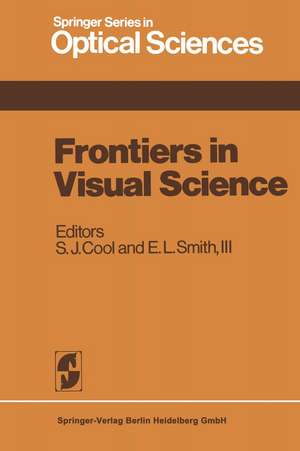
Frontiers in Visual Science: Springer Series in Optical Sciences, cartea 8
Editat de Steven J. Cool, Earl L. Smithen Limba Engleză Paperback – 3 oct 2013
Din seria Springer Series in Optical Sciences
- 18%
 Preț: 1436.66 lei
 - 18%
 Preț: 1174.91 lei
 - 18%
 Preț: 958.26 lei
 - 20%
 Preț: 830.84 lei
 - 15%
 Preț: 670.11 lei
 - 18%
 Preț: 1846.34 lei
 -
 Preț: 364.80 lei
 - 18%
 Preț: 1392.57 lei
 - 18%
 Preț: 1610.77 lei
 - 18%
 Preț: 2102.31 lei
 - 18%
 Preț: 1233.64 lei
 - 18%
 Preț: 910.28 lei
 -
 Preț: 395.45 lei
 - 18%
 Preț: 1002.62 lei
 - 18%
 Preț: 1497.80 lei
 - 18%
 Preț: 1064.77 lei
 - 15%
 Preț: 657.02 lei
 -
 Preț: 413.61 lei
 - 18%
 Preț: 915.58 lei
 - 15%
 Preț: 616.28 lei
 - 15%
 Preț: 609.78 lei
 - 18%
 Preț: 1846.51 lei
 - 18%
 Preț: 1276.23 lei
 -
 Preț: 368.82 lei
 - 15%
 Preț: 640.28 lei
 - 18%
 Preț: 957.81 lei
 - 18%
 Preț: 919.83 lei
 - 18%
 Preț: 1387.68 lei
 - 18%
 Preț: 952.71 lei
 - 18%
 Preț: 1114.16 lei
 - 18%
 Preț: 952.86 lei
 - 18%
 Preț: 2108.76 lei
 - 18%
 Preț: 964.48 lei
Preț: 401.99 lei
Puncte Express: 603
Carte tipărită la comandă
Livrare economică 19 noiembrie-03 decembrie
Livrare prin curier în România Termenul estimat este afișat lângă disponibilitate.
Transport gratuit pentru acest produs Plată online sau ramburs, în funcție de opțiunile comenzii.
Retur gratuit în 14 zile Comandă securizată și suport în română.
Specificații
ISBN-13: 9783662158159
ISBN-10: 3662158159
Pagini: 816
Ilustrații: XIV, 798 p. 199 illus.
Dimensiuni: 152 x 229 x 44 mm
Greutate: 1.16 kg
Ediția:Softcover reprint of the original 1st ed. 1978
Editura: Springer
Colecția Springer Series in Optical Sciences
Seria Springer Series in Optical Sciences
Locul publicării:Berlin, Heidelberg, Germany
ISBN-10: 3662158159
Pagini: 816
Ilustrații: XIV, 798 p. 199 illus.
Dimensiuni: 152 x 229 x 44 mm
Greutate: 1.16 kg
Ediția:Softcover reprint of the original 1st ed. 1978
Editura: Springer
Colecția Springer Series in Optical Sciences
Seria Springer Series in Optical Sciences
Locul publicării:Berlin, Heidelberg, Germany
V-ar putea interesa
-
 Thyroid Eye DiseaseRaymond S. Douglas-5%Preț: 694.96 lei731.53 lei
 -
 The Lacrimal SystemAdam J. Cohen-5%Preț: 692.91 lei729.37 lei
 -
 Ocular Vascular Occlusive DisordersSohan Singh Hayreh-5%Preț: 1751.50 lei1843.69 lei
 -
 Intravitreal SteroidsAlbert J. Augustin-5%Preț: 697.00 lei733.69 lei
 -
 Dry EyeColin Chan-5%Preț: 841.81 lei886.11 lei
 -
 Teleophthalmology in Preventive MedicineGeorg Michelson-5%Preț: 692.97 lei729.45 lei
 -
 -5%Preț: 1109.66 lei1168.06 lei
 -
 The Ophthalmology Examinations ReviewTien Yin Wong-5%Preț: 770.18 lei810.72 lei
Public țintă
ResearchCuprins
The Significance of Antidromic Potentiation and Induced Activity in the Retina.- The Sensitivity of the Cornea in Normal Eyes.- The Corneal Environment: Osmotic Responses.- A Common Ocular Pathology Spheroidal Degeneration of the Cornea and Conjunctiva.- New Studies on Fluctuations of Accommodation.- The Etiopathogenesis of Primary Glaucoma.- Biogenic Monoamines and Amino Acids as Retinal Neurotransmitters.- Lipid-Rhodopsin Interactions in Photoreceptor Membranes.- Lipid Function in Excitable Membranes.- Photoreceptor Shedding in the Frog Retina.- Mapping Retinal Features in a Freely Moving Eye with Precise Control of Retinal Stimulus Position.- Acute Effects of Alcohol and Marijuana on Vision.- Soft Contact Lenses: A Look into the Future.- The State of the Art and Science of Contact Lens Fabrication and Fitting.- Important Diagnostic Testing of the Contact Lens Wearer.- Analysis of Human Color Vision by Exchange Thresholods.- The Distribution of Blue Receptors in Primates’ Eyes Revealed by Spectral Photic Damage and by Histochemical Response Experiments.- Discriminations That Depend Upon Blue Cones.- Opponent Chromatic Mechanisms Predict Hue Naming.- Opponent-Colors Theory and Color Blindness.- Optical Society Uniform Color Scales.- A Photon Counting Microspectrophotometer for the Study of Single Vertebrate Photoreceptor Cells.- Spatial Vision in the Cat.- Behavioral Analysis of the Role of Geniculocortical System in Form Vision.- The Absolute Efficiency of Human Pattern Detection.- Sources Suitable for Use in Illuminating Visual Acuity Charts.- Current Status of Research on the Spatial Organization of the Human Visual System at Detection Threshold.- Interactions Among Spatial Frequency Channels in the Human Visual System.- Orientation Discrimination.- A NewApproach to Perceptual Grouping.- Optical Illusions and Visual Functions.- Binocularity and Stereopsis in the Evolution of Vertebrate Vision.- Comparison of the Retinotopic Organization of the Visual Wulst in Nocturnal and Diurnal Raptors, with a Note on the Evolution of Frontal Vision.- Orientation and Position Disparities in Stereopsis.- Stereoscopic Depth Channels for Position and for Motion.- Neural Mechanisms Underlying Stereoscopic Depth Perception in Cat Visual Cortex.- Mechanisms for Stereopsis.- Spatio-Temporal Aspects of Binocular Depth Discrimination.- Discharges of Visual Neurons in Eye Movements.- The Primate Superior Colliculus and its Sensory Inputs.- Properties of Saccade-Related Unit Activity in the Monkey Superior Colliculus.- Potentials Accompany Eye Movement.- A Model of Function at the Outer Plexiform Layer of the Cyprinid Retina.- Center-Surround Retinal Ganglion Cells: Receptive Field Organization with Special Reference to Light-Dark Adaptation.- The Coding and Decoding of Steady State Visual Information by Patterned Pulse Trains in the Crayfish Visual System.- Photic Sensitivity of Macaque Monkey and Pulvinar Neurons.- The Organization of the Cat Pretectum.- Central Mechanisms of Foveal Vision in the Monkey.- Cortical Cells: Bar and Edge Detectors, or Spatial Frequency Filters?.- Subdivisions and Interconnections of the Primate Visual System.- Gross Electric Recording from the Human Retina and Cortex.- Properties of Cortical Electrical Phosphenes.- Development of the Eye and Retina of Kittens.- Postnatal Development of the Human Lateral Geniculate Nucleus.- Response Properties of Retinal Ganglion Cells in Siamese Cats.- Response Properties of Striate Neurons in Area 17 of Siamese Cats.- Role of Binocular Interactions in Visual System Developmentin the Cat.- Animal Models for Human Visual Development.- Cortical Effects of Early Visual Experience.- Neural Correlates of Visual Experience in Single Units of Cat’s Visual and Somatosensory Cortex.- Meridional Amblyopia.- Development of Visual Acuity in Normal and Astigmatic Infants.- Eye Motility and Visual Motor Development.- Psychophysical Functions in Fish with Respecified Retinotectal Connections.- The Cheshire Study: Changes in Incidence of Myopia Following Program Intervention.- Visual Deprivation Studies and the Therapy of Strabismus, Amblyopia and Learning Disorders.- Optometry as Remediation and as Education.- Tasks and Goals of a Clinically Oriented Vision Research Laboratory: Its Role in Research and its Application to Serve Patients.- Trends in Higher Education and Health: Opportunities for Optometry.- The Future of Public and Community Health in Optometry.