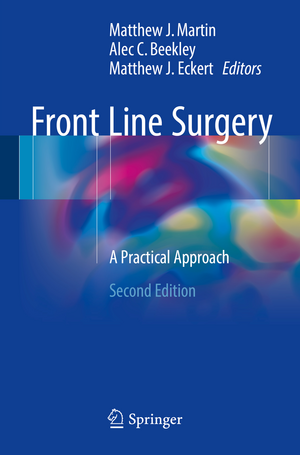
Front Line Surgery
Editat de Martin, Beekley, Matthew J. Eckerten Limba Engleză Paperback – 4 aug 2017
Actualizarea ghidurilor de intervenție în teatrele de operațiuni a devenit imperativă odată cu evoluția rapidă a tehnicilor de control al hemoragiilor și a protocoalelor de resuscitare. Putem afirma că ediția a doua a Front Line Surgery reprezintă un salt necesar de la principiile stabilite în 2011 către medicina de traumă contemporană. Subliniem integrarea tehnicilor REBOA și a metodelor endovasculare, elemente care au redefinit supraviețuirea în cazul traumatismelor penetrante severe. Ne-a atras atenția modul în care editorii Martin, Beekley și Matthew J. Eckert au reușit să distileze experiența acumulată în conflictele recente în recomandări clinice aplicabile imediat.
Structura volumului este optimizată pentru mediul de mare intensitate: fiecare capitol debutează cu secțiunea „BLUF” (Bottom Line Up Front), oferind perlele clinice esențiale înainte de a trece la discuția detaliată despre capcane și management. Progresia de la triaj și îngrijirea tactică (TC3) către intervenții chirurgicale specifice pe organe asigură o acoperire exhaustivă a traumei de luptă. Această lucrare este o alternativă la Fundamentals of Frontline Surgery pentru rezidenții care caută o rigoare academică sporită, având avantajul unei secțiuni dedicate traducerii experienței militare în practica civilă. Față de Emergency War Surgery 2014, acest volum pune un accent mai mare pe noile generații de agenți heostatici și pe managementul în situații cu trăgători activi, reflectând riscurile actuale ale chirurgiei de urgență.
Preț: 1283.49 lei
Preț vechi: 1351.05 lei
-5%
Carte disponibilă
Livrare economică 13-27 noiembrie
Specificații
ISBN-10: 3319567799
Pagini: 948
Ilustrații: XXXVI, 909 p. 381 illus., 264 illus. in color.
Dimensiuni: 155 x 235 x 48 mm
Greutate: 1.58 kg
Ediția:Second Edition 2017
Editura: Springer
Locul publicării:Cham, Switzerland
V-ar putea interesa
-
 Rich's Vascular TraumaTodd E. Rasmussen-28%Preț: 1289.59 lei1792.11 lei
 -
 Trauma Surgery Essentials: A Must-Know Guide to Emergency ManagementAnil K. Srivastava-28%Preț: 624.60 lei873.46 lei
 -
 Oh's Intensive Care ManualJonathan M. Handy-29%Preț: 692.37 lei971.74 leiRecomandat
 -
 Sabiston Textbook of Surgery: The Biological Basis of Modern Surgical PracticeDouglas Scott Tyler-29%Preț: 1169.15 lei1645.26 leiRecomandat
 -
 -28%Preț: 352.11 lei490.12 lei
 -
 -5%Preț: 638.93 lei672.56 lei
 -
 -5%Preț: 899.22 lei946.55 lei
 -
 Hamilton Bailey's Emergency SurgeryWilliam English-5%Preț: 791.65 lei833.32 lei
 -
 Atlas of Surgical Techniques in TraumaDemetrios Demetriades-5%Preț: 1216.40 lei1280.43 lei
 -
 -5%Preț: 874.87 lei920.91 lei
 -
 PHTLS: Prehospital Trauma Life Support for First Responders Course Manual, 10e Spanish EditionNational Association of Emergency Medical Technicians-5%Preț: 195.65 lei205.95 lei
 -
 -30%Preț: 981.98 lei1400.70 lei
 -
 Emergency War Surgery: The Survivalist's Medical Desk ReferenceU.S. Department of the Army-5%Preț: 115.78 lei121.88 lei
 -
 LandbridgeY-Dang TroeungPreț: 79.37 lei
 -
 -21%Preț: 1028.91 lei1309.74 lei
 -
 The Trauma Manual: Trauma and Acute Care SurgeryAndrew B. Peitzman MD, FACS-12%Preț: 533.43 lei603.03 lei
 -
 Marino's The ICU BookPaul L Marino MD, PhD-25%Preț: 537.38 lei714.12 leiRecomandat
 -
 Textbook of Polytrauma Management: A Multidisciplinary ApproachHans-Christoph Pape-5%Preț: 783.19 lei824.42 lei
 -
 Surgical Intensive Care MedicineJohn M. O'Donnell-5%Preț: 1584.98 lei1668.40 lei
 -
 Front Line Extremity and Orthopaedic Surgery: A Practical GuideLawrence B. Bone-5%Preț: 727.69 lei765.99 lei
De ce să citești această carte
Recomandăm această carte chirurgilor de traumă și medicilor de urgență care activează în medii cu resurse limitate sau în zone de conflict. Cititorul câștigă acces la protocoale militare de ultimă oră, precum REBOA, adaptate prin secțiuni speciale pentru practica civilă. Este un instrument esențial pentru decizii rapide sub presiune, oferind un echilibru între tehnici avansate și soluții pragmatice de teren.
Despre autor
Deși o coincidență de nume în datele biografice furnizate îl menționează pe un pionier al logisticii, editorul medical Martin, împreună cu echipa formată din Beekley și Matthew J. Eckert, reprezintă autoritatea de vârf în chirurgia militară americană. Aceștia sunt practicieni cu o vastă experiență în teatrele de operațiuni, contribuind la dezvoltarea Tactical Combat Casualty Care (TC3). Lucrarea de față se distinge radical de alte publicații sub nume similare prin focalizarea strictă pe discipline chirurgicale și managementul traumei, consolidând prestigiul editurii Springer în literatura medicală de specialitate.
Descriere scurtă
Cuprins
Part I. Before the Operating Room
Chapter 1. Tactical Combat Casualty Care
Frank K. Butler, Jr. and Russ S. Kotwal
Chapter 2. Combat Triage and Mass Casualty Management
Jayson D. Aydelotte, John J. Lammie, Joseph G. Kotora, Jr., Jamie C. Riesberg, and Alec C.
Beekley
Civilian Translation of Military Experience and Lessons Learned: Alec C. Beekley
Chapter 3. Initial Management Priorities: Beyond ABCDE
Daniel Grabo and Alec C. Beekley
Civilian Translation of Military Experience and Lessons Learned: Daniel Grabo
Chapter 4. Damage Control Resuscitation
Jacob R. Peschman, Donald H. Jenkins, John B. Holcomb, and Timothy C. Nunez
Civilian Translation of Military Experience and Lessons Learned: Donald H. Jenkins
Chapter 5. To Operate or Image? (Pulling the Trigger)
Matthew J. Martin and James W. Davis
Civilian Translation of Military Experience and Lessons Learned: James W. Davis
Chapter 6. Ultrasound in Combat Trauma
Michael D. Perreault, Jason D. Bothwell, and Benjamin Harrison
Part II. To the Operating Room
Chapter 7. The Bowel: Contamination, Colostomies, and Combat Surgery
Robert B. Lim, Eric K. Johnson, and Scott R. Steele
Civilian Translation of Military Experience and Lessons Learned: Scott R. Steele
Chapter 8. Liver and Spleen Injury Management in Combat
Brian Eastridge, Lorne Blackbourne, Katherine M. McBride, and James R. Dunne
Civilian Translation of Military Experience and Lessons Learned: Katherine M. McBride
and James R. Dunne
Chapter 9. Pancreatic and Duodenal Injuries (Don’t Mess with the…) Matthew T. Hueman and Thomas M. Scalea
Civilian Translation of Military Experience and Lessons Learned: Thomas M. Scalea
<
Chapter 10. Operative Management of Renal Injuries
Carlos V. R. Brown and Joseph M. Galante
Civilian Translation of Military Experience and Lessons Learned: Joseph M. Galante
Chapter 11. Major Abdominal Vascular Trauma
Niten Singh, David R. King, and David V. Feliciano
Civilian Translation of Military Experience and Lessons Learned: David V. Feliciano
Chapter 12. To Close or Not to Close: Managing the Open Abdomen
Amy Vertrees, Craig D. Shriver, and Ali Salim
Civilian Translation of Military Experience and Lessons Learned: Ali Salim
Chapter 13. Dismounted Complex Blast Injury Management
Travis M. Polk, Matthew J. Martin, and Matthew J. Eckert
Chapter 14. Thoracic Approaches and Incisions
Jeffrey A. Bailey, Philip S. Mullenix, and Jared L. Antevil
Chapter 15. Lung Injuries in Combat
Matthew J. Martin, Michael S. Meyer, and Riyad Karmy-Jones
Civilian Translation of Military Experience and Lessons Learned: Riyad Karmy-Jones
Chapter 16. Diagnosis and Management of Penetrating Cardiac Injury
Daniel G. Cuadrado and Kenji Inaba
Civilian Translation of Military Experience and Lessons Learned: Kenji Inaba
Chapter 17. Thoracic Vascular Injuries: Operative Management in “Enemy” Territory
Joseph J. DuBose, Timothy K. Williams, and Benjamin W. Starnes
Chapter 18. Chest Wall and Diaphragm Injury
Alec C. Beekley, Matthew D. Tadlock, and William B. Long Civilian Translation of Military Experience and Lessons Learned: William B. Long
Chapter 19. Soft Tissue Wounds and Fasciotomies
Mark W. Bowyer, Peter Rhee, and Joseph J. DuBose
Chapter 20. Extremity Fractures and the Mangled Extremity Brandon R. Horne, R. Judd Robins, and George Velmahos
Civilian Translation of Military Experience and Lessons Learned: George Velmahos
Chapter 21. Traumatic Amputations
Eric G. Puttler, Stephen A. Parada, Brandon R. Horne, R. Judd Robins, and James C. Krieg
Civilian Translation of Military Experience and Lessons Learned: James C. Krieg
Chapter 22. Peripheral Vascular Injuries
Robert Jason Thomas Perry and Charles J. Fox Civilian Translation of Military Experience and Lessons Learned: Charles J. Fox
Chapter 23. The Neck
John S. Oh and Demetrios Demetriades Civilian Translation of Military Experience and Lessons Learned: Demetrios Demetriades
Chapter 24. Genitourinary Injuries (Excluding Kidney)
Jack R. Walter and Andrew C. Peterson
Chapter 25. Neurosurgery for Dummies
Hans Bakken and Alex B. Valadka Civilian Translation of Military Experience and Lessons Learned: Alex B. Valadka
Chapter 26. Traumatic Brain Injury and Neurocritical Care
Stacy Shackelford, Peter Rhee, and Bellal Joseph
Civilian Translation of Military Experience and Lessons Learned: Bellal Joseph
Chapter 27. Spine Injuries
Matthew J. Martin, Ryan Gocke, and John G. DeVine
Civilian Translation of Military Experience and Lessons Learned: John G. DeVine
Chapter 28. Face and Head (Non-Ocular) Injury
Nici Eddy Bothwell
Chapter 29. Managing Eye Trauma in the Combat Environment
Morohunranti O. Oguntoye and Robert A. Mazzoli
Civilian Translation of Military Experience and Lessons Learned: Robert A. Mazzoli
Chapter 30. Burn Care in the Deployed Setting
Gary Vercruysse
Chapter 31. The Pediatric Patient in Wartime Lucas P. Neff, Philip C. Spinella, Kenneth S. Azarow, and Mubeen A. Jafri
Civilian Translation of Military Experience and Lessons Learned: Kenneth S. Azarow and Mubeen A. Jafri
Part III. Postoperative Principles and Miscellaneous Topics
Chapter 32. The Combat Hospital ICU
Kevin K. Chung and Matthew J. Eckert Civilian Translation of Military Experience and Lessons Learned: Matthew J. Eckert
Chapter 33. Postoperative Resuscitation
Richard Nahouraii, Martin Schreiber, and Andrew C. Bernard
Civilian Translation of Military Experience and Lessons Learned: Andrew C. Bernard
Chapter 34. TEG/ROTEM Driven Resuscitation in Trauma
Hunter B. Moore, Eduardo Gonzalez, and Ernest E. Moore
Chapter 35. Monitoring
Jay A. Johannigman, Alec C. Beekley, and Timothy A. Pritts
Civilian Translation of Military Experience and Lessons Learned: Timothy A. Pritts
Chapter 36. Ventilator Management: A Practical Approach to Respiratory Failure in Combat
Casualties
Anita A. Shah, Paul B. Kettle, and Alexander S. Niven
Chapter 37. Practical Approach to Combat-Related Infections and Antibiotics
Heather C. Yun and Clinton K. Murray
Chapter 38. Patient Transfer, En-route Care, and Critical Care Air Transport Team (CCATT)
Raymond Fang
Chapter 39. The Homefront: Role 4 and 5 Care
Warren C. Dorlac and Carlos J. Rodriguez
Chapter 40. Active Shooter and Intentional Mass Casualty Events Alexander L. Eastman and Matthew L. Davis
Chapter 41. Tactical Emergency Casualty Care (TECC): Principles and Practice
Geoff Shapiro, Babak Sarani, and E. Reed Smith
Chapter 42. Humanitarian and Local National Care
Matthew J. Eckert, James Sebesta, and Sherry M. Wren
Civilian Translation of Military Experience and Lessons Learned: Sherry M. Wren
Chapter 43. Expectant and End of Life Care in a Combat Zone
Robert M. Rush, Jr., Matthew J. Martin, and Christine S. Cocanour
Civilian Translation of Military Experience and Lessons Learned: Christine S. Cocanour
Chapter 44. Trauma System Development and the Joint Trauma System
Kirby R. Gross, Brian Eastridge, Jeffrey A. Bailey, and M. Margaret Knudson
Civilian Translation of Military Experience and Lessons Learned: M. Margaret Knudson
Chapter 45. The Next Generation of Hemorrhage Therapy
Vahagn Nikolian and Hasan B. Alam
Chapter 46. Resident Readiness and Training the Surgeon for Battlefield Care
Jennifer M. Gurney, Daniel W. Nelson, and C. William Schwab
Civilian Translation of Military Experience and Lessons Learned: C. William Schwab
Chapter 47. The Deployed Advanced Care Provider
Zaradhe M. S. Yach, Jonathan R. Van Horn, Matthew J. Eckert, and Matthew J. Martin
Civilian Translation of Military Experience and Lessons Learned: Matthew J. Martin
Chapter 48. Military Civilian Collaboration for National Preparedness During Peace and War
Kyle N. Remick, Eric Elster, and Raquel C. Bono
Chapter 49. Battlefield Resuscitation of the Future
Matthew J. Martin, Hasan B. Alam, and Jeremy G. Perkins
Chapter 50. Non-Conventional Forward Surgical Elements
Matthew J. Eckert, Matthew J. Martin, and Steven A. Satterly
Appendix A. Improvise, Adapt, Overcome: Field Expedient Methods in a Forward Environment
Appendix B. Burn Charts and Orders
Appendix C. Resources, References, and Readiness
Appendix D. “C” BNRE Primer for Surgeons
Notă biografică
Caracteristici
Richly illustrated with full color images illustrating difficult techniques and situations
Designed to provide the most necessary and practical knowledge needed by Surgeons working on the front lines
Includes supplementary material: sn.pub/extras