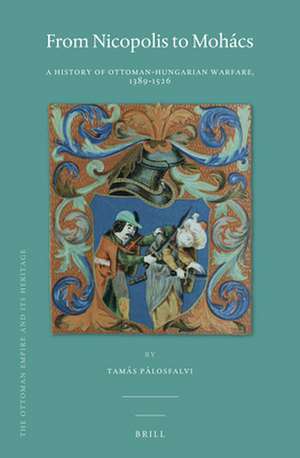
From Nicopolis to Mohács
Autor Tamás Pálosfalvien Limba Engleză Hardback – 20 sep 2018
Autorul Tamás Pálosfalvi, cercetător recunoscut al istoriei medievale, fundamentează această lucrare pe o investigație riguroasă a unor surse documentare inedite. În From Nicopolis to Mohács, acesta propune o reevaluare a confruntării dintre Regatul Ungariei și Imperiul Otoman, acoperind intervalul critic dintre 1396 și 1526. Observăm că autorul nu se limitează la o simplă cronologie a bătăliilor, ci construiește o analiză structurală a modului în care instituțiile militare maghiare s-au transformat pentru a face față celui mai constant rival european al otomanilor. Structura volumului este organizată tematic și cronologic, începând cu reformele lui Sigismund de Luxemburg și continuând cu epocile lui Iancu de Hunedoara și Matei Corvin. Un aspect distinctiv îl reprezintă demitizarea „Armatei Negre” și analiza adaptărilor sub dinastia Jagiello. Reținem efortul autorului de a explica nu doar victoriile, ci și motivele profunde care au dus la prăbușirea militară a Ungariei în 1526. Lucrarea reprezintă o alternativă academică solidă la Hungary Between Two Empires 1526-1711 de Géza Pálffy pentru cursurile de istorie a Europei Centrale, având avantajul de a se concentra strict pe mecanismele militare și pe contextul premergător divizării regatului. De asemenea, completează studiile punctuale precum cele din The Holy Wars of King Wladislas and Sultan Murad de John Jefferson, oferind o perspectivă de ansamblu pe termen lung asupra frontierei creștine.
Preț: 1041.49 lei
Preț vechi: 1352.59 lei
-23%
Carte tipărită la comandă
Livrare economică 26 noiembrie-10 decembrie
Specificații
ISBN-10: 9004365842
Pagini: 515
Dimensiuni: 157 x 236 x 30 mm
Greutate: 0.82 kg
Editura: Brill
V-ar putea interesa
-
 -23%Preț: 1273.80 lei1654.29 lei
 -
 -23%Preț: 1603.59 lei2082.59 lei
 -
 -23%Preț: 1155.09 lei1500.12 lei
 -
 A Companion to the Byzantine Culture of War, ca. 300-1204Yannis Stouraitis-23%Preț: 1601.02 lei2079.25 lei
De ce să citești această carte
Această lucrare este esențială pentru istoricii și studenții interesați de strategia militară medievală și de geopolitica Europei de Sud-Est. Cititorul câștigă o înțelegere profundă a modului în care un stat european major a rezistat presiunii otomane timp de 150 de ani. Este o resursă academică de referință, publicată de Brill, care clarifică evoluția tacticii și logisticii militare într-o eră a transformărilor radicale.
Despre autor
Tamás Pálosfalvi este un istoric specializat în perioada medievală târzie a Ungariei și a Europei Centrale. Cercetările sale se concentrează pe istoria militară, structurile sociale și familiile nobiliare din secolele XIV-XVI. Prin utilizarea extensivă a arhivelor și a documentelor de epocă, Pálosfalvi a contribuit semnificativ la înțelegerea campaniilor lui Iancu de Hunedoara și a contextului politic al Regatului Ungariei în raport cu expansiunea Imperiului Otoman. Expertiza sa este recunoscută la nivel internațional, fiind un colaborator frecvent al publicațiilor academice de prestigiu dedicate studiilor medievale.
Notă biografică
Descriere
Based on the extensive use of hitherto unexplored source material, Pálosfalvi not only offers a sound chronology of military events, but also a description of Hungarian military structures and their transformation under constant Ottoman pressure, as well as an analysis of the reasons that lay behind the military breakdown of Hungary in the third decade of the sixteenth century.
Cuprins
A Note on Spelling
Figures and Maps
Introduction
1 Hungarian Military Organization, 1387–1526
1 The Inheritance: Political and Territorial Structures
2 The Angevin Legacy
3 Sigismund and his Reforms
4 The Armies of Hunyadi
5 King Matthias – The Myth of the Black Army
6 The Jagiellos: Adaptation under Pressure
2 The New Enemy: Hungary and the Ottomans, 1389–1429
1 The First Contacts between Hungary and the Turks
2 The Battle of Nicopolis
3 From Nicopolis to Golubac
4 The Siege of Golubac
3 From Golubac to Belgrade, 1428–1456
1 The Last Years of Sigismund
2 Albert to Wladislas i – Troubled Times
3 The First Ottoman Wars of Hunyadi, 1441–1443
4 The War of Illusions: The “Long March,” 1443–1444
5 The King’s Death: The Varna Campaign
6 The Last Offensive: The Battle of Kosovo Polje, 1448
7 On the Defensive: From Kosovo Polje to Belgrade, 1448–1456
8 The Siege of Belgrade, 1456
4 From Belgrade to Vienna: King Matthias and the Ottomans, 1458–1483
1 Securing the Borders, 1458–1466
1.1 Hungary and the Fall of Serbia, 1457-1459
1.2 Conflicting Views: King Matthias and Mihály Szilágyi, 1459-1460
1.3 The Return of Mehmed ii to the North
1.4 From Jajce to Zvornik, 1463-1464
1.5 “Passive Resistance”, 1465-1466
2 Turning West, 1467–1483
2.1 The Years of Disengagement, 1467-1475
2.2 The Siege of Šabac
2.3 Transylvania, Bosnia, Otranto, 1478-1482
5 The Wars of the “Long Peace,” 1483–1520
1 The Last Years of Matthias
2 From War to Peace, 1490–1495
3 A War that Nobody Wanted, 1499–1503
4 Shifting Alliances, 1508–1511
5 Under Pressure Again, 1511–1513
6 Towards the Edge of the Abyss, 1514–1520
6 The Collapse, 1521–1526
1 The Third Siege of Belgrade, 1521
2 Preparing for the Deluge: After Belgrade, 1522–1525
3 The Final Countdown, 1525–1526
4 The Battle of Mohács
7 Conclusion: Why Did Hungary Lose?
1 The Fall of Medieval Hungary, Part One: The Superiority of Ottoman Military Organization
2 The Fall of Medieval Hungary, Part Two: A Fiscal Breakdown
Bibliography
Index
Recenzii
Robyn Dora Radway, Central European University, in Renaissance Quarterly Volume LXXIII, No. 1: 309-310