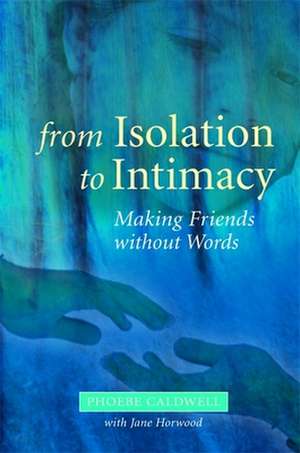
From Isolation to Intimacy: Making Friends without Words
Autor Phoebe Caldwell Contribuţii de Jane Horwooden Limba Engleză Paperback – 15 mar 2007
Prezentat sub formă de manual de bune practici, From Isolation to Intimacy propune o abordare umanistă și pragmatică a comunicării cu persoanele care nu utilizează limbajul articulat. Ne-a atras atenția modul în care Phoebe Caldwell demonstrează că barierele de comunicare în cazurile de autism sever sau dizabilități intelectuale nu sunt insurmontabile, ci necesită o recalibrare a atenției noastre către micro-semnalele non-verbale. Cartea este structurată în două secțiuni complementare: prima parte explorează fundamentele teoretice ale interacțiunii, de la gestionarea stresului la limbajul corporal, în timp ce a doua parte oferă perspective valoroase prin studii de caz ce includ copii cu autism și adulți cu paralizie cerebrală. Găsim în această lucrare o metodologie clară pentru tehnica numită Intensive Interaction, care pune accentul pe „ascultarea” activă a mișcărilor și sunetelor celuilalt pentru a stabili un contact emoțional real. From Isolation to Intimacy acoperă o arie tematică similară cu The Intensive Interaction Handbook de Dave Hewett, însă lucrarea lui Caldwell se distinge printr-o perspectivă mai intimă, axată pe transformarea izolării în participare prin empatie senzorială, mai degrabă decât pe un cadru pur pedagogic. Această ediție consolidează temele explorate de autoare în Using Intensive Interaction and Sensory Integration, unde accentul cădea pe procesarea senzorială, oferind aici instrumente concrete pentru construirea relațiilor în viața de zi cu zi.
Preț: 124.92 lei
Preț vechi: 158.22 lei
-21%
Carte disponibilă
Livrare economică 12-26 mai
Specificații
ISBN-10: 1843105004
Pagini: 188
Dimensiuni: 155 x 234 x 10 mm
Greutate: 0.31 kg
Ediția:1
Editura: JESSICA KINGSLEY PUBLISHERS
Colecția Jessica Kingsley Publishers
Locul publicării:London, United Kingdom
V-ar putea interesa
-
 The Neurotic Personality of Our TimeKaren HorneyPreț: 118.87 lei
 -
 Treatment Approaches for Alcohol and Drug DependenceTracey J Jarvis-8%Preț: 514.50 lei559.23 lei
 -
 Personality Disorders in Modern LifeTheodore Millon-9%Preț: 1303.96 lei1432.92 lei
 -
 Handbook of Posttraumatic Growth: Research and PracticeLawrence G. Calhoun-5%Preț: 730.40 lei768.84 lei
 -
 Abnormal PsychologyAlan CarrPreț: 388.67 lei
 -
 -21%Preț: 117.94 lei149.37 lei
 -
 -22%Preț: 155.60 lei199.69 lei
 -
 -22%Preț: 137.15 lei174.77 lei
 -
 -26%Preț: 416.13 lei561.15 lei
 -
 An Exceptional Children's Guide to Touch: Teaching Social and Physical Boundaries to KidsMcKinley Hunter Manasco-20%Preț: 112.76 lei141.66 lei
De ce să citești această carte
Recomandăm această carte educatorilor, terapeuților și părinților care caută o modalitate practică de a se conecta cu persoane non-verbale. Cititorul câștigă o înțelegere profundă a modului în care atenția și oglindirea limbajului corporal pot reduce comportamentele agresive și pot deschide calea către o relație bazată pe încredere. Este un ghid esențial pentru oricine dorește să transforme izolarea într-o experiență de participare socială autentică.
Despre autor
Phoebe Caldwell este un practician de renume cu o experiență de peste 35 de ani în domeniul autismului și al dizabilităților severe de învățare. A fost cercetător Rowntree și a primit prestigiosul premiu Times/Sternberg în 2009 pentru munca sa de pionierat în tratamentul autismului. Expertiza sa este recunoscută la nivel academic și clinic, fiind solicitată frecvent de serviciile de sănătate britanice (NHS) pentru intervenții în cazuri complexe. Activitatea sa se concentrează pe perfecționarea metodei Intensive Interaction, oferind cursuri de formare pentru personal medical și aparținători din întreaga lume.
Descriere
This is the key to Intensive Interaction, which she shows is a straightforward and uncomplicated way, through attending to body language and other non-verbal means of communication, of establishing contact and building a relationship with people who are non-verbal, even those in a state of considerable distress. This simple method is accessible to anyone who lives or works with such people, and is shown to transform lives and to introduce a sense of fun, of participation and of intimacy, as trust and familiarity are established.
Recenzii
With over thirty years of experiences, Phoebe's enthusiasm is clear from beginning to end.
In short, this is a wonderful book - it challenges current thinking, it makes you want to go straight up to the next person you meet who has communication difficulties and try out the approaches she suggests. It is early days, but if evidence can be produced to support her theories this may just come to be regarded as a book that changed the world.
This book reminds us of the 'intuitive' in therapy. Intensive Interaction is all about affect, about interpersonal contact and about affect, about valuing the person's communicative attempts.This book explains simply and effectively how use of imitation and repetition of body language, sounds and movements might change the focus of attention in an adult with autism/learning difficulties from a self-centred to an other-centred one.
This book is about how we get in touch with people who, in the words of the author, "are separated from us because they cannot tell us what they want, or perhaps more importantly, how they feel". It is a beautifully written endorsement of the universal importance of emotional needs such as intimacy and social connection, irrespective of an individual's ability to communicate with others. It introduces communication as a prerequisite to all intimacy, and makes the point that communication at "deeper" levels is not verbal but physical, tactile or visual: a look, a nod, a smile - a feeling of safety with another person. In this respect, this book has applicability and value beyond those for whom it was written this book's strength is its emphasis on improving the quality of life - identifying and meeting needs - of people who are in one way or another isolated by their disability.