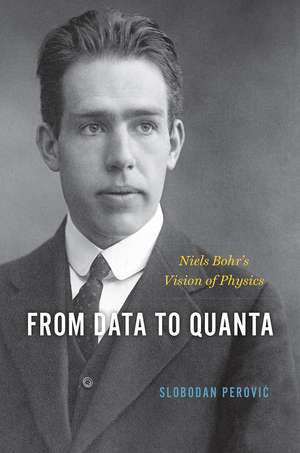
From Data to Quanta: Niels Bohr’s Vision of Physics
Autor Slobodan Perovicen Limba Engleză Hardback – oct 2021
Evoluția istoriei și filosofiei științei din ultimele decenii a marcat o tranziție clară de la analiza teoriilor ca entități abstracte către înțelegerea modului în care practica experimentală modelează conceptele fundamentale. În lucrarea From Data to Quanta, Slobodan Perovic reflectă această schimbare de paradigmă, oferind prima relatare cuprinzătoare a fundamentelor experimentale care au susținut viziunea lui Niels Bohr asupra fizicii. Ne-a atras atenția modul în care autorul reușește să demonstreze că filosofia lui Bohr nu a fost o construcție metafizică izolată, ci un rezultat direct al angajamentului său profund cu latura empirică a fenomenelor cuantice.
Apreciem structura riguroasă a volumului, care ghidează cititorul prin progresia intelectuală a lui Bohr, de la primele modele atomice bazate pe linii spectrale, până la stabilirea complementarității. Cartea extinde cadrul propus de Niels Bohr and the Philosophy of Physics de Jan Faye cu date noi extrase din contextul istoric al laboratoarelor epocii, oferind o perspectivă mai tehnică asupra 'ipotezelor intermediare'. Spre deosebire de lucrările care se concentrează strict pe interpretarea de la Copenhaga, Slobodan Perovic analizează rolul lui Bohr ca 'moderator științific' și modul în care acesta a navigat între formalismul matematic și realitatea experimentală.
Observăm că această lucrare continuă preocuparea autorului pentru construcția teoriilor științei, temă centrală și în The Cosmic Microwave Background. Dacă în lucrarea anterioară Slobodan Perovic investiga factorii epistemologici din spatele teoriei Big Bang, aici aplică aceeași rigoare pentru a decoda metoda de cercetare a lui Bohr. Volumul este organizat în patru părți esențiale: preliminarii experimentale, vechea teorie cuantică, drumul către mecanica cuantică modernă și, în final, maturitatea lui Bohr în fața provocărilor lansate de Einstein. Este o resursă academică ce recalibrează înțelegerea noastră asupra modului în care datele brute devin cuante.
Preț: 361.55 lei
Carte disponibilă
Livrare economică 28 octombrie-11 noiembrie
Livrare express 14-20 octombrie pentru 38.42 lei
Specificații
ISBN-10: 022679833X
Pagini: 240
Ilustrații: 8 halftones, 1 line drawing
Dimensiuni: 152 x 229 x 28 mm
Greutate: 0.48 kg
Ediția:First Edition
Editura: University of Chicago Press
Colecția University of Chicago Press
De ce să citești această carte
Această lucrare este esențială pentru cercetătorii și studenții la filosofie sau fizică ce doresc să înțeleagă nu doar 'ce' a gândit Niels Bohr, ci 'cum' a ajuns la acele concluzii. Cititorul câștigă o perspectivă rară asupra simbiozei dintre experiment și teorie, descoperind un Bohr mai ancorat în realitatea laboratorului decât cel prezentat în manualele clasice. Este o invitație la a redescoperi fundamentele mecanicii cuantice printr-o lentilă istorică și metodologică precisă.
Despre autor
Slobodan Perovic este un distins filosof al științei, cunoscut pentru abordările sale interdisciplinare care combină rigoarea istorică cu analiza conceptuală. În cariera sa, s-a concentrat pe modul în care comunitățile științifice dezvoltă și validează teorii complexe, un exemplu notabil fiind lucrarea sa The Cosmic Microwave Background, care explorează interpretarea radiației cosmice de fond. Prin volumul From Data to Quanta, publicat la University of Chicago Press, Perovic își consolidează poziția de expert în studiul metodologiei lui Niels Bohr, oferind o perspectivă nuanțată asupra tranziției de la fizica clasică la cea cuantică.
Descriere scurtă
Niels Bohr was a central figure in quantum physics, well known for his work on atomic structure and his contributions to the Copenhagen interpretation of quantum mechanics. In this book, philosopher of science Slobodan Perović explores the way Bohr practiced and understood physics, and analyzes its implications for our understanding of modern science. Perović develops a novel approach to Bohr’s understanding of physics and his method of inquiry, presenting an exploratory symbiosis of historical and philosophical analysis that uncovers the key aspects of Bohr’s philosophical vision of physics within a given historical context.
To better understand the methods that produced Bohr’s breakthrough results in quantum phenomena, Perović clarifies the nature of Bohr’s engagement with the experimental side of physics and lays out the basic distinctions and concepts that characterize his approach. Rich and insightful, Perović’s take on the early history of quantum mechanics and its methodological ramifications sheds vital new light on one of the key figures of modern physics.
Notă biografică
Cuprins
Part 1: Preliminaries
2 From Laboratory to Theory
3 From Classical Experiments to Quantum Theory
Part 2: Bohr’s Vision in Practice: the Old Quantum Theory
4 Spectral Lines, Quantum States, and a Master Model of the Atom
5 The Correspondence Principle as an Intermediary Hypothesis
6 Reception
7 The Scientific Moderator
Part 3: Toward Quantum Mechanics
8 Quantum Corpuscles, Quantum Waves, and the Experiments
9 The Uncertainty Principle as an Intermediary Hypothesis
10 Metaphysical Principles and Heuristic Rules
11 New Formalisms and Bohr’s Atom
12 Complementarity Established and Applied
Part 4: Aftermath
13 Bohr and the “Copenhagen Orthodoxy”
14 Bohr’s Response to the Einstein-Podolsky-Rosen Argument
15 The Mature Bohr and the Rise of Slick Theory and Theoreticians
Acknowledgments
Bibliography
Index