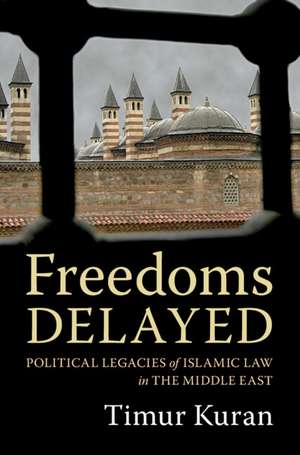
Freedoms Delayed
Autor Timur Kuranen Limba Engleză Hardback – 20 iul 2023
Orientul Mijlociu rămâne, conform indicilor internaționali, cea mai puțin liberă regiune a lumii, o realitate care alimentează dezbateri aprinse despre rolul religiei în guvernare. În Freedoms Delayed, Timur Kuran depășește dihotomia simplistă dintre secularism și religiozitate pentru a investiga cum instituțiile istorice islamice au modelat arhitectura politică actuală. Reținem din această analiză riguroasă că problema nu rezidă neapărat în dogmă, ci în mecanismele juridice și sociale — cum ar fi sistemul 'Waqf' — care au limitat formarea unor organizații autonome capabile să limiteze puterea statului. Pe linia practică a lucrării Islam Instrumentalized, dar cu un focus distinct pe persistența atomizării sociale și a impotenței politice a antreprenorilor, Kuran demonstrează cum statele au rămas nesupravegheate de o societate civilă robustă. Această lucrare continuă cercetările profunde începute în The Long Divergence și Islam and Mammon, unde autorul a explorat decalajele economice, de data aceasta mutând centrul de greutate către libertățile civile și politice. Structura cărții este una progresivă: pornește de la fața autoritară a regiunii, analizează blocajele istorice ale ONG-urilor și represiunea religioasă, culminând cu o examinare a guvernanței economice precare. Găsim în aceste pagini o demonstrație a faptului că, deși premisele pentru o ordine liberală există în istoria regiunii, moștenirea instituțională a creat un parcurs dificil de inversat fără reforme structurale profunde.
Preț: 273.36 lei
Carte tipărită la comandă
Livrare economică 20 noiembrie-04 decembrie
Specificații
ISBN-10: 1009320017
Pagini: 450
Dimensiuni: 155 x 233 x 32 mm
Greutate: 0.79 kg
Editura: Cambridge University Press
Locul publicării:New York, United States
De ce să citești această carte
Veți înțelege de ce democrația a întâmpinat obstacole majore în Orientul Mijlociu dintr-o perspectivă economică și politică, nu doar culturală. Este o lectură esențială pentru cei care doresc să depășească clișeele despre islam și să descopere mecanismele concrete — de la corupția fundațiilor la marginalizarea antreprenorilor — care au permis consolidarea autoritarismului. Câștigați o viziune clară asupra modului în care trecutul juridic influențează libertățile de astăzi.
Despre autor
Timur Kuran este profesor de economie și științe politice, deținând totodată catedra „Gorter Family” de studii islamice la Duke University. Recunoscut la nivel internațional pentru abordările sale interdisciplinare, Kuran analizează evoluția instituțiilor din lumea musulmană prin prisma teoriei economice. Opera sa, care include titluri de referință precum The Long Divergence, explorează motivele pentru care Orientul Mijlociu a rămas în urma Occidentului din punct de vedere economic și politic, fiind considerat unul dintre cei mai importanți experți contemporani în istoria instituțională a islamului.
Descriere scurtă
Cuprins
Recenzii
'In the past decade, Timur Kuran has revolutionalized our understanding of the economic development in the Middle East. Now he turns to politics. This book is compulsory reading for anyone who wants to understand the modern world.' James A. Robinson, University of Chicago
'Freedoms Delayed is a must-read for anyone who wants to understand why the struggle for political rights has been so contentious in the modern Middle East. In this powerful book, Kuran makes the case for the importance of deeply-rooted legacies of Islamic law as a key determinant of political freedom today.' Lisa Blaydes, Stanford University
'The Middle East is the least free part of the modern world. In this tour de force, Timur Kuran rigorously probes the sources of this problem, and objectively exposes its roots in the Islamic tradition…' Mustafa Akyol, Senior Fellow at the Cato Institute