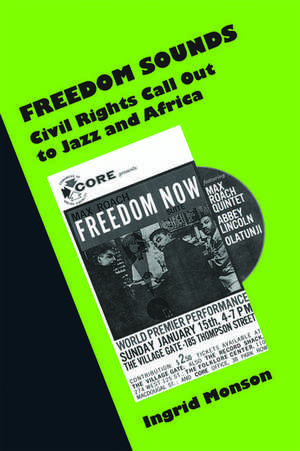
Freedom Sounds: Civil Rights Call out to Jazz and Africa
Autor Ingrid Monsonen Limba Engleză Paperback – 25 noi 2010
Provenind din arhiva riguroasă a Oxford University Press, volumul Freedom Sounds ne propune o incursiune senzorială în peisajul politic și sonor al Americii de la mijlocul secolului XX. Descoperim aici nu doar o istorie a muzicii, ci o analiză profundă a modului în care jazz-ul a devenit vocea mișcărilor pentru drepturi civile și a luptei pentru independență în Africa. Ingrid Monson reușește să capteze tensiunea acelor decenii, transformând lectura într-o experiență care depășește sfera academică prin integrarea a 32 de ilustrații și desene care oferă o dimensiune tactilă și vizuală contextului istoric.
Notăm cu interes modul în care autoarea navighează între estetică și activism, de la scenele cluburilor de jazz segregate până la marile turnee internaționale. Colecționarii care au apreciat Freedom Is, Freedom Ain′t – Jazz and the Making of the Sixties de Scott Saul vor găsi aici aceeași calitate de reproducere a atmosferei de epocă și o rigoare similară în documentarea impactului social. În timp ce alte lucrări se concentrează pe biografiile individuale, Monson pune accent pe „agenția estetică” a muzicienilor, arătând cum genuri precum hard bop sau modal jazz au fost influențate direct de nevoia de autodeterminare.
Această lucrare continuă direcțiile explorate de autoare în volumele sale anterioare, precum Saying Something, unde analiza secția ritmică în jazz, sau The African Diaspora, unde investiga legăturile transatlantice. Freedom Sounds reprezintă însă punctul culminant al cercetării sale, oferind o perspectivă integrată asupra modului în care muzica poate transcende realitățile economice și rasiale pentru a genera o critică socială durabilă.
Preț: 307.36 lei
Preț vechi: 367.55 lei
-16%
Carte tipărită la comandă
Livrare economică 13-24 noiembrie
Specificații
ISBN-10: 0199757097
Pagini: 416
Ilustrații: 16 halftones and 16 line drawings
Dimensiuni: 229 x 152 x 24 mm
Greutate: 0.61 kg
Editura: Oxford University Press
Colecția OUP USA
Locul publicării:New York, United States
V-ar putea interesa
-
 Below the Radar: How Silence Can Save Civil RightsAlison L. Gash-28%Preț: 427.82 lei595.48 lei
 -
 Globalizing Rights: The Oxford Amnesty Lectures 1999Matthew J. Gibney-17%Preț: 199.07 lei239.19 lei
 -
 -14%Preț: 222.53 lei258.99 lei
 -
 A Political Theory of RightsAttracta Ingram-28%Preț: 344.94 lei481.73 lei
 -
 Inside Immigration DetentionMary Bosworth-22%Preț: 413.99 lei533.82 lei
 -
 -23%Preț: 550.83 lei717.50 lei
 -
 -28%Preț: 452.25 lei631.50 lei
 -
 Citizenship and Immigration in Postwar BritainRandall Hansen-33%Preț: 708.47 lei1052.77 lei
 -
 Citizenship and the EnvironmentAndrew Dobson-31%Preț: 541.20 lei789.90 lei
 -
 -11%Preț: 382.35 lei431.47 lei
 -
 -20%Preț: 62.08 lei77.93 lei
 -
 CitizenshipÉtienne BalibarPreț: 149.34 lei
 -
 Speakers CorneredPhilip WolmuthPreț: 114.42 lei
 -
 -18%Preț: 759.07 lei925.70 lei
 -
 The Barefoot LawyerChen Guangcheng-25%Preț: 94.78 lei125.94 lei
 -
 The Muslims Are ComingArun KundnaniPreț: 190.35 lei
 -
 -19%Preț: 141.78 lei174.45 lei
De ce să citești această carte
Recomandăm această carte pasionaților de muzicologie și istorie culturală care doresc să înțeleagă jazz-ul dincolo de notele muzicale. Cititorul câștigă o perspectivă clară asupra modului în care arta devine instrument politic, totul într-un format elegant, îmbogățit cu ilustrații rare. Este o resursă esențială pentru a înțelege rădăcinile activismului în muzica afro-americană și influența sa globală.
Despre autor
Ingrid Monson este profesor de muzică afro-americană (Quincy Jones Professor) la Universitatea Harvard, deținând o numire comună în departamentele de Muzică și Studii Afro-Americane. Expertiza sa vastă în etnomuzicologie și antropologie este susținută de Time Warner Endowment. De-a lungul carierei, s-a specializat în analiza improvizatizației și a diasporei africane, fiind o voce autoritară în studiul intersecției dintre politică, rasă și estetică muzicală, aspecte care definesc întreaga sa operă academică.
Descriere
Recenzii
In this brilliant, polyphonic rendering of the relationship of jazz to the civil rights movement, Monson offers a compelling account of the interplay of music, race, and aesthetic modernism in American history. The music itself is never tangential to her story; on the contrary, we see how it came to embody the very ethos of the struggle and the presumptions that nurtured it. Monson insists that jazz exemplifies the faith that inspired performance can break beyond existing artistic and social constraints, that it offers a vision of history relevant way beyond its time and place. The same might be said of this extraordinary book.