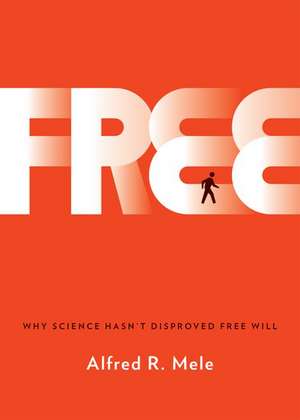
Free: Why Science Hasn't Disproved Free Will
Autor Alfred R. Meleen Limba Engleză Hardback – 13 noi 2014
Preț: 108.85 lei
Preț vechi: 139.26 lei
-22%
Puncte Express: 163
Carte tipărită la comandă
Livrare economică 10-21 iulie
Livrare prin curier în România Termenul estimat este afișat lângă disponibilitate.
Transport gratuit de la 400.00 lei Plată online sau ramburs, în funcție de opțiunile comenzii.
Retur gratuit în 14 zile Comandă securizată și suport în română.
Specificații
ISBN-13: 9780199371624
ISBN-10: 0199371628
Pagini: 112
Dimensiuni: 136 x 190 x 15 mm
Greutate: 0.21 kg
Editura: Oxford University Press
Colecția OUP USA
Locul publicării:New York, United States
ISBN-10: 0199371628
Pagini: 112
Dimensiuni: 136 x 190 x 15 mm
Greutate: 0.21 kg
Editura: Oxford University Press
Colecția OUP USA
Locul publicării:New York, United States
V-ar putea interesa
-
 Surrounding Free Will: Philosophy, Psychology, NeuroscienceAlfred R. Mele-6%Preț: 571.76 lei608.39 lei
 -
 Replacing TruthKevin Scharp-27%Preț: 618.27 lei845.64 lei
 -
 Epistemic Norms: New Essays on Action, Belief, and AssertionClayton Littlejohn-33%Preț: 539.14 lei809.10 lei
 -
 The Aim of BeliefTimothy Chan-34%Preț: 645.75 lei974.47 lei
 -
 -33%Preț: 655.62 lei985.37 lei
 -
 -10%Preț: 285.40 lei316.11 lei
 -
 The A Priori in PhilosophyAlbert Casullo-33%Preț: 596.72 lei895.43 lei
 -
 Effective Intentions: The Power of Conscious WillAlfred R. Mele-10%Preț: 279.61 lei310.19 lei
 -
 Unruly Words: A Study of Vague LanguageDiana Raffman-11%Preț: 385.70 lei433.38 lei
 -
 Causation and its Basis in Fundamental PhysicsDouglas Kutach-34%Preț: 595.33 lei899.67 lei
 -
 Idea of the World, TheBernardo KastrupPreț: 114.63 lei
Recenzii
A must read for all who are concerned with free will.
Both serious and fun
Short and businesslike... a model of accessible philosophical argument
... his book is a model of accessible philosophical argument.
Alfred Mele's beautifully written and easily accessible book is a perfect tonic to the many recent claims by scientists that there is no such thing as free will. Mele has written a book for everyone, including specialists in the sciences and in philosophy, as well as a much wider audience. Indeed, any thoughtful layperson will profit from reading this book, learning first why a range of scientific studies are taken to prove that no one has free will, and then why these studies actually fail to do so. Free is interdisciplinary inquiry at its finest. Mele truly shows how contemporary philosophy and the sciences can learn from one another, and why doing so is so very enriching.
Mele provides a devastating critique of the typical grounds for skepticism about free will that arise from work in neuroscience and psychology. Even better, Mele's discussion is straightforward and accessible to non-specialists and specialists alike. It is the first thing anyone should read to get a sense of the state of play on the relevance of science to questions of free will.
As director of the Big Questions on Free Will project and author of many books on the topic, Al Mele has been at the forefront of contemporary philosophers exploring the implications of recent research in neuroscience and psychology for philosophical debates about free will. In Free, he surveys the key results of these explorations in an accessible book that will engage students and non-specialists, while at the same time providing a useful overview of the issues for specialists as well. New research in neuroscience and psychology forces us to refine our thinking about free will. But Mele makes a strong case that this research does not undermine all modern views about it, and he does so in straightforward, understandable discussions of the research and its implications in this short, informative book.
Whether readers agree with [the] conclusion, they will in any event be stimulated by the arguments in this lucid and accessible book.
Both serious and fun
Short and businesslike... a model of accessible philosophical argument
... his book is a model of accessible philosophical argument.
Alfred Mele's beautifully written and easily accessible book is a perfect tonic to the many recent claims by scientists that there is no such thing as free will. Mele has written a book for everyone, including specialists in the sciences and in philosophy, as well as a much wider audience. Indeed, any thoughtful layperson will profit from reading this book, learning first why a range of scientific studies are taken to prove that no one has free will, and then why these studies actually fail to do so. Free is interdisciplinary inquiry at its finest. Mele truly shows how contemporary philosophy and the sciences can learn from one another, and why doing so is so very enriching.
Mele provides a devastating critique of the typical grounds for skepticism about free will that arise from work in neuroscience and psychology. Even better, Mele's discussion is straightforward and accessible to non-specialists and specialists alike. It is the first thing anyone should read to get a sense of the state of play on the relevance of science to questions of free will.
As director of the Big Questions on Free Will project and author of many books on the topic, Al Mele has been at the forefront of contemporary philosophers exploring the implications of recent research in neuroscience and psychology for philosophical debates about free will. In Free, he surveys the key results of these explorations in an accessible book that will engage students and non-specialists, while at the same time providing a useful overview of the issues for specialists as well. New research in neuroscience and psychology forces us to refine our thinking about free will. But Mele makes a strong case that this research does not undermine all modern views about it, and he does so in straightforward, understandable discussions of the research and its implications in this short, informative book.
Whether readers agree with [the] conclusion, they will in any event be stimulated by the arguments in this lucid and accessible book.
Notă biografică
Alfred R. Mele is the William H. and Lucyle T. Werkmeister Professor of Philosophy at Florida State University. He is the author of eight previous Oxford books, including Free Will and Luck (2006), Effective Intentions (2009), Backsliding (2012), and A Dialogue on Free Will and Science (2013). He also is the editor or co-editor of five OUP books, including The Philosophy of Action (1997) and Free Will and Consciousness: How Might They Work? (2010).