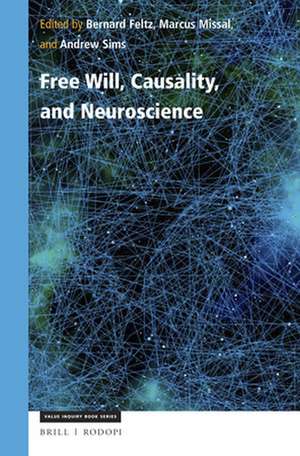
Free Will, Causality, and Neuroscience
en Limba Engleză Hardback – noi 2019
Preț: 688.58 lei
Preț vechi: 894.25 lei
-23%
Puncte Express: 1033
Carte tipărită la comandă
Livrare economică 05-19 iunie
Specificații
ISBN-13: 9789004372917
ISBN-10: 9004372911
Pagini: 184
Dimensiuni: 158 x 238 x 16 mm
Greutate: 0.4 kg
Editura: Brill
ISBN-10: 9004372911
Pagini: 184
Dimensiuni: 158 x 238 x 16 mm
Greutate: 0.4 kg
Editura: Brill
Cuprins
Acknowledgements
The Authors
Introduction
Bernard Feltz, Marcus Missal and Andrew Sims
1 Perceptual Decision-Making and Beyond: Intention as Mental Imagery
Andrew Sims and Marcus Missal
2 Dual-System Theory and the Role of Consciousness in Intentional Action
Markus Schlosser
3 When Do Robots Have Free Will? Exploring the Relationships between (Attributions of) Consciousness and Free Will
Eddy Nahmias, Corey Allen and Bradley Loveall
4 Free Will and Neuroscience: Decision Times and the Point of No Return
Alfred Mele
5 Why Libet-Style Experiments Cannot Refute All Forms of Libertarianism
László Bernáth
6 Actions and Intentions
Sofia Bonicalzi
7 The Mental, the Physical, and the Informational
Anna Drozdzewska
8 Free Will, Language, and the Causal Exclusion Problem
Bernard Feltz and Olivier Sartenaer
Index of Authors
Index of Concepts
The Authors
Introduction
Bernard Feltz, Marcus Missal and Andrew Sims
Part 1: Intention and Consciousness
1 Perceptual Decision-Making and Beyond: Intention as Mental Imagery
Andrew Sims and Marcus Missal
2 Dual-System Theory and the Role of Consciousness in Intentional Action
Markus Schlosser
3 When Do Robots Have Free Will? Exploring the Relationships between (Attributions of) Consciousness and Free Will
Eddy Nahmias, Corey Allen and Bradley Loveall
Part 2: Libet-Style Experiments
4 Free Will and Neuroscience: Decision Times and the Point of No Return
Alfred Mele
5 Why Libet-Style Experiments Cannot Refute All Forms of Libertarianism
László Bernáth
6 Actions and Intentions
Sofia Bonicalzi
Part 3: Causality and Free Will
7 The Mental, the Physical, and the Informational
Anna Drozdzewska
8 Free Will, Language, and the Causal Exclusion Problem
Bernard Feltz and Olivier Sartenaer
Index of Authors
Index of Concepts
Notă biografică
Bernard Feltz, MD in Biology (1976) and PhD in Philosophy (1986), is Emeritus Professor at the Université catholique de Louvain, Belgium. He has published many articles and books on the philosophy of biology, including Self-Organization and Emergence in Life Sciences (Springer, 2006).
Marcus Missal is Professor of Neurosciences at the Université catholique de Louvain (Belgium) where he obtained a PhD in Sciences in 1994. His area of interests are time perception in humans and animals, anticipation, and eye movements. He is an expert electrophysiologist and behavioral neuroscientist.
Andrew Sims obtained a PhD in Philosophy from Deakin University in 2015 with a dissertation on the explanation of psychological delusion after brain damage. He writes on topics in the philosophy of mind ranging from the psychogenic explanation of monomania to the explanation of social polarisation in terms of rational choice theory. His contribution to this book is linked to a post-doctoral stay at the Université catholique de Louvain, Belgium.
Marcus Missal is Professor of Neurosciences at the Université catholique de Louvain (Belgium) where he obtained a PhD in Sciences in 1994. His area of interests are time perception in humans and animals, anticipation, and eye movements. He is an expert electrophysiologist and behavioral neuroscientist.
Andrew Sims obtained a PhD in Philosophy from Deakin University in 2015 with a dissertation on the explanation of psychological delusion after brain damage. He writes on topics in the philosophy of mind ranging from the psychogenic explanation of monomania to the explanation of social polarisation in terms of rational choice theory. His contribution to this book is linked to a post-doctoral stay at the Université catholique de Louvain, Belgium.