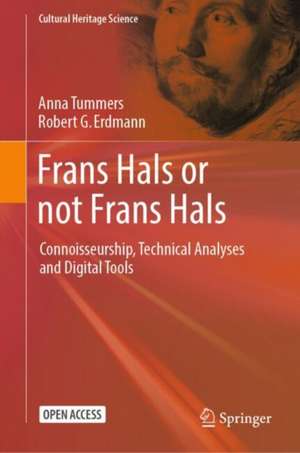
Frans Hals or not Frans Hals: Cultural Heritage Science
Autor Anna Tummers, Robert G. Erdmannen Limba Engleză Hardback – 20 ian 2025
Noua ediție 2024 a volumului Frans Hals or not Frans Hals marchează un punct de cotitură în studiul artei olandeze, propunând o metodologie hibridă care depășește limitele tradiționale ale expertizei de artă. Remarcăm faptul că această lucrare nu se limitează la o analiză stilistică subiectivă, ci integrează pentru prima dată instrumente de vizualizare digitală de ultimă generație și analize tehnice complexe pentru a naviga prin labirintul de atribuiri și dezbateri juridice ce înconjoară opera lui Hals. Cititorii familiarizați cu The Signature Style of Frans Hals de Christopher D.M. Atkins vor aprecia modul în care acest nou volum extinde discuția despre tehnica picturală a maestrului, trecând de la semnificația estetică a tușei la validarea ei prin date concrete și științifice. Structura cărții reflectă o progresie logică de la fundamentele teoretice ale expertizei („connoisseurship”) către aplicații practice riguroase. Primele capitole analizează sursele scrise din secolul al XVII-lea și tehnicile de laborator, în timp ce secțiunile centrale explorează conceptul de „ochi digital îmbunătățit”, demonstrând cum algoritmii pot asista ochiul uman în identificarea specificului atelierului lui Hals. Subliniem contribuția colectivă a experților de la universități de renume (Ghent, Leiden, Delft) și muzee de talie mondială precum Rijksmuseum sau Metropolitan Museum of Art. Lucrarea reușește să clarifice procesul de lucru virtuos al artistului și noțiunea sa de autenticitate, oferind un model de cercetare interdisciplinară. Spre deosebire de abordările monografice clasice, acest volum din seria Cultural Heritage Science transformă incertitudinea istorică într-un studiu de caz riguros despre intersecția dintre patrimoniu și tehnologie.




Preț: 403.76 lei
Carte disponibilă
Livrare economică 09-23 noiembrie
Livrare express 23-29 octombrie pentru 47.04 lei
Specificații
ISBN-10: 3031594886
Pagini: 288
Ilustrații: Approx. 200 p.
Dimensiuni: 242 x 159 x 20 mm
Greutate: 0.64 kg
Ediția:2024 edition
Editura: Springer International Publishing AG
Colecția Cultural Heritage Science
Seria Cultural Heritage Science
Locul publicării:Cham, Switzerland
De ce să citești această carte
Această lucrare este esențială pentru istoricii de artă, curatori și studenții care doresc să înțeleagă viitorul expertizei în artă. Cititorul câștigă acces la studii de caz recente asupra unor tablouri disputate, învățând cum tehnologia digitală și analiza chimică pot confirma sau infirma paternitatea unei opere. Este un ghid metodologic indispensabil pentru oricine este interesat de autenticitatea operelor lui Frans Hals și de dinamica atelierelor din Epoca de Aur olandeză.
Despre autor
Editorii și contribuitorii acestui volum, printre care se numără Anna Tummers și Robert G. Erdmann, reprezintă o elită academică formată din prieteni, colegi și discipoli ai renumitului Ernst van de Wetering. Aceștia continuă tradiția riguroasă de cercetare a maestrului lor, aplicând standardele înalte de analiză tehnică dezvoltate în cadrul studiilor despre Rembrandt asupra operei lui Frans Hals. Expertiza lor combinată acoperă istoria artei, conservarea și științele computaționale, reflectând o abordare modernă și colaborativă în cadrul seriei Cultural Heritage Science de la Springer International Publishing AG.
Cuprins
Notă biografică
Previously, she worked in the museum world for over 15 years. She was a research assistant at the Print Room, The Royal Library in Windsor Castle, England in 1999-2000, an assistant curator at National Gallery of Art in Washington D.C. from 2000-2003, and curator of old master paintings at the Frans Hals Museum from 2008-2020. She is a specialist in authenticity research and has led and co-led two Dutch Science Foundation (NWO) Projects focused around Frans Hals attribution issues, assessing various technical research methods as well as advanced data visualization tools: Frans Hals or not Frans Hals (2016-2018) and 21ST Century Connoisseurship (2018-2022 led together with Prof. Robert Erdmann). She has also done classified research for the French Ministry of Justice for a large court case that will shortly commence in France. She has published a total of 12 books and 251 articles and entries.
Prof. dr. Robert G. Erdmann - Prior to earning his Ph.D. from the University of Arizona in 2006, Robert Erdmann started a science and engineering software company and worked extensively on solidification and multiscale transport modeling at Sandia National Laboratories. He subsequently joined the faculty at the University of Arizona in the Program in Applied Mathematics and the Department of Materials Science and Engineering as Assistant Professor and then Associate Professor, where he worked on multiscale material process modeling and image processing for cultural heritage. In 2011 he was named University of Arizona Teacher of the Year and was named a Faculty Teaching Fellow. After a 2013 Resident Fellowship at the Netherlands Institute for Advanced Study, he moved permanently to Amsterdam in 2014 to focus full time on combining materials science, imaging science, and computer science to help the world access, understand, and preserve its cultural heritage. From 2014 to 2016, he was Special Professor for the Visualization of Art History at Radboud University. He has been Senior Scientist at the Rijksmuseum since 2014, and is also Full Professor of Conservation Science in the Faculties of Science and of Humanities at the University of Amsterdam. He is a recipient of the Europa Nostra Award (Grand Prix), the highest prize for cultural heritage in the European Union for work on the Bosch Research and Conservation Project. He is the inventor of the “Curtain Viewer” visualization technique and has done extensive work applying machine learning and artificial intelligence to huge datasets in cultural heritage, including the creation of a 717 gigapixel image of Rembrandt’s Night Watch.
With Contributions by:
Andrei Anisimov
Silvia Centeno
Joris Dik
Nouchka De Keyser
Roger Groves
Babette Hartwieg
Erma Hermens
Katja Kleinert
Annelies van Loon
Dorothy Mahon
Claudia Laurenze-Landsberg
Vassilis Papadakis
Arie Wallert
Textul de pe ultima copertă
In this Open Access book, experts from Ghent University, Leiden University, Amsterdam University, Delft University of Technology, the Frans Hals Museum (Haarlem), the Rijksmuseum (Amsterdam), the Gemäldegalerie (Berlin) and the Metropolitan Museum of Art (New York) give surprising new insights into some of Hals’s most well-known paintings as well as into some of the most fiercely contested pictures in his style. Their insights result from in-depth study of a wealth of reference material: seventeenth-century sources, advanced technical analyses and newly developed digital visualisation tools.
“Tummers and Erdmann have produced a work of ground-breaking new scholarship. They combine in-depth art historical study with new technical analyses and data visualisation tools in order to solve current issues in the attribution of paintings by Frans Hals. This book significantly sharpens our understanding of Hals’s virtuoso work process, his characteristic workshop practice, and his notion of authenticity. The rich data gathered for the case studies will be useful for a next generation of art historians and connoisseurs: digital tools enhance the human eye in matters of attribution.”
Prof. Thijs Weststeijn, Professor of Art History before 1800, Utrecht University
Tummers bravely interrogates the history of connoisseurship and the seemingly never-ending search for attributions of paintings associated with Frans Hals. A series of well-chosen case studies of paintings rigorously subjected to the most current means of examination and scientific imaging by leading experts in the field extends our understanding of Hals, his manner of painting, and the possibilities for aligning traditional connoisseurship with technical studies and techniques. In the process, this book thoughtfully probes the merits, challenges, and potential of 21st-century digital tools alongside the role of visual analysis.
Christopher D.M. Atkins, Van Otterloo-Weatherbie Director of the Center for Netherlandish Art at the Museum of Fine Arts, Boston