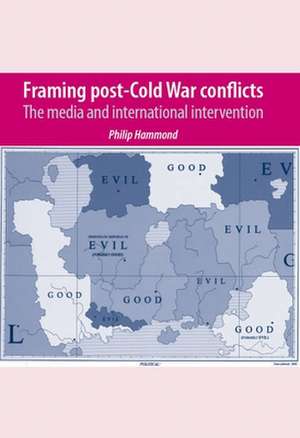
Framing Post-Cold War Conflicts
Autor Philip Hammonden Limba Engleză Hardback – dec 2007
Preț: 552.97 lei
Preț vechi: 779.58 lei
-29%
Puncte Express: 829
Carte indisponibilă temporar
Doresc să fiu notificat când acest titlu va fi disponibil:
Se trimite...
Specificații
ISBN-13: 9780719076961
ISBN-10: 071907696X
Pagini: 256
Dimensiuni: 163 x 239 x 25 mm
Greutate: 0.55 kg
Editura: MANCHESTER UNIVERSITY PRESS
ISBN-10: 071907696X
Pagini: 256
Dimensiuni: 163 x 239 x 25 mm
Greutate: 0.55 kg
Editura: MANCHESTER UNIVERSITY PRESS
V-ar putea interesa
-
 Journalism Studies: A Critical IntroductionAndrew CalcuttPreț: 387.49 lei
 -
 The Violence of AusterityDavid WhytePreț: 156.38 lei
 -
 United States of JihadPeter BergenPreț: 124.24 lei
 -
 Contested Knowledge - Social Theory Today 6eSteven SeidmanPreț: 450.85 lei
 -
 War With Russia: The urgent warning from senior military commandGeneral Sir Richard Shirreff-25%Preț: 59.16 lei79.02 lei
 -
 Unleashing Demons: The Inside Story of BrexitCraig Oliver-24%Preț: 83.73 lei109.79 lei
 -
 Somerville, K: IvoryKeith Somerville-23%Preț: 164.20 lei212.19 lei
 -
 -51%Preț: 44.12 lei89.74 lei
 -
 The Endless Quest for Israeli-Palestinian PeaceRobert Serry-18%Preț: 610.86 lei744.94 lei
Cuprins
Acknowledgements Tables and charts 1. Introduction: post-Cold War conflicts and the media 2. Somalia, 1992-94 3. Bosnia, 1992-95 4. Rwanda, 1994 5. Kosovo, 1999 6. Afghanistan, 2001 7. Iraq, 2003 8. Conclusions: framing post-Cold War conflicts Notes References Index
Notă biografică
Philip Hammond is Reader in Media and Communications at London South Bank University
Descriere
This book examines how the media interprets contemporary conflicts and international interventions. It compares British press coverage across six different crises (Somalia, Bosnia, Rwanda, Kosovo, Afghanistan and Iraq), examining how conflict is explained and how far Western military intervention is represented as justifiable and necessary. -- .