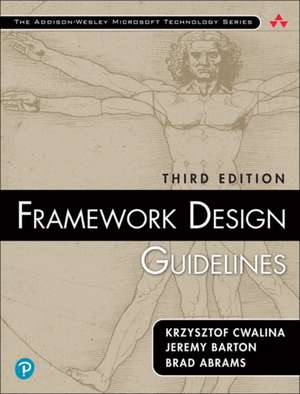
Framework Design Guidelines: Conventions, Idioms, and Patterns for Reusable .NET Libraries
Autor Krzysztof Cwalina, Jeremy Barton, Brad Abramsen Limba Engleză Paperback – 21 mar 2024
Ecosistemul vizat de Framework Design Guidelines este cel al dezvoltării de biblioteci și componente reutilizabile pe platforma .NET, ediția a treia fiind actualizată special pentru a reflecta schimbările aduse până la versiunea .NET 7.3. Putem afirma că această lucrare reprezintă standardul de aur pentru inginerii software care nu scriu doar cod funcțional, ci API-uri destinate consumului de către alți programatori. Cartea se distinge prin rigoarea tehnică și prin adnotările semnate de arhitecți Microsoft, care explică nu doar „ce” să faci, ci mai ales „de ce” anumite decizii de design sunt preferabile în contextul evoluției limbajului C#. Structura volumului urmează o progresie logică, de la fundamentele filosofice ale designului de framework, la detalii granulare precum regulile de denumire (Naming Guidelines) și proiectarea membrilor claselor. Capitolele dedicate extensibilității și gestionării excepțiilor oferă soluții practice pentru problemele care apar adesea în producție, în timp ce apendicele despre stilul de codare și schimburile care pot rupe compatibilitatea (Breaking Changes) transformă cartea într-un instrument de referință zilnică. Merită menționat sistemul de clasificare a recomandărilor în categorii precum „Do” sau „Avoid”, care permite o asimilare rapidă a normelor. Cititorul care a aplicat ideile din Pro .NET 2.0 Code and Design Standards in C# va găsi aici o continuare necesară și mult mai profundă, adaptată tehnologiilor moderne. În timp ce titlurile anterioare se concentrau pe standarde de bază, Framework Design Guidelines analizează subtilitățile designului de API la nivel enterprise. Față de Design Patterns in .NET 6, care explorează implementarea tiparelor clasice, această lucrare pune accent pe consistența și ergonomia interfețelor programabile, oferind perspectiva critică a celor care au construit efectiv platforma .NET.
Preț: 373.16 lei
Preț vechi: 466.46 lei
-20%
Carte tipărită la comandă
Livrare economică 02-16 decembrie
Livrare express 28 octombrie-03 noiembrie pentru 78.59 lei
Specificații
ISBN-10: 0135896460
Pagini: 624
Dimensiuni: 178 x 235 x 34 mm
Greutate: 0.98 kg
Ediția:Adnotată
Editura: Pearson International
V-ar putea interesa
-
 Optical Integrated CircuitsHiroshi Nishihara-15%Preț: 518.35 lei609.82 lei
 -
 Preț: 172.51 lei
 -
 Telerobotics, Automation, and Human Supervisory ControlThomas B. Sheridan-20%Preț: 344.44 lei430.56 lei
 -
 Handbook of Silicon Semiconductor MetrologyAlain C. Diebold-18%Preț: 2680.76 lei3269.22 lei
 -
 Battery Technology HandbookH a Kiehne-18%Preț: 2229.61 lei2719.03 lei
 -
 -18%Preț: 1603.92 lei1956.00 lei
 -
 John Deere Model 4055-4955 Tractor Service Repair ManualHaynes PublishingPreț: 299.98 lei
 -
 Ambient Noise in the SeaRobert J UrickPreț: 383.18 lei
 -
 Best Mobile Apps of 2013Jeremy WarnerPreț: 262.59 lei
 -
 Recursive Digital FiltersStefan HollosPreț: 92.67 lei
 -
 Preț: 439.67 lei
 -
 Nachrichtenübertragung 1Alfons Gottwald-9%Preț: 632.88 lei695.47 lei
De ce să citești această carte
Recomandăm această carte oricărui dezvoltator .NET care dorește să treacă de la scrierea de aplicații la crearea de biblioteci profesionale. Veți câștiga o înțelegere profundă a modului în care arhitecții Microsoft gândesc extensibilitatea și mentenabilitatea codului. Este un ghid practic esențial pentru a construi API-uri intuitive, robuste și capabile să reziste în timp, eliminând presupunerile din procesul de design software.
Despre autor
Krzysztof Cwalina, Jeremy Barton și Brad Abrams sunt arhitecți cu o experiență vastă în cadrul Microsoft, fiind direct implicați în definirea și evoluția arhitecturii .NET încă de la începuturile sale. Krzysztof Cwalina este recunoscut pentru contribuția sa la designul API-urilor fundamentale ale framework-ului, în timp ce Brad Abrams a fost unul dintre fondatorii echipei .NET. Expertiza lor cumulată oferă cititorului o perspectivă unică, „din interior”, asupra deciziilor tehnice care stau la baza uneia dintre cele mai utilizate platforme de dezvoltare din lume.
Descriere scurtă
Notă biografică
Cuprins
- Chapter 1: Introduction
- Chapter 2: Framework Design Fundamentals
- Chapter 3: Naming Guidelines
- Chapter 4: Type Design Guidelines
- Chapter 5: Member Design
- Chapter 6: Designing for Extensibility
- Chapter 7: Exceptions
- Chapter 8: Usage Guidelines
- Chapter 9: Common Design Patterns
- Appendix A: C# Coding Style Conventions
- Appendix B: Obsolete Guidance
- Appendix C: Sample API Specification
- Appendix D: Breaking Changes
- Glossary