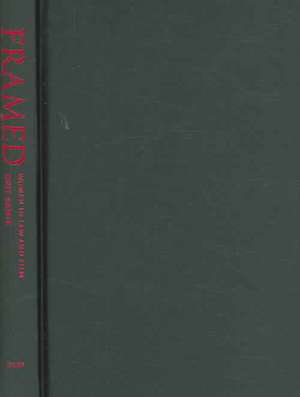
Framed
Autor Orit Kamiren Limba Engleză Hardback – 19 ian 2006
"Framed" not only offers a unique study of law and film but also points toward new directions in feminist thought. Shedding light on central feminist themes such as victimization and agency, multiculturalism, and postmodernism, Kamir outlines a feminist cinematic legal critique, a perspective from which to evaluate the "cinematic legalism" that indoctrinates and disciplines audiences around the world. Bringing an original perspective to feminist analysis, she demonstrates that the distinction between honor and dignity has crucial implications for how societies construct women, their social status, and their legal rights. In "Framed," she outlines a dignity-oriented, honor-sensitive feminist approach to law and film.
Preț: 691.77 lei
Preț vechi: 792.12 lei
-13%
Puncte Express: 1038
Preț estimativ în valută:
122.25€ • 141.10$ • 106.62£
122.25€ • 141.10$ • 106.62£
Carte indisponibilă temporar
Doresc să fiu notificat când acest titlu va fi disponibil:
Se trimite...
Specificații
ISBN-13: 9780822336365
ISBN-10: 0822336367
Pagini: 352
Dimensiuni: 152 x 234 x 30 mm
Greutate: 0.64 kg
Ediția:New.
Editura: Duke University Press
ISBN-10: 0822336367
Pagini: 352
Dimensiuni: 152 x 234 x 30 mm
Greutate: 0.64 kg
Ediția:New.
Editura: Duke University Press
V-ar putea interesa
-
 The Woman's Encyclopedia of Myths and SecretsBarbara G WalkerPreț: 220.45 lei
 -
 How To Be a WomanCaitlin Moran-20%Preț: 55.38 lei68.93 lei
 -
 Charity and Sylvia: A Same-Sex Marriage in Early AmericaRachel Hope Cleves-25%Preț: 110.38 lei146.79 lei
 -
 -27%Preț: 95.30 lei130.82 lei
 -
 The Feminism of Uncertainty – A Gender DiaryAnn SnitowPreț: 273.40 lei
 -
 Preț: 273.64 lei
 -
 Preț: 205.05 lei
 -
 Preț: 274.30 lei
 -
 The Feminist Bookstore MovementKristen HoganPreț: 152.50 lei
 -
 Beyond the Whiteness of WhitenessJane LazarrePreț: 207.98 lei
 -
 Gender Lens InvestingJoseph QuinlanPreț: 189.51 lei
 -
 Words of Wisdom from Women to WatchBusiness InsurancePreț: 128.66 lei
 -
 Fantastically Great Women Who Changed The WorldKate Pankhurst-36%Preț: 35.79 lei55.86 lei
 -
 Bad Girls Throughout HistoryAnn Shen-23%Preț: 99.10 lei128.33 lei
 -
 Campbell, R: Rise Sister RiseRebecca Campbell-19%Preț: 84.27 lei104.08 lei
Recenzii
Framed is groundbreaking. It pushes law-and-film scholarship forward in significant ways. The question at its core is not how various groups are represented but rather the more difficult one of how we as legal or cinematic audiences are led to judge these groups. Orit Kamir doesnt simply do an analysis of a group of films. Rather, she uses a set of films as a vehicle to explore the mechanisms of judgment. Rebecca Johnson, author of Taxing Choices: The Intersection of Class, Gender, Parenthood, and the Law
In this fascinating book, Orit Kamir displays an original method for reading law and film that illuminates both a remarkable set of films from around the world and many of our deepest assumptions about law. All this is done from a powerful feministic perspective. I know nothing like it. James Boyd White, author of The Edge of Meaning
"Framed is groundbreaking. It pushes law-and-film scholarship forward in significant ways. The question at its core is not how various groups are represented but rather the more difficult one of how we as legal or cinematic audiences are led to judge these groups. Orit Kamir doesn't simply 'do' an analysis of a group of films. Rather, she uses a set of films as a vehicle to explore the mechanisms of judgment." Rebecca Johnson, author of Taxing Choices: The Intersection of Class, Gender, Parenthood, and the Law "In this fascinating book, Orit Kamir displays an original method for reading law and film that illuminates both a remarkable set of films from around the world and many of our deepest assumptions about law. All this is done from a powerful feministic perspective. I know nothing like it." James Boyd White, author of The Edge of Meaning
In this fascinating book, Orit Kamir displays an original method for reading law and film that illuminates both a remarkable set of films from around the world and many of our deepest assumptions about law. All this is done from a powerful feministic perspective. I know nothing like it. James Boyd White, author of The Edge of Meaning
"Framed is groundbreaking. It pushes law-and-film scholarship forward in significant ways. The question at its core is not how various groups are represented but rather the more difficult one of how we as legal or cinematic audiences are led to judge these groups. Orit Kamir doesn't simply 'do' an analysis of a group of films. Rather, she uses a set of films as a vehicle to explore the mechanisms of judgment." Rebecca Johnson, author of Taxing Choices: The Intersection of Class, Gender, Parenthood, and the Law "In this fascinating book, Orit Kamir displays an original method for reading law and film that illuminates both a remarkable set of films from around the world and many of our deepest assumptions about law. All this is done from a powerful feministic perspective. I know nothing like it." James Boyd White, author of The Edge of Meaning
Notă biografică
Orit Kamir
Textul de pe ultima copertă
"In this fascinating book, Orit Kamir displays an original method for reading law and film that illuminates both a remarkable set of films from around the world and many of our deepest assumptions about law. All this is done from a powerful feministic perspective. I know nothing like it."--James Boyd White, author of "The Edge of Meaning"
Cuprins
Acknowledgments ix
Preface xi
Introduction: Conceptual Framework 1
Part I. Feminist Critique of Law Films that Honor-Judge Women
1. Rashomon (Japan, 1950): Construction of Woman as Guilty Object 43
2. Pandora’s Box (Germany, 1928): Exorcising Pandora-Lilith in the Weimar Republic 73
3. Blackmail (England, 1929): Hitchcock’s Sound and the New Woman’s Guilty Silence 90
4. Anatomy of a Murder (U.S.A., 1959): Hollywood’s Hero-Lawyer Revives the Unwritten Law 112
Part II. Cinematic Women Demanding Judgment
From Liberal Attitudes to Radical Feminist Jurisprudence and the Ethics of Care
5. Adam’s Rib (U.S.A., 1949): Hollywood’s Female Lawyer and Family Values (Read with Disclosure and Legally Blonde) 135
6. Nuts (U.S.A., 1987): The Mad Woman’s Day in Court 160
7. Death and the Maiden (U.S.A., 1994): Challenging Trauma with Feminine Judgment and Justice (Read with The Piano) 185
Part III. Women Resisting and Subverting Judgment
Beyond Conventional Feminist Jurisprudence
8. A Question of Silence (Netherlands, 1982): Feminist Community as Revolution (Read against “A Jury of Her Peers”) 217
9. Set it Off (U.S.A., 1996): Minority Women at the Point of No Return 243
10. High Heels (Spain, 1991): Almodovar’s Postmodern Transgression 264
Notes 285
Bibliography 299
Index 313
Preface xi
Introduction: Conceptual Framework 1
Part I. Feminist Critique of Law Films that Honor-Judge Women
1. Rashomon (Japan, 1950): Construction of Woman as Guilty Object 43
2. Pandora’s Box (Germany, 1928): Exorcising Pandora-Lilith in the Weimar Republic 73
3. Blackmail (England, 1929): Hitchcock’s Sound and the New Woman’s Guilty Silence 90
4. Anatomy of a Murder (U.S.A., 1959): Hollywood’s Hero-Lawyer Revives the Unwritten Law 112
Part II. Cinematic Women Demanding Judgment
From Liberal Attitudes to Radical Feminist Jurisprudence and the Ethics of Care
5. Adam’s Rib (U.S.A., 1949): Hollywood’s Female Lawyer and Family Values (Read with Disclosure and Legally Blonde) 135
6. Nuts (U.S.A., 1987): The Mad Woman’s Day in Court 160
7. Death and the Maiden (U.S.A., 1994): Challenging Trauma with Feminine Judgment and Justice (Read with The Piano) 185
Part III. Women Resisting and Subverting Judgment
Beyond Conventional Feminist Jurisprudence
8. A Question of Silence (Netherlands, 1982): Feminist Community as Revolution (Read against “A Jury of Her Peers”) 217
9. Set it Off (U.S.A., 1996): Minority Women at the Point of No Return 243
10. High Heels (Spain, 1991): Almodovar’s Postmodern Transgression 264
Notes 285
Bibliography 299
Index 313
Descriere
Intervenes in the emerging discipline of law-and-film by developing a framework for evaluating how films represent gender crimes and how those representations affect audiences ideas about women, their legal rights, and their roles in society