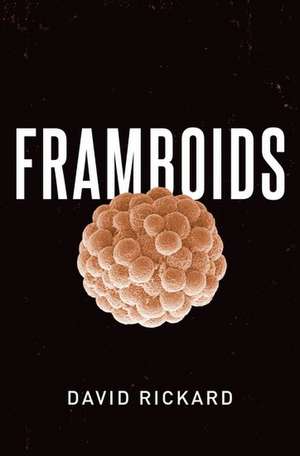
Framboids
Autor David Rickarden Limba Engleză Hardback – 12 oct 2021
Preț: 664.82 lei
Preț vechi: 987.69 lei
-33%
Puncte Express: 997
Carte disponibilă
Livrare economică 06-17 noiembrie
Livrare prin curier în România Termenul estimat este afișat lângă disponibilitate.
Transport gratuit pentru acest produs Plată online sau ramburs, în funcție de opțiunile comenzii.
Retur gratuit în 14 zile Comandă securizată și suport în română.
Specificații
ISBN-13: 9780190080112
ISBN-10: 0190080116
Pagini: 360
Dimensiuni: 241 x 164 x 24 mm
Greutate: 0.66 kg
Editura: Oxford University Press
Colecția OUP USA
Locul publicării:New York, United States
ISBN-10: 0190080116
Pagini: 360
Dimensiuni: 241 x 164 x 24 mm
Greutate: 0.66 kg
Editura: Oxford University Press
Colecția OUP USA
Locul publicării:New York, United States
Recenzii
The book by David Rickard, world authority on sulfide chemistry, geochemistry, geomicrobiology, biogeochemistry and ore geology, opens the doors of this fascinating world... David Rickard has condensed in a relatively small book a wealth of information which makes it a reference text certainly for many years to come
Framboidal pyrite; a riddle wrapped in a mystery inside an enigma. An engaging text on mineral morphology seems a contradiction in terms, but Rickard's superbly crafted book will surprise and inform readers at all levels. Popular audiences will be awestruck by the sheer profligacy of framboid formation: more than ten thousand billion framboids are formed every second, giving a worldwide abundance a billion times larger than the number of sand grains on Earth. Professionals will get a closer look into the physio-chemical controls of burst nucleation that produce the exquisite architecture of framboidal pyrite
There is a mystery behind framboids. They represent fool's gold, many compare their appearance to that of a tasty raspberry, and they're invisible to the naked eye. In this book, Dave Rickard expertly provides readers with the most recent data about framboids, and he also delves into the history and future of framboids. This is a must-have for Earth scientists, chemists, and materials scientists.
I found Framboids to be a fun and highly educational read. Ever since I first saw a pyrite framboid, I wondered how these entities could arrange themselves in such beautiful symmetries. In this book, David Rickard documents how other compounds generate framboids and that these materials are everywhere even though they cannot easily be seen. Rickard does a spectacular job in providing the history of their discovery, starting with optical microscopy through more advanced electron microscopy methods. For the scientist who wishes to understand the physical and chemical forces that align microcrystals into framboids, he provides an exquisite step-by-step dissertation regarding their formation, growth mechanisms, nucleation, self-assembly, and self-organization.
Framboidal pyrite; a riddle wrapped in a mystery inside an enigma. An engaging text on mineral morphology seems a contradiction in terms, but Rickard's superbly crafted book will surprise and inform readers at all levels. Popular audiences will be awestruck by the sheer profligacy of framboid formation: more than ten thousand billion framboids are formed every second, giving a worldwide abundance a billion times larger than the number of sand grains on Earth. Professionals will get a closer look into the physio-chemical controls of burst nucleation that produce the exquisite architecture of framboidal pyrite
There is a mystery behind framboids. They represent fool's gold, many compare their appearance to that of a tasty raspberry, and they're invisible to the naked eye. In this book, Dave Rickard expertly provides readers with the most recent data about framboids, and he also delves into the history and future of framboids. This is a must-have for Earth scientists, chemists, and materials scientists.
I found Framboids to be a fun and highly educational read. Ever since I first saw a pyrite framboid, I wondered how these entities could arrange themselves in such beautiful symmetries. In this book, David Rickard documents how other compounds generate framboids and that these materials are everywhere even though they cannot easily be seen. Rickard does a spectacular job in providing the history of their discovery, starting with optical microscopy through more advanced electron microscopy methods. For the scientist who wishes to understand the physical and chemical forces that align microcrystals into framboids, he provides an exquisite step-by-step dissertation regarding their formation, growth mechanisms, nucleation, self-assembly, and self-organization.
Notă biografică
David Rickard is Emeritus Professor of Geochemistry at Cardiff University and Adjunct Professor of Marine Geochemistry at the University of Delaware. He received his BSc, ARSM, DIC, and PhD from Imperial College London. Rickard has authored more than 300 publications, including four books and over 150 original research papers on sulfide chemistry, geochemistry, biogeochemistry, and ore geology. His most recent book is Pyrite (Oxford University Press, 2015). He is a Fellow of the Royal Society of Chemistry, the Royal Society of Biology, the Geochemical Society, and the Geological Society of London.
Cuprins
- Dedication
- Synopsis
- Acknowledgments
- Chapter 1: Introduction
- Chapter 2: Framboid Sizes
- Chapter 3: Framboid Shapes
- Chapter 4: Microcrystal Morphology
- Chapter 5: Framboid Microarchitecture
- Chapter 6: The Crystallography of Pyrite Framboids
- Chapter 7: Organic Matter in Framboids
- Chapter 8: Framboid Mineralogy
- Chapter 9: Geochemistry of Framboids
- Chapter 10: Pyrite Framboid Formation Chemistry
- Chapter 11: Nucleation of Framboids
- Chapter 12: Framboid Microcrystal Growth
- Chapter 13: Framboid Self-Assembly and Self-Organization
- List of Symbols and Abbreviations
- List of Units
- Glossary
- References
- Index