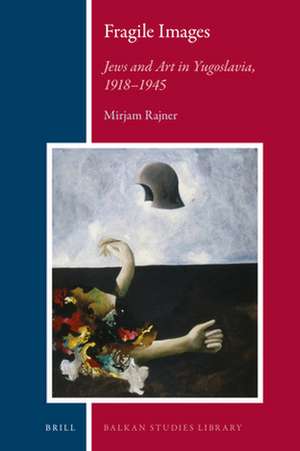
Fragile Images: Fragile Images, cartea 26
Autor Mirjam Rajneren Limba Engleză Hardback – 19 sep 2019
These fluctuating identities found expression in their art, as did their wartime fate as refugees, camp inmates, partisans and survivors. A wealth of newly-discovered images, diaries and letters highlight this little-known aspect of Jewish life and art in Yugoslavia, illuminating a turbulent era that included integration into a newly-founded country, the catastrophe of the Holocaust, and renewal in its aftermath.
Preț: 1265.71 lei
Preț vechi: 1643.78 lei
-23%
Puncte Express: 1899
Carte tipărită la comandă
Livrare economică 26 septembrie-10 octombrie
Livrare prin curier în România Termenul estimat este afișat lângă disponibilitate.
Transport gratuit pentru acest produs Plată online sau ramburs, în funcție de opțiunile comenzii.
Retur gratuit în 14 zile Comandă securizată și suport în română.
Specificații
ISBN-13: 9789004408852
ISBN-10: 9004408851
Pagini: 476
Dimensiuni: 155 x 234 x 27 mm
Greutate: 0.84 kg
Editura: Koninklijke Brill Bv
Colecția Fragile Images
Seriile Fragile Images, Brill
ISBN-10: 9004408851
Pagini: 476
Dimensiuni: 155 x 234 x 27 mm
Greutate: 0.84 kg
Editura: Koninklijke Brill Bv
Colecția Fragile Images
Seriile Fragile Images, Brill
Cuprins
Acknowledgments xi
List of Illustrations
Note on Personal Names
Introduction
Introduction to Part 1
1 From Dorćol to Paris and Back: Moša Pijade’s Self-Portraits
1 Coming of Age in Belgrade
2 Fin-de-siècle Munich
3 The Bohemian Paris
4 Pijade’s Self-Portraits: In Search of an Identity
2 Sarajevo’s Multiculturalism: Daniel Kabiljo’s Sephardic Types
1 Between East and West
2 Bosnian Artist or Yugoslav Zionist?
3 Choosing Sides
4 Kabiljo’s Sephardic Types
3 A Croatian Zionist: Adolf Weiller between the East European Shtetl and the Lure of Nature
1 Becoming a “Jewish Artist”
2 The Lure of Nature
Introduction to Part 2
4 Bora Baruh’s Refugees
1 “Four Mahaneh Portraits”
2 The Early Works
3 Paris: A Painter and a Revolutionary
4 Painting Refugees
5 Two Directions: The “Art for Art’s Sake” and the Socially Engaged Art
5 Ivan Rein’s Paris: From the Quartier Latin to Camp Vernet
1 Growing Up in an Affluent and Acculturated Jewish-Catholic Family
2 The Croatian School of Painting
3 Rein’s Paris
4 Social Awareness and Political Protest
5 Letters to Cuca: On Being Jewish, Yugoslav, and Universal on the Eve of WWII
6 The Ethnic and Universal Avante-Garde: Daniel Ozmo’s Linocuts
1 A Bosnian Sephardic Artist in Belgrade
2 Discussing “Jewish Art” in the 1930’s: Between Racial Traits and Human Values
3 Social Content and Expressionist Form
4 Sarajevo’s Avant-Garde: Collegium Artisticum
Introduction to Part 3
7 Bora Baruh in Occupied Belgrade: Images of Jewish and Christian Mourning
1 Bombing of Belgrade and Persecution of the Jews
2 Painting Portraits
3 Refugees on Ruins
8 Art in Jasenovac: Daniel Ozmo and the Artists of the Ceramic Workshop
1 The Destruction of Sarajevo’s Jewish Community and Daniel Ozmo’s Arrest
2 The Jasenovac Camp and the Ceramic Workshop
3 Ozmo’s Depictions of Forced Labor
4 Slavko Bril
5 Portraits and Landscapes
6 Ozmo’s End
9 Refugee and Artist: Ivan Rein, Johanna Lutzer, and Jewish Cultural Life in Kraljevica
1 Escaping to the Adriatic Coast
2 Being a Refugee in Kraljevica
3 Ivan Rein’s Refugee Art
4 The Kraljevica—Porto Re Camp
5 Ivan Rein’s Drawings Created in the Kraljevica Camp
6 Johanna Lutzer: A Jewish Artist from Vienna
10 The Rab Island Camp: From Internment to Freedom
Introduction to Part 4
11 Bora Baruh as a Partisan, 1941–1942
12 Johanna Lutzer: Jewish Refugees with the Partisans in Croatia
13 Postscript: Jewish Artists as National Heroes, Victims of Fascism, and Holocaust Survivors
Conclusion
Bibliography
Index
List of Illustrations
Note on Personal Names
Introduction
Part 1: In Search of an Identity: Sephardic, Zionist, Yugoslav
Introduction to Part 1
1 From Dorćol to Paris and Back: Moša Pijade’s Self-Portraits
1 Coming of Age in Belgrade
2 Fin-de-siècle Munich
3 The Bohemian Paris
4 Pijade’s Self-Portraits: In Search of an Identity
2 Sarajevo’s Multiculturalism: Daniel Kabiljo’s Sephardic Types
1 Between East and West
2 Bosnian Artist or Yugoslav Zionist?
3 Choosing Sides
4 Kabiljo’s Sephardic Types
3 A Croatian Zionist: Adolf Weiller between the East European Shtetl and the Lure of Nature
1 Becoming a “Jewish Artist”
2 The Lure of Nature
Part 2: From Avant-Garde to Political Activism
Introduction to Part 2
4 Bora Baruh’s Refugees
1 “Four Mahaneh Portraits”
2 The Early Works
3 Paris: A Painter and a Revolutionary
4 Painting Refugees
5 Two Directions: The “Art for Art’s Sake” and the Socially Engaged Art
5 Ivan Rein’s Paris: From the Quartier Latin to Camp Vernet
1 Growing Up in an Affluent and Acculturated Jewish-Catholic Family
2 The Croatian School of Painting
3 Rein’s Paris
4 Social Awareness and Political Protest
5 Letters to Cuca: On Being Jewish, Yugoslav, and Universal on the Eve of WWII
6 The Ethnic and Universal Avante-Garde: Daniel Ozmo’s Linocuts
1 A Bosnian Sephardic Artist in Belgrade
2 Discussing “Jewish Art” in the 1930’s: Between Racial Traits and Human Values
3 Social Content and Expressionist Form
4 Sarajevo’s Avant-Garde: Collegium Artisticum
Part 3: “We Artists Have to Paint”: Art Created during the War and the Holocaust
Introduction to Part 3
7 Bora Baruh in Occupied Belgrade: Images of Jewish and Christian Mourning
1 Bombing of Belgrade and Persecution of the Jews
2 Painting Portraits
3 Refugees on Ruins
8 Art in Jasenovac: Daniel Ozmo and the Artists of the Ceramic Workshop
1 The Destruction of Sarajevo’s Jewish Community and Daniel Ozmo’s Arrest
2 The Jasenovac Camp and the Ceramic Workshop
3 Ozmo’s Depictions of Forced Labor
4 Slavko Bril
5 Portraits and Landscapes
6 Ozmo’s End
9 Refugee and Artist: Ivan Rein, Johanna Lutzer, and Jewish Cultural Life in Kraljevica
1 Escaping to the Adriatic Coast
2 Being a Refugee in Kraljevica
3 Ivan Rein’s Refugee Art
4 The Kraljevica—Porto Re Camp
5 Ivan Rein’s Drawings Created in the Kraljevica Camp
6 Johanna Lutzer: A Jewish Artist from Vienna
10 The Rab Island Camp: From Internment to Freedom
Part 4: Producing Art for Partisans: Creativity between Ideology and Survival
Introduction to Part 4
11 Bora Baruh as a Partisan, 1941–1942
12 Johanna Lutzer: Jewish Refugees with the Partisans in Croatia
13 Postscript: Jewish Artists as National Heroes, Victims of Fascism, and Holocaust Survivors
Conclusion
Bibliography
Index
Notă biografică
Mirjam Rajner, Ph.D. (2004), The Hebrew University of Jerusalem, is a senior lecturer in the Jewish Art Department of Bar-Ilan University and the co-editor of Ars Judaica, The Bar-Ilan Journal of Jewish Art. She has published numerous articles on modern Jewish art in edited volumes and academic journals such as Images, East-European Jewish Studies, Studia Rosenthaliana, and Studies in Contemporary Jewry.