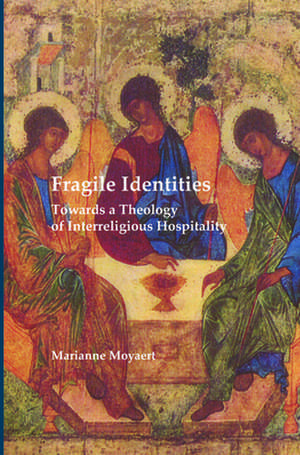
Fragile Identities: Towards a Theology of Interreligious Hospitality: Currents of Encounter, cartea 39
Autor Marianne Moyaerten Limba Engleză Paperback – 31 dec 2010



Preț: 617.32 lei
Preț vechi: 693.62 lei
-11%
Puncte Express: 926
Carte tipărită la comandă
Livrare economică 21 noiembrie-05 decembrie
Livrare prin curier în România Termenul estimat este afișat lângă disponibilitate.
Transport gratuit pentru acest produs Plată online sau ramburs, în funcție de opțiunile comenzii.
Retur gratuit în 14 zile Comandă securizată și suport în română.
Specificații
ISBN-13: 9789042032798
ISBN-10: 9042032790
Pagini: 352
Dimensiuni: 155 x 235 x 20 mm
Greutate: 0.5 kg
Editura: Brill
Colecția Brill
Seria Currents of Encounter
ISBN-10: 9042032790
Pagini: 352
Dimensiuni: 155 x 235 x 20 mm
Greutate: 0.5 kg
Editura: Brill
Colecția Brill
Seria Currents of Encounter
V-ar putea interesa
-
 The Battle for GodKaren ArmstrongPreț: 106.74 lei
 -
 -31%Preț: 932.50 lei1355.55 lei
 -
 Women and Religious TraditionsLeona M. Anderson-21%Preț: 312.23 lei397.00 lei
 -
 Preț: 192.95 lei
 -
 The Good HeartDalai LamaPreț: 114.31 lei
 -
 Families of FaithPaul Varo MartinsonPreț: 166.18 lei
 -
 The Desecularization of the WorldPeter L. BergerPreț: 118.47 lei
 -
 Conviction and ConflictMichael Nazir-Ali-42%Preț: 124.29 lei214.06 lei
 -
 -9%Preț: 1201.50 lei1320.32 lei
 -
 Religion in BritainGrace DaviePreț: 238.92 lei
 -
 The Wiley Blackwell Companion to World ChristianityLamin Sanneh-9%Preț: 1433.43 lei1575.20 lei
 -
 -27%Preț: 50.94 lei70.26 lei
 -
 Islam in Relation to the Christ ImpulseAndrei YounisPreț: 145.07 lei
 -
 -19%Preț: 575.10 lei710.00 lei
 -
 -22%Preț: 234.11 lei299.51 lei
Cuprins
Introduction
Approach
The Theology of Religions
Religious Plurality: A New Theological Challenge?
The Theology of Religions
Exclusivism
Inclusivism
Pluralism
Conclusion
The Theology of Religions and the Tension between Openness and Closedness
Interreligious Dialogue in the Exclusivist Model
Inclusivism and Interreligious Dialogue
Interreligious Dialogue and Pluralism
Conclusion
A Critique of the Pluralist Model of Interreligious Dialogue
The Virtue of Openness: Pluralism as Confessional Discourse
Pluralism and the Inability to do Justice to Difference
Pluralism and “Faith Commitment”: The Difference between Expression and Impression
Conclusion
The Cultural-Linguistic Theory, Postliberalism, and Religious Incommensurability
Biographical Reflections and Theological Concerns
The Cultural-Linguistic Theory of Religion and Ecumenism
Postliberalism and the Cultural Crisis
Postliberalism, The Theology of Religions, and Interreligious Dialogue
Conclusion
The End of Dialogue? A Theological Critique of Postliberalism
The “Reception History” of the Cultural-Linguistic Model
Intermezzo
Intratextual Hermeneutics and the End of Dialogue
A Theological Critique of Postliberalism: Dichotomy or Dialogue?
Concluding Reflections on Exclusivism, Inclusivism, and Hermeneutical Openness
Interreligious Dialogue and Hermeneutical Openness
The Analogy between Language and Religion
A Theological Hermeneutics of the Story of Babel
Linguistic Hospitality
Hermeneutical Openness as Linguistic Hospitality
Narrative Identity
Conclusion: A Theology of Interreligious Hospitality
Testimony and Openness: A Theological Perspective
Fragility and Human Restlessness
Balm for the Soul: The Generosity of the Feast
Bibliography
Index of Subjects
Index of Names
Approach
The Theology of Religions
Religious Plurality: A New Theological Challenge?
The Theology of Religions
Exclusivism
Inclusivism
Pluralism
Conclusion
The Theology of Religions and the Tension between Openness and Closedness
Interreligious Dialogue in the Exclusivist Model
Inclusivism and Interreligious Dialogue
Interreligious Dialogue and Pluralism
Conclusion
A Critique of the Pluralist Model of Interreligious Dialogue
The Virtue of Openness: Pluralism as Confessional Discourse
Pluralism and the Inability to do Justice to Difference
Pluralism and “Faith Commitment”: The Difference between Expression and Impression
Conclusion
The Cultural-Linguistic Theory, Postliberalism, and Religious Incommensurability
Biographical Reflections and Theological Concerns
The Cultural-Linguistic Theory of Religion and Ecumenism
Postliberalism and the Cultural Crisis
Postliberalism, The Theology of Religions, and Interreligious Dialogue
Conclusion
The End of Dialogue? A Theological Critique of Postliberalism
The “Reception History” of the Cultural-Linguistic Model
Intermezzo
Intratextual Hermeneutics and the End of Dialogue
A Theological Critique of Postliberalism: Dichotomy or Dialogue?
Concluding Reflections on Exclusivism, Inclusivism, and Hermeneutical Openness
Interreligious Dialogue and Hermeneutical Openness
The Analogy between Language and Religion
A Theological Hermeneutics of the Story of Babel
Linguistic Hospitality
Hermeneutical Openness as Linguistic Hospitality
Narrative Identity
Conclusion: A Theology of Interreligious Hospitality
Testimony and Openness: A Theological Perspective
Fragility and Human Restlessness
Balm for the Soul: The Generosity of the Feast
Bibliography
Index of Subjects
Index of Names
Notă biografică
Marianne Moyaert is a post-doctoral researcher at the Centre for Religious Studies and Interreligious Dialogue at the Faculty of Theology, Catholic University of Louvain, Belgium. An expert in Judaism, particularly Catholic-Jewish dialogue and post-Holocaust studies, Moyaert’s broad area of research is the contemporary context of cultural and religious diversity as a theological, hermeneutical and ethical challenge.