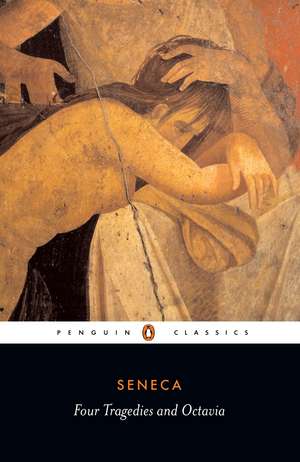
Four Tragedies and Octavia
Autor Seneca Traducere de E. Watlingen Limba Engleză Paperback – 24 feb 2005
For more than seventy years, Penguin has been the leading publisher of classic literature in the English-speaking world. With more than 1,700 titles, Penguin Classics represents a global bookshelf of the best works throughout history and across genres and disciplines. Readers trust the series to provide authoritative texts enhanced by introductions and notes by distinguished scholars and contemporary authors, as well as up-to-date translations by award-winning translators.
Preț: 72.83 lei
Preț vechi: 91.75 lei
-21%
Puncte Express: 109
Carte disponibilă
Livrare economică 05-11 noiembrie
Livrare express 16-22 octombrie pentru 39.79 lei
Livrare prin curier în România Termenul estimat este afișat lângă disponibilitate.
Transport gratuit de la 400.00 lei Plată online sau ramburs, în funcție de opțiunile comenzii.
Retur gratuit în 14 zile Comandă securizată și suport în română.
Specificații
ISBN-13: 9780140441741
ISBN-10: 0140441743
Pagini: 320
Dimensiuni: 130 x 197 x 15 mm
Greutate: 0.24 kg
Editura: Penguin Books
Locul publicării:London, United Kingdom
ISBN-10: 0140441743
Pagini: 320
Dimensiuni: 130 x 197 x 15 mm
Greutate: 0.24 kg
Editura: Penguin Books
Locul publicării:London, United Kingdom
V-ar putea interesa
-
 Iphigenia, Phaedra and AthaliahJean RacinePreț: 92.93 lei
 -
 The Rope and Other PlaysPlautusPreț: 94.52 lei
 -
 The Robbers and WallensteinF. LamportPreț: 109.83 lei
 -
 Complete Plays Lenz and Other WritingsGeorg BuchnerPreț: 95.24 lei
 -
 Last PlaysDan LaurencePreț: 93.34 lei
 -
 Baby Doll and Other PlaysTennessee WilliamsPreț: 92.78 lei
 -
 Sweet Bird of Youth and Other PlaysTennessee Williams-25%Preț: 59.06 lei79.20 lei
 -
 Three Elizabethan Domestic TragediesKeith SturgessPreț: 107.33 lei
 -
 Fences & Ma Rainey's Black BottomAugust Wilson-21%Preț: 71.97 lei90.53 lei
 -
 Viva Zapata!John SteinbeckPreț: 64.32 lei
 -
 Preț: 142.66 lei
 -
 Of Thorns, Roses and a Devil's LieJana MeadorPreț: 91.48 lei
 -
 Preț: 93.54 lei
 -
 From Boyz To MenJ. AlexanderPreț: 83.35 lei
 -
 Preț: 103.76 lei
 -
 Preț: 37.36 lei
 -
 AgamemnonHoward ColyerPreț: 85.19 lei
 -
 Consolations from a StoicSenecaPreț: 52.87 lei
 -
 Preț: 83.26 lei
 -
 Consolacion a PolibioSenecaPreț: 76.46 lei
 -
 ConsolacionesSenecaPreț: 77.07 lei
 -
 de La ClemenciaSenecaPreț: 76.07 lei
 -
 de La Constancia del SabioSenecaPreț: 76.67 lei
 -
 Preț: 49.91 lei
 -
 ThyestesSenecaPreț: 37.60 lei
Notă biografică
Lucius Annaeus Seneca (c.4BC - AD65) was born in Cordoba, Spain, where he was brought up studying the traditional virtues of republican Roman life. He became a teacher of rhetoric but attracted attention for his incisive style of writing. Closely linked to Nero, his death was ordered by the emperor in AD65. Seneca committed suicide.
E.F. Watling had translated many Ancient Classics for Penguin, including plays of Sophocles and Plautus. He died in 1990.
E.F. Watling had translated many Ancient Classics for Penguin, including plays of Sophocles and Plautus. He died in 1990.
Cuprins
Seneca: Four Tragedies And OctaviaIntroduction Acknowledgement Thyestes Phaedra (or Hippolytus) The Trojan Women Oedipus Octavia
Appendix I.
Elizabethan translations and imitations Appendix II. Passages from Seneca's prose
Appendix I.
Elizabethan translations and imitations Appendix II. Passages from Seneca's prose
Descriere
Dramas by the classical playwright and philosopher are accompanied by a modern work to demonstrate the Roman's impact on the development of the tragedy.