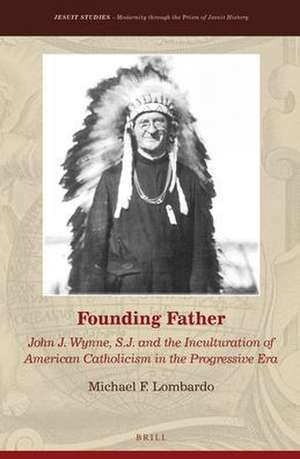
Founding Father
Autor Michael F Lombardoen Limba Engleză Hardback – 6 apr 2017
Lombardo uses theological inculturation to explore the ways in which Wynne used his publications to negotiate American Catholic citizenship during the Progressive Era. He concludes that Wynne’s legacy was part of a flowering of early-twentieth century American Catholic intellectual thought that made him a key forerunner to the mid-century Catholic Revival.
Preț: 963.54 lei
Preț vechi: 1251.35 lei
-23%
Puncte Express: 1445
Preț estimativ în valută:
170.55€ • 199.26$ • 148.02£
170.55€ • 199.26$ • 148.02£
Carte tipărită la comandă
Livrare economică 25 februarie-11 martie
Preluare comenzi: 021 569.72.76
Specificații
ISBN-13: 9789004301146
ISBN-10: 9004301143
Pagini: 376
Dimensiuni: 157 x 236 x 25 mm
Greutate: 0.66 kg
Ediția:XIV, 345 Pp. with 3 Illustrati edition
Editura: de Gruyter Brill
ISBN-10: 9004301143
Pagini: 376
Dimensiuni: 157 x 236 x 25 mm
Greutate: 0.66 kg
Ediția:XIV, 345 Pp. with 3 Illustrati edition
Editura: de Gruyter Brill
Cuprins
Acknowledgments
List of Figures
List of Abbreviations
Introduction
1. The Progressive Era
2. Negotiating US Identity: Progressive Era Catholicism and National Unity
3. Ever Bright Light: John Joseph Wynne, S.J. (1859–1948)
4. The Guardian of Liberty
5. The Catholic Encyclopedia
6. America
Conclusion: “Vir Deo conjunctus”
Bibliography
List of Figures
List of Abbreviations
Introduction
1. The Progressive Era
2. Negotiating US Identity: Progressive Era Catholicism and National Unity
3. Ever Bright Light: John Joseph Wynne, S.J. (1859–1948)
4. The Guardian of Liberty
5. The Catholic Encyclopedia
6. America
Conclusion: “Vir Deo conjunctus”
Bibliography
Notă biografică
Michael F. Lombardo, Ph.D. (2014), is Program Director and Assistant Professor of Theology at the University of Mary's Rome Campus in Italy. His research and publications explore topics related to U.S. Catholic history and theology.
Recenzii
“Michael Lombardo has done a great service by drawing attention to one of the many overlooked characters in the history of US Catholicism, one of the far too many unknown Catholics who made important contributions to the USA”. - James Grummer SJ, Rome, in: Archivum Historicum Societatis Iesu, Vol. 86, No. 171 (2017), pp. 237-240
“an important addition to Brill’s “Jesuit studies” series” - Patrick Hayes, Redemptorist Archives of the Baltimore Province, Philadelphia, in: The Catholic Historical Review, Vol. 104, No. 1 (Winter 2018), pp. 159-160
“In this fascinating book, Michael Lombardo brings renewed attention to Wynne’s life and career, situating him within the context of Progressive Era America and its tremendous transformations. […] It deserves attention from those interested in the history of Catholic thought and literary culture in the United States.” - Thomas Rzeznik, Seton Hall University, in: Jounal of Jesuit Studies, Vol. 5, No. 2 (2018), pp. 339-340 [DOI: ]
“Lombardo’s monograph is a timely reminder of the delicate balancing act in which the American Catholic Church indulged in the years when its identity was still defined by mass immigration and of the role that churchmen like Wynne played in its development. It also serves as a corrective to accounts that continue to locate the origins of modern America Catholicism no earlier than the years immediately following the First World War.” - Jeremy Bonner, Durham University, in: The Journal of Ecclesiastical History, Vol. 69, No. 4 (October 2018), pp. 911-912
“an important addition to Brill’s “Jesuit studies” series” - Patrick Hayes, Redemptorist Archives of the Baltimore Province, Philadelphia, in: The Catholic Historical Review, Vol. 104, No. 1 (Winter 2018), pp. 159-160
“In this fascinating book, Michael Lombardo brings renewed attention to Wynne’s life and career, situating him within the context of Progressive Era America and its tremendous transformations. […] It deserves attention from those interested in the history of Catholic thought and literary culture in the United States.” - Thomas Rzeznik, Seton Hall University, in: Jounal of Jesuit Studies, Vol. 5, No. 2 (2018), pp. 339-340 [DOI: ]
“Lombardo’s monograph is a timely reminder of the delicate balancing act in which the American Catholic Church indulged in the years when its identity was still defined by mass immigration and of the role that churchmen like Wynne played in its development. It also serves as a corrective to accounts that continue to locate the origins of modern America Catholicism no earlier than the years immediately following the First World War.” - Jeremy Bonner, Durham University, in: The Journal of Ecclesiastical History, Vol. 69, No. 4 (October 2018), pp. 911-912