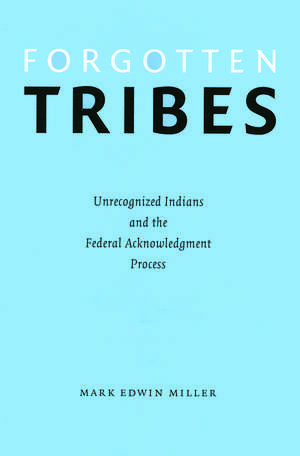
Forgotten Tribes: Unrecognized Indians and the Federal Acknowledgment Process
Autor Mark Edwin Milleren Limba Engleză Hardback – iul 2004
The Federal Acknowledgment Process (FAP) is one of the most important and contentious issues facing Native Americans today. A complicated system of criteria and procedures, the FAP is utilized by federal officials to determine whether a Native community qualifies for federal recognition by the United States government. In Forgotten Tribes, Mark Edwin Miller offers a balanced and detailed look at the origins, procedures, and assumptions governing the FAP. His work examines the FAP through the prism of four previously unrecognized tribal communities and their battles to gain indigenous rights under federal law.
Based on a wealth of interviews and original research, Forgotten Tribes features the first in-depth history and overview of the FAP and sheds light on this controversial Native identification policy involving state power over Native peoples and tribal sovereignty.
Preț: 415.17 lei
Preț vechi: 508.47 lei
-18%
Puncte Express: 623
Preț estimativ în valută:
73.49€ • 85.67$ • 63.66£
73.49€ • 85.67$ • 63.66£
Carte indisponibilă temporar
Doresc să fiu notificat când acest titlu va fi disponibil:
Se trimite...
Preluare comenzi: 021 569.72.76
Specificații
ISBN-13: 9780803232266
ISBN-10: 0803232268
Pagini: 355
Ilustrații: Map
Dimensiuni: 152 x 229 x 15 mm
Greutate: 0.68 kg
Editura: Nebraska
Colecția University of Nebraska Press
Locul publicării:United States
ISBN-10: 0803232268
Pagini: 355
Ilustrații: Map
Dimensiuni: 152 x 229 x 15 mm
Greutate: 0.68 kg
Editura: Nebraska
Colecția University of Nebraska Press
Locul publicării:United States
Notă biografică
Mark Edwin Miller is an assistant professor of history at Southern Utah University.
Recenzii
“Miller’s well-researched book is a significant contribution to the literature on the federal acknowledgment process (FAP). . . . The book couples rigorous empirical research with a critique of cultural constructions of Indian identity.”—American Historical Review
"An important book that should be the cause of great discomfort for us all. . . . Highly original and well-executed."—Daniel M. Cobb, Western Historical Quarterly
“What could be overwhelming and uninteresting bureaucratic, political, and petty personal minutiae is handled very well by Miller's insight, concise writing, and chapter organization.”—Choice
"As you read [Miller's] well-researched book, you may feel the beginnings of a headache creeping into your skull along with his words, as you take in the bureaucratic complexities and mind-boggling, intricate ambiguities of the federal acknowledgment process. This is no fault of Miller's—rather, it is a testament to his achievement in imparting a sense of the human impact of this process."—Southwestern Mission Research Center
"This book will readily find its way onto lists of required texts for course work in federal Indian law and policy. It will also serve as a handbook and cautionary guide to tribal groups enmeshed in, or contemplating entering, the federal acknowledgement process. . . . Miller's book will serve as the standard on the topic for some time to come." —Victoria Smith, Journal of Arizona History
“Miller’s exhaustive historical work, thorough interviews, and persuasive analysis all serve to document the troubles with acknowledgment in a powerful, and potentially enlightening, way. . . . I enthusiastically recommend this book for anthropologists interested in tribal peoples and indigenous politics, historians interested in the late 1990s, political scientists investigating bureaucratic decision-making as well as state and local governments, and anyone interested in American Indian politics, culture, and survival.”—Renee Ann Cramer, American Studies