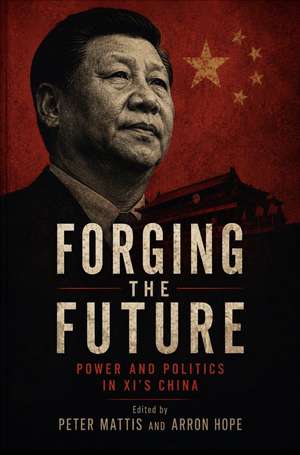
Forging Order: Power & Politics In Xi's China
Editat de Peter Mattis, Arran Hopeen Limba Engleză Paperback – 2 dec 2026
Preț: 160.17 lei
Precomandă
Puncte Express: 240
Carte nepublicată încă
Livrare prin curier în România Precomanda se expediază când titlul devine disponibil.
Transport gratuit de la 400.00 lei Plată online sau ramburs, în funcție de opțiunile comenzii.
Retur gratuit în 14 zile Comandă securizată și suport în română.
Doresc să fiu notificat când acest titlu va fi disponibil:
Se trimite...
Specificații
ISBN-13: 9780888903990
ISBN-10: 0888903995
Pagini: 224
Dimensiuni: 152 x 229 x 19 mm
Greutate: 0.3 kg
Editura: Optimum Publishing International
Colecția Optimum Publishing International
Locul publicării:Ottawa, Canada
ISBN-10: 0888903995
Pagini: 224
Dimensiuni: 152 x 229 x 19 mm
Greutate: 0.3 kg
Editura: Optimum Publishing International
Colecția Optimum Publishing International
Locul publicării:Ottawa, Canada
Descriere
China’s rise is one of the defining transformations of the modern world. But military strength, technological ambition, economic power and political influence tell only part of the story. To understand what Beijing is doing, we must first understand how the Chinese Communist Party thinks about power itself.
Since taking power in 1949, the Chinese Communist Party has remained at the centre of China’s political life. Under Xi Jinping, however, the reach and ambition of the Party have become impossible to overlook. Economic development, technological innovation, education, national security, diplomacy and military power are increasingly coordinated in pursuit of a larger national project; one whose ambitions extend far beyond China’s borders.
In Forging Order, the authors and editors reveal the doctrine helping to shape that project: Comprehensive National Power.
Drawing on generations of Chinese Communist Party doctrine, Forging Order examines how Beijing brings together military strength, industrial capacity, technological leadership, economic influence and political power as interconnected instruments of national strategy. From the Belt and Road Initiative and China's growing presence in Africa to military pressure on Taiwan and the intensifying competition over artificial intelligence, seemingly disparate developments emerge as pieces of a much larger strategic picture.
The book also examines the United Front Work Department (UFWD) and the networks through which the Party seeks to cultivate relationships, shape perceptions and build constituencies sympathetic to Beijing’s interests beyond China. In democratic societies, these activities raise difficult questions about political influence, economic relationships, community organizations and the resilience of open institutions.
At its heart is a contest between two profoundly different conceptions of political power: one that concentrates authority in the Party and state, and another in which governments can be challenged, leaders replaced and institutions held accountable by the citizens they serve.
Forging Order argues that until the United States and its allies understand China as Beijing understands itself, they risk recognizing the individual moves on the geopolitical chessboard while missing the strategy connecting them.
The challenge is therefore greater than determining which nation will become the dominant power of the twenty-first century. It is deciding what kind of political order will shape the world and the freedoms of those who live in it.
Since taking power in 1949, the Chinese Communist Party has remained at the centre of China’s political life. Under Xi Jinping, however, the reach and ambition of the Party have become impossible to overlook. Economic development, technological innovation, education, national security, diplomacy and military power are increasingly coordinated in pursuit of a larger national project; one whose ambitions extend far beyond China’s borders.
In Forging Order, the authors and editors reveal the doctrine helping to shape that project: Comprehensive National Power.
Drawing on generations of Chinese Communist Party doctrine, Forging Order examines how Beijing brings together military strength, industrial capacity, technological leadership, economic influence and political power as interconnected instruments of national strategy. From the Belt and Road Initiative and China's growing presence in Africa to military pressure on Taiwan and the intensifying competition over artificial intelligence, seemingly disparate developments emerge as pieces of a much larger strategic picture.
The book also examines the United Front Work Department (UFWD) and the networks through which the Party seeks to cultivate relationships, shape perceptions and build constituencies sympathetic to Beijing’s interests beyond China. In democratic societies, these activities raise difficult questions about political influence, economic relationships, community organizations and the resilience of open institutions.
At its heart is a contest between two profoundly different conceptions of political power: one that concentrates authority in the Party and state, and another in which governments can be challenged, leaders replaced and institutions held accountable by the citizens they serve.
Forging Order argues that until the United States and its allies understand China as Beijing understands itself, they risk recognizing the individual moves on the geopolitical chessboard while missing the strategy connecting them.
The challenge is therefore greater than determining which nation will become the dominant power of the twenty-first century. It is deciding what kind of political order will shape the world and the freedoms of those who live in it.