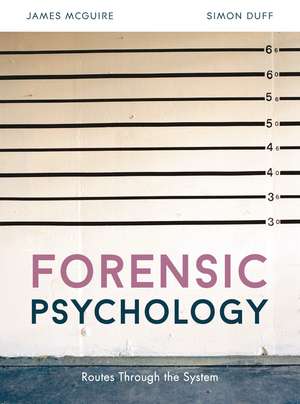
Forensic Psychology: Routes through the system
Autor James McGuire, Simon Duffen Limba Engleză Paperback – 23 apr 2018
This text will be core reading for upper level undergraduates and postgraduates studying forensic psychology, either as a module on a BSc Psychology degree or on an MSc for trainee Forensic Psychologists. It will also be ideal for early career practitioners.
Accompanying online resources for this title can be found at bloomsburyonlineresources.com/forensic-psychology. These resources are designed to support teaching and learning when using this textbook and are available at no extra cost.
Preț: 366.10 lei
Preț vechi: 429.30 lei
-15%
Puncte Express: 549
Carte disponibilă
Livrare economică 07-21 noiembrie
Livrare prin curier în România Termenul estimat este afișat lângă disponibilitate.
Transport gratuit de la 400.00 lei Plată online sau ramburs, în funcție de opțiunile comenzii.
Retur gratuit în 14 zile Comandă securizată și suport în română.
Specificații
ISBN-13: 9780230249097
ISBN-10: 0230249094
Pagini: 464
Ilustrații: 33 bw illus
Dimensiuni: 192 x 260 x 36 mm
Greutate: 1.34 kg
Ediția:1st ed. 2018
Editura: Bloomsbury Publishing
Colecția Red Globe Press
Locul publicării:London, United Kingdom
ISBN-10: 0230249094
Pagini: 464
Ilustrații: 33 bw illus
Dimensiuni: 192 x 260 x 36 mm
Greutate: 1.34 kg
Ediția:1st ed. 2018
Editura: Bloomsbury Publishing
Colecția Red Globe Press
Locul publicării:London, United Kingdom
Cuprins
PART ONE: BASIC CONCEPTS, METHODS AND THEORY
1.Setting the scene
2.Defining and surveying crime
3.Researching crime: methods and correlates
4.Explaining criminal offences and patterns
5.Criminal acts and actors
PART TWO: TYPES OF CRIME AND INFLUENCING FACTORS
6.Serious Violence: Assault and hate crimes
7. Serious crime: Single victim homicide
8.Extreme violence: multiple homicide
9.Sexual offences and partner assault
10.Substance-related offending and other serious crimes
11.Mental disorder and crime
PART THREE: INVESTIGATION, EVIDENCE AND SENTENCING
12.Police investigation and interviews
13.Profiling: methods and results
14.Court processes and legal decision making
15.Evidence: witnesses, experts and juries
16.Sentencing: principles and procedures
17.After sentencing
PART FOUR: PROFESSIONAL ACTIVITIES, STANDARDS AND SKILLS
18.Assessment in forensic psychology
19.Interventions to reduce re-offending
20.Ethical issues in practice
21.Professional training, competence and expertise.
1.Setting the scene
2.Defining and surveying crime
3.Researching crime: methods and correlates
4.Explaining criminal offences and patterns
5.Criminal acts and actors
PART TWO: TYPES OF CRIME AND INFLUENCING FACTORS
6.Serious Violence: Assault and hate crimes
7. Serious crime: Single victim homicide
8.Extreme violence: multiple homicide
9.Sexual offences and partner assault
10.Substance-related offending and other serious crimes
11.Mental disorder and crime
PART THREE: INVESTIGATION, EVIDENCE AND SENTENCING
12.Police investigation and interviews
13.Profiling: methods and results
14.Court processes and legal decision making
15.Evidence: witnesses, experts and juries
16.Sentencing: principles and procedures
17.After sentencing
PART FOUR: PROFESSIONAL ACTIVITIES, STANDARDS AND SKILLS
18.Assessment in forensic psychology
19.Interventions to reduce re-offending
20.Ethical issues in practice
21.Professional training, competence and expertise.
Recenzii
The book draws together research by pre-eminent academics working at the intersections of forensic psychology and related subjects. A must-read textbook!
With their original and creative approach, McGuire and Duff guide us through everything we need to know to head down the road to becoming a forensic psychologist: that most exciting of future occupations.
A well-written, engaging book which focuses on the applied nature of forensic psychology. I believe researchers and students will find the content invaluable.
This is a very timely book which contains comprehensive and up-to-date information. It will be an essential text for anyone interested in current thinking and ideas in forensic psychology.
McGuire and Duff articulate not only how the discipline developed as it did, but why forensic psychology is so critical to our understanding of crime, investigation and rehabilitation within the criminal justice system.
With their original and creative approach, McGuire and Duff guide us through everything we need to know to head down the road to becoming a forensic psychologist: that most exciting of future occupations.
A well-written, engaging book which focuses on the applied nature of forensic psychology. I believe researchers and students will find the content invaluable.
This is a very timely book which contains comprehensive and up-to-date information. It will be an essential text for anyone interested in current thinking and ideas in forensic psychology.
McGuire and Duff articulate not only how the discipline developed as it did, but why forensic psychology is so critical to our understanding of crime, investigation and rehabilitation within the criminal justice system.