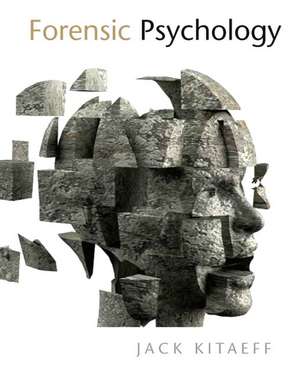
Forensic Psychology
Autor Jack Kitaeffen Limba Engleză Hardback – 31 dec 2009
Preț: 1176.41 lei
Preț vechi: 1527.80 lei
-23%
Puncte Express: 1765
Carte tipărită la comandă
Livrare economică 30 noiembrie-14 decembrie
Livrare prin curier în România Termenul estimat este afișat lângă disponibilitate.
Transport gratuit pentru acest produs Plată online sau ramburs, în funcție de opțiunile comenzii.
Retur gratuit în 14 zile Comandă securizată și suport în română.
Specificații
ISBN-13: 9780132352918
ISBN-10: 0132352915
Pagini: 404
Dimensiuni: 206 x 254 x 25 mm
Greutate: 1 kg
Ediția:1
Editura: Prentice Hall
Locul publicării:Upper Saddle River, United States
ISBN-10: 0132352915
Pagini: 404
Dimensiuni: 206 x 254 x 25 mm
Greutate: 1 kg
Ediția:1
Editura: Prentice Hall
Locul publicării:Upper Saddle River, United States
V-ar putea interesa
-
 A Psychologist's Casebook of Crime: From Arson to VoyeurismBelinda Winder-20%Preț: 329.14 lei411.18 lei
 -
 Preț: 326.84 lei
 -
 Forensic PsychologyAdrian ScottPreț: 128.85 lei
 -
 Forensic Reports and TestimonyRandy K Otto-8%Preț: 403.05 lei438.11 lei
 -
 -18%Preț: 819.64 lei999.56 lei
 -
 Sex Offender TreatmentDaniel T WilcoxPreț: 392.39 lei
 -
 Preț: 142.58 lei
 -
 Profiling Violent CrimesRonald M Holmes-15%Preț: 634.89 lei746.92 lei
 -
 -21%Preț: 384.37 lei484.48 lei
 -
 PsychopathsHerschel PrinsPreț: 154.22 lei
Cuprins
1. History and Current Issues in Forensic Psychology
2. Roles and Responsibilities of Forensic Psychologists
3. Aggression and Violent Crime
4. Non-Violent Crimes
5. Mass Murders and Serial Killers
6. The Psychology of Terrorism, Cults, and Extremism
7. Law Enforcement and Police Psychology
8. Investigations
9. Eyewitness Testimony and Accuracy
10. Psychology of False Confessions and Repressed Memories
11. Capacity and Incapacity
12. Juries and the Courtroom
13. Repressed Memories and Novel Syndromes
14. Forensic Psychology and the Workplace
15. Forensic Psychology Applied to Children and Families
16. Treatment and Rehabilitation in Forensic Psychology
GLOSSARY
REFERENCES
CODES AND AUTHORITIES
2. Roles and Responsibilities of Forensic Psychologists
3. Aggression and Violent Crime
4. Non-Violent Crimes
5. Mass Murders and Serial Killers
6. The Psychology of Terrorism, Cults, and Extremism
7. Law Enforcement and Police Psychology
8. Investigations
9. Eyewitness Testimony and Accuracy
10. Psychology of False Confessions and Repressed Memories
11. Capacity and Incapacity
12. Juries and the Courtroom
13. Repressed Memories and Novel Syndromes
14. Forensic Psychology and the Workplace
15. Forensic Psychology Applied to Children and Families
16. Treatment and Rehabilitation in Forensic Psychology
GLOSSARY
REFERENCES
CODES AND AUTHORITIES
Caracteristici
For undergraduate, graduate, and law school courses in forensic psychology; and for criminology courses that cover forensic psychology.
This book presents a clear, complete picture of forensic psychology, covering both psychological and legal principles, and demonstrating their connections through actual case law and clinical examples. Dr. Jack Kitaeff first reviews the field’s history, and the roles, responsibilities, and obligations of practitioners. Next, he addresses criminological aspects of forensic psychology, examining theories of aggression and violent crime; non-violent crimes; and topics ranging from serial killing to terrorism. He thoroughly reviews forensic psychologists’ roles in law enforcement and the U.S. criminal justice system, and covers crucial issues such as repressed memories, novel syndromes, the workplace, children, families, and treatment.
HALLMARK FEATURES
Thorough coverage of all critical issues in contemporary forensic psychology–including topics missed orunderrepresented in other texts, such as scientific jury selection
This book presents a clear, complete picture of forensic psychology, covering both psychological and legal principles, and demonstrating their connections through actual case law and clinical examples. Dr. Jack Kitaeff first reviews the field’s history, and the roles, responsibilities, and obligations of practitioners. Next, he addresses criminological aspects of forensic psychology, examining theories of aggression and violent crime; non-violent crimes; and topics ranging from serial killing to terrorism. He thoroughly reviews forensic psychologists’ roles in law enforcement and the U.S. criminal justice system, and covers crucial issues such as repressed memories, novel syndromes, the workplace, children, families, and treatment.
HALLMARK FEATURES
Thorough coverage of all critical issues in contemporary forensic psychology–including topics missed orunderrepresented in other texts, such as scientific jury selection
- Captures students’ attention with up-to-date, highly-relevant coverage
- Prepares students for the realities of work in contemporary forensic psychology
- Helps students understand both the capabilities and limitations of the state-of-the-art methods and models used in forensic psychology
- Gives students insights into the application of forensic psychology in national security
- Helps students understand and compare options in treatment and rehabilitation that forensic psychologists may be called upon to evaluate, recommend, or engage in.
- Helps students understand the full spectrum of crimes that forensic psychologists may be called upon to address, prevent, and intervene.
- Helps students clearly assess the legitimacy of psychological claims that are made within the rubric of forensic psychology
- Gives students realistic insights into the preparation they will need to become both academic and practicing forensic psychologists
- Connects students with resources for gaining a deeper understanding, including professional-level resources they may use as working forensic psychologists
- Promotes effective learning and rapid mastery
- Gives students deeper practical insight into the work forensic psychologists actually perform on a day-to-day basis
- Provides the tools instructors need to meet their instructional goals efficiently and effectively