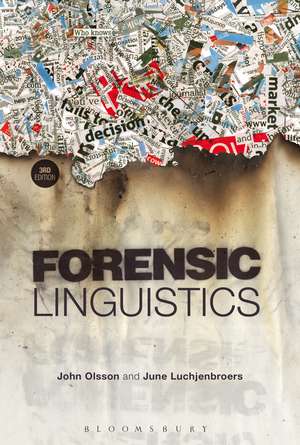
Forensic Linguistics
Autor Dr John Olsson, June Luchjenbroersen Limba Engleză Paperback – 5 dec 2013
new chapters on identifying forensic texts and important interactional aspects of the language used in legal contexts
an additional chapter on forensic phonetics by Harry Hollien, a world renowned forensic phonetician
an appendix of forensic texts for student study, and even more exercises and suggestions for further reading
a companion website with a repository of statements, notes and examples referred to throughout the text.
Preț: 267.21 lei
Preț vechi: 343.40 lei
-22%
Puncte Express: 401
Carte disponibilă
Livrare economică 16-30 noiembrie
Livrare express 30 octombrie-05 noiembrie pentru 118.88 lei
Livrare prin curier în România Termenul estimat este afișat lângă disponibilitate.
Transport gratuit de la 400.00 lei Plată online sau ramburs, în funcție de opțiunile comenzii.
Retur gratuit în 14 zile Comandă securizată și suport în română.
Specificații
ISBN-13: 9781441170767
ISBN-10: 1441170766
Pagini: 368
Dimensiuni: 156 x 234 x 22 mm
Greutate: 0.54 kg
Ediția:3rd Revised edition
Editura: Bloomsbury Publishing
Colecția Bloomsbury Academic
Locul publicării:London, United Kingdom
ISBN-10: 1441170766
Pagini: 368
Dimensiuni: 156 x 234 x 22 mm
Greutate: 0.54 kg
Ediția:3rd Revised edition
Editura: Bloomsbury Publishing
Colecția Bloomsbury Academic
Locul publicării:London, United Kingdom
V-ar putea interesa
-
 The Elements of Murder: A History of PoisonJohn Emsley-18%Preț: 88.27 lei108.14 lei
 -
 Preț: 477.89 lei
 -
 Death's AcreBill BassPreț: 115.28 lei
 -
 Fundamentals of Forensic AnthropologyLinda L Klepinger-9%Preț: 992.04 lei1090.15 lei
 -
 Bog Bodies UncoveredMiranda Aldhouse-GreenPreț: 179.45 lei
 -
 Forensic Facial ReconstructionCaroline Wilkinson-10%Preț: 324.60 lei361.56 lei
 -
 Forensic Applications of Mass SpectrometryJehuda Yinon-18%Preț: 2077.75 lei2533.84 lei
 -
 Communication in Investigative and Legal ContextsGavin OxburghPreț: 370.81 lei
 -
 -20%Preț: 1135.27 lei1419.09 lei
 -
 The Use of Forensic AnthropologyRobert B. Pickering-18%Preț: 1152.21 lei1405.14 lei
 -
 -18%Preț: 1011.57 lei1233.61 lei
 -
 Wordcrime: Solving Crime Through Forensic LinguisticsDr John Olsson-44%Preț: 96.26 lei172.47 lei
 -
 Handbook of Forensic Mental HealthKeith Soothill-15%Preț: 607.90 lei715.17 lei
Cuprins
Introduction.
Part I: Language as Forensic Evidence
1. The road to authorship
2. The author constructed
3. Time, variation and genre
4. Range of variation
5. Textual Variation
6. Forensic phonetics
7. Cybercrime
Part Two: Dealing with linguistic Evidence
8. Forensic texts
9. Forensic transcription
10. Forensic authorship in practice
11. Investigating author variation in naturalistic data
12. Forensic linguistic evidence in court
Part Three: The legal process: Language and the law
13. Power in legal contexts: The courts
14. Power in legal contexts: The police
15. Vulnerable witnesses
Part Four: Language of the law
16. The law and us
17. The language of statutes
Appendix 1: Forensic texts
Appendix 2: Exercises and exercise commentaries
Appendix 3: Active researchers in the field of the forensic linguistics
Bibliography
Author Index
Subject Index
Part I: Language as Forensic Evidence
1. The road to authorship
2. The author constructed
3. Time, variation and genre
4. Range of variation
5. Textual Variation
6. Forensic phonetics
7. Cybercrime
Part Two: Dealing with linguistic Evidence
8. Forensic texts
9. Forensic transcription
10. Forensic authorship in practice
11. Investigating author variation in naturalistic data
12. Forensic linguistic evidence in court
Part Three: The legal process: Language and the law
13. Power in legal contexts: The courts
14. Power in legal contexts: The police
15. Vulnerable witnesses
Part Four: Language of the law
16. The law and us
17. The language of statutes
Appendix 1: Forensic texts
Appendix 2: Exercises and exercise commentaries
Appendix 3: Active researchers in the field of the forensic linguistics
Bibliography
Author Index
Subject Index
Recenzii
[A]n extremely useful book for students and practitioners in a broad range of fields ... [including] law students, practising lawyers, students of applied linguistics, criminologists [and] police officers ... One of the strengths of the book is that real-life legal cases are referred to when illustrating theoretical points ... [A]n informative and accessible text.
This book is vital reading for students and researchers of forensic linguistics and will undoubtedly help to cement interest in the field. It is stunningly comprehensive, addressing a generous range of forensic-related themes and issues: from cyber-terrorism to suicide notes. It takes in spoken, written and computer-mediated communication, examines, in detail, key studies and cases, and is written in a limpid and engaging style. The book also usefully includes a number of practical exercises and insightful commentaries which will prove invaluable to readers wishing to sharpen their forensic analytical sensibilities. This new edition of Forensic Linguistics is a joy to read, and I will be recommending it to all of my students interested in the interface between language and society.
This book is vital reading for students and researchers of forensic linguistics and will undoubtedly help to cement interest in the field. It is stunningly comprehensive, addressing a generous range of forensic-related themes and issues: from cyber-terrorism to suicide notes. It takes in spoken, written and computer-mediated communication, examines, in detail, key studies and cases, and is written in a limpid and engaging style. The book also usefully includes a number of practical exercises and insightful commentaries which will prove invaluable to readers wishing to sharpen their forensic analytical sensibilities. This new edition of Forensic Linguistics is a joy to read, and I will be recommending it to all of my students interested in the interface between language and society.