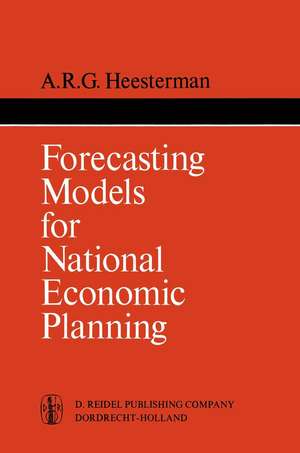
Forecasting Models for National Economic Planning: International Studies in Economics and Econometrics, cartea 2
Autor Aaart R. Heestermanen Limba Engleză Paperback – 6 noi 2011
Din seria International Studies in Economics and Econometrics
-
 Preț: 389.87 lei
 -
 Preț: 380.82 lei
 -
 Preț: 378.44 lei
 -
 Preț: 382.49 lei
 - 15%
 Preț: 619.12 lei
 -
 Preț: 378.69 lei
 -
 Preț: 375.81 lei
 -
 Preț: 378.19 lei
 -
 Preț: 385.60 lei
 -
 Preț: 377.24 lei
 -
 Preț: 377.79 lei
 -
 Preț: 370.78 lei
 -
 Preț: 371.23 lei
 -
 Preț: 375.81 lei
 -
 Preț: 371.73 lei
 -
 Preț: 372.96 lei
 - 15%
 Preț: 618.03 lei
 - 15%
 Preț: 615.22 lei
 -
 Preț: 371.03 lei
 -
 Preț: 375.00 lei
 - 18%
 Preț: 918.59 lei
 - 15%
 Preț: 615.05 lei
 - 15%
 Preț: 618.64 lei
 - 18%
 Preț: 917.56 lei
 - 18%
 Preț: 915.73 lei
 -
 Preț: 372.96 lei
 - 15%
 Preț: 620.68 lei
 - 15%
 Preț: 620.38 lei
 - 18%
 Preț: 910.58 lei
 - 18%
 Preț: 908.61 lei
 -
 Preț: 368.16 lei
 -
 Preț: 367.02 lei
 -
 Preț: 383.23 lei
 -
 Preț: 371.11 lei
 - 15%
 Preț: 617.08 lei
Preț: 366.02 lei
Puncte Express: 549
Carte tipărită la comandă
Livrare economică 08-22 iunie
Specificații
ISBN-13: 9789401031417
ISBN-10: 940103141X
Pagini: 172
Ilustrații: 166 p.
Dimensiuni: 152 x 229 x 9 mm
Greutate: 0.24 kg
Ediția:2nd ed. 1972
Editura: SPRINGER NETHERLANDS
Colecția Springer
Seria International Studies in Economics and Econometrics
Locul publicării:Dordrecht, Netherlands
ISBN-10: 940103141X
Pagini: 172
Ilustrații: 166 p.
Dimensiuni: 152 x 229 x 9 mm
Greutate: 0.24 kg
Ediția:2nd ed. 1972
Editura: SPRINGER NETHERLANDS
Colecția Springer
Seria International Studies in Economics and Econometrics
Locul publicării:Dordrecht, Netherlands
V-ar putea interesa
-
 Minitab DemystifiedAndrew Sleeper-32%Preț: 245.28 lei359.15 lei
 -
 A Practical Guide to Price Index and Hedonic TechniquesAna M. Aizcorbe-31%Preț: 487.57 lei707.45 lei
 -
 Workbook on CointegrationPeter Reinhard Hansen-24%Preț: 351.97 lei464.12 lei
 -
 -34%Preț: 940.66 lei1420.93 lei
 -
 Naked StatisticsCharles WheelanPreț: 94.62 lei
 -
 How to Measure Anything WorkbookDouglas W HubbardPreț: 166.12 lei
 -
 Ensemble Methods: Foundations and AlgorithmsZhi-Hua Zhou-20%Preț: 654.08 lei817.59 lei
 -
 Business Analytics for ManagersWolfgang Jank-15%Preț: 505.72 lei594.96 lei
Public țintă
ResearchCuprins
Preface and Introduction.- Preface to the Second Edition.- I. The Basic Concepts of Linear Models.- 1.1. Economic Equation Systems.- 1.2. Some Conventions of Notation.- 1.3. The Basic Block-Equation.- 1.4. Some Types of Relations.- 1.5. The Nature of Stochastic Relations.- 1.6. Instruments, Target-Variables and Data.- 1.7. The Conditional Forecast.- 1.8. The Reduced Form.- 1.9. Subsystems.- II. The Short-term Forecasting Model.- 2.1. What is’ short-Term’?.- 2.2. An Example of a Short-Term Model.- 2.3. Linear Approximation.- 2.4. Production, Income and its Distribution.- 2.5. The Institutional Relations.- 2.6. The Demand for Production Factors.- 2.7. The Consumption Function.- 2.8. The Demand for Investment Goods.- 2.9. The Demand for Inventories.- 2.10. The Price Equations.- 2.11. Supply and Demand.- 2.12. Capacity.- 2.13. Built-in Stabilizers.- 2.14. The Use of Percentage Increments.- 2.15. Summary of the Short-Term Forecasting Model.- III. The (Static) Input-Output Model.- 3.1. Use of the Input-Output Model.- 3.2. The Input-Output Table.- 3.3. The Input-Output Production Model.- 3.4. The Matrix Formulae.- 3.5. Cumulative Input-Output Coefficients.- 3.6. Allocation under Capacity Limits.- 3.7. Artificial Sectors.- 3.8. The Input-Output Costing Model.- 3.9. Units of Measurement.- 3.10. The Requirements of Productiveness.- 3.11. The Generalized Input-Output Model.- 3.12. Regional Input-Output Models.- 3.13. History of Input-Output Analysis.- IV. Some Building Stones of Sectorized Models.- 4.1. The Extended Input-Output Model.- 4.2. Average and Marginal Input Coefficients.- 4.3. Stone’s Linear Expenditure System.- 4.4. Price-Based Substitution in Input-Output Models.- 4.5. An Input-Output System with Substitution and Technical Progress.- 4.6. Unequal Lags.- V.Capital-Output Ratios.- 5.1. The Harrod-Domar Model.- 5.2. Those Awful Data.- 5.3. The Role of Technical Innovation.- 5.4. The Computation of Capital-Output Ratios.- 5.5. In Defence of the Gross Ratio.- VI. The Dynamics of Economic Growth.- 6.1. The Dynamic Input-Output Model.- 6.2. The Accelerator Model.- 6.3. The Quasi-Static Model.- 6.4. The National Plan.- VII. Dynamic Adjustment Models and their Convergence.- 7.1. The Dichotomy.- 7.2. The Causal Chain.- 7.3. The Cumulative Forecast.- 7.4. The Long-Run Equilibrium.- 7.5. The Problem of Stability.- 7.6. The’ simple’ Long-Term Model.- VIII. Forecast and Policy.- 8.1. Data and Instruments.- 8.2. The Policy Programming Problem.- 8.3. Tinbergen’s Method of Instruments and Targets.- 8.4. Theil’s Quadratic Programming Approach.- List of some of the Tables and the Examples to which they belong.