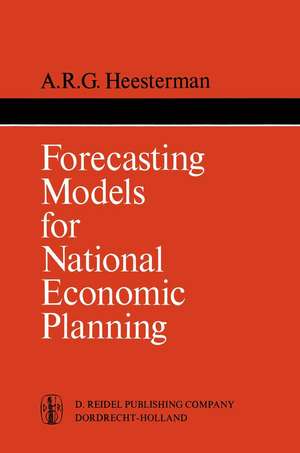
Forecasting Models for National Economic Planning: International Studies in Economics and Econometrics, cartea 2
Autor Aaart R. Heestermanen Limba Engleză Paperback – 6 noi 2011
Din seria International Studies in Economics and Econometrics
-
 Preț: 389.87 lei
-
 Preț: 380.82 lei
-
 Preț: 378.44 lei
-
 Preț: 382.49 lei
- 15%
 Preț: 663.36 lei
-
 Preț: 378.69 lei
-
 Preț: 375.81 lei
-
 Preț: 378.19 lei
-
 Preț: 385.60 lei
-
 Preț: 392.00 lei
-
 Preț: 377.79 lei
-
 Preț: 370.78 lei
-
 Preț: 371.23 lei
-
 Preț: 375.81 lei
-
 Preț: 371.73 lei
-
 Preț: 372.96 lei
- 15%
 Preț: 618.03 lei
- 15%
 Preț: 677.52 lei
-
 Preț: 371.03 lei
-
 Preț: 389.67 lei
- 18%
 Preț: 985.52 lei
- 15%
 Preț: 615.05 lei
- 15%
 Preț: 662.17 lei
- 18%
 Preț: 984.26 lei
- 18%
 Preț: 911.64 lei
- 18%
 Preț: 982.14 lei
-
 Preț: 372.96 lei
- 15%
 Preț: 650.34 lei
- 18%
 Preț: 910.58 lei
-
 Preț: 397.72 lei
-
 Preț: 367.02 lei
-
 Preț: 383.23 lei
-
 Preț: 371.11 lei
- 15%
 Preț: 660.08 lei
- 15%
 Preț: 610.50 lei
Preț: 403.14 lei
Puncte Express: 605
Carte tipărită la comandă
Livrare economică 06-20 ianuarie 27
Livrare prin curier în România Termenul estimat este afișat lângă disponibilitate.
Transport gratuit pentru acest produs Plată online sau ramburs, în funcție de opțiunile comenzii.
Retur gratuit în 14 zile Comandă securizată și suport în română.
Specificații
ISBN-13: 9789401031417
ISBN-10: 940103141X
Pagini: 172
Ilustrații: 166 p.
Dimensiuni: 152 x 229 x 10 mm
Greutate: 0.26 kg
Ediția:Second Edition 1972
Editura: Springer
Colecția International Studies in Economics and Econometrics
Seria International Studies in Economics and Econometrics
Locul publicării:Dordrecht, Netherlands
V-ar putea interesa
-
 Minitab DemystifiedAndrew Sleeper-36%Preț: 236.00 lei371.13 lei
-
 A Practical Guide to Price Index and Hedonic TechniquesAna M. Aizcorbe-27%Preț: 556.08 lei763.91 lei
-
 Workbook on CointegrationPeter Reinhard Hansen-27%Preț: 403.50 lei555.23 lei
-
 -31%Preț: 1076.08 lei1560.24 lei
-
 Naked StatisticsCharles WheelanPreț: 103.81 lei
-
 How to Measure Anything WorkbookDouglas W HubbardPreț: 181.58 lei
-
 Ensemble Methods: Foundations and AlgorithmsZhi-Hua Zhou-20%Preț: 717.17 lei896.47 lei
-
 Business Analytics for ManagersWolfgang Jank-15%Preț: 525.61 lei618.36 lei
Public țintă
ResearchCuprins
Preface and Introduction.- Preface to the Second Edition.- I. The Basic Concepts of Linear Models.- 1.1. Economic Equation Systems.- 1.2. Some Conventions of Notation.- 1.3. The Basic Block-Equation.- 1.4. Some Types of Relations.- 1.5. The Nature of Stochastic Relations.- 1.6. Instruments, Target-Variables and Data.- 1.7. The Conditional Forecast.- 1.8. The Reduced Form.- 1.9. Subsystems.- II. The Short-term Forecasting Model.- 2.1. What is’ short-Term’?.- 2.2. An Example of a Short-Term Model.- 2.3. Linear Approximation.- 2.4. Production, Income and its Distribution.- 2.5. The Institutional Relations.- 2.6. The Demand for Production Factors.- 2.7. The Consumption Function.- 2.8. The Demand for Investment Goods.- 2.9. The Demand for Inventories.- 2.10. The Price Equations.- 2.11. Supply and Demand.- 2.12. Capacity.- 2.13. Built-in Stabilizers.- 2.14. The Use of Percentage Increments.- 2.15. Summary of the Short-Term Forecasting Model.- III. The (Static) Input-Output Model.- 3.1. Use of the Input-Output Model.- 3.2. The Input-Output Table.- 3.3. The Input-Output Production Model.- 3.4. The Matrix Formulae.- 3.5. Cumulative Input-Output Coefficients.- 3.6. Allocation under Capacity Limits.- 3.7. Artificial Sectors.- 3.8. The Input-Output Costing Model.- 3.9. Units of Measurement.- 3.10. The Requirements of Productiveness.- 3.11. The Generalized Input-Output Model.- 3.12. Regional Input-Output Models.- 3.13. History of Input-Output Analysis.- IV. Some Building Stones of Sectorized Models.- 4.1. The Extended Input-Output Model.- 4.2. Average and Marginal Input Coefficients.- 4.3. Stone’s Linear Expenditure System.- 4.4. Price-Based Substitution in Input-Output Models.- 4.5. An Input-Output System with Substitution and Technical Progress.- 4.6. Unequal Lags.- V.Capital-Output Ratios.- 5.1. The Harrod-Domar Model.- 5.2. Those Awful Data.- 5.3. The Role of Technical Innovation.- 5.4. The Computation of Capital-Output Ratios.- 5.5. In Defence of the Gross Ratio.- VI. The Dynamics of Economic Growth.- 6.1. The Dynamic Input-Output Model.- 6.2. The Accelerator Model.- 6.3. The Quasi-Static Model.- 6.4. The National Plan.- VII. Dynamic Adjustment Models and their Convergence.- 7.1. The Dichotomy.- 7.2. The Causal Chain.- 7.3. The Cumulative Forecast.- 7.4. The Long-Run Equilibrium.- 7.5. The Problem of Stability.- 7.6. The’ simple’ Long-Term Model.- VIII. Forecast and Policy.- 8.1. Data and Instruments.- 8.2. The Policy Programming Problem.- 8.3. Tinbergen’s Method of Instruments and Targets.- 8.4. Theil’s Quadratic Programming Approach.- List of some of the Tables and the Examples to which they belong.