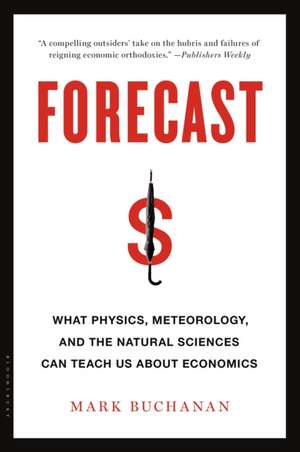
Forecast
Autor Mark Buchananen Limba Engleză Paperback – 3 iun 2014
In Forecast, physicist and acclaimed science writer Mark Buchanan answers these questions and more in building a new model for economics, one that accepts that markets act much like the weather does. While centuries of classical financial thought has trained us to understand "the market" as something that always returns to equilibrium, economies work more like our atmosphere-a loose surface balance riding on a deeper torrent of fluctuation. Market instability is as natural-and dangerous-as a prairie twister. With Buchanan's help, we can better govern the markets and weather their storms.
Preț: 78.89 lei
Preț vechi: 106.68 lei
-26%
Puncte Express: 118
Carte tipărită la comandă
Livrare economică 05-19 decembrie
Livrare prin curier în România Termenul estimat este afișat lângă disponibilitate.
Transport gratuit de la 400.00 lei Plată online sau ramburs, în funcție de opțiunile comenzii.
Retur gratuit în 14 zile Comandă securizată și suport în română.
Specificații
ISBN-13: 9781608198535
ISBN-10: 1608198537
Pagini: 272
Ilustrații: B&W illustrations throughout
Dimensiuni: 138 x 216 x 20 mm
Greutate: 0.35 kg
Editura: Bloomsbury Publishing
Locul publicării:New York, United States
ISBN-10: 1608198537
Pagini: 272
Ilustrații: B&W illustrations throughout
Dimensiuni: 138 x 216 x 20 mm
Greutate: 0.35 kg
Editura: Bloomsbury Publishing
Locul publicării:New York, United States
V-ar putea interesa
-
 The PlantagenetsDan JonesPreț: 96.30 lei
 -
 Modelling Economic Series: Readings in Econometric MethodologyC. W. J. Granger-17%Preț: 353.27 lei425.25 lei
 -
 -28%Preț: 551.88 lei763.19 lei
 -
 -18%Preț: 364.05 lei443.80 lei
 -
 An Introduction to State Space Time Series AnalysisJacques J.F. Commandeur-30%Preț: 607.59 lei868.35 lei
 -
 Econometric Analysis of Cross Section and Panel DataJeffrey M. Wooldridge-18%Preț: 744.63 lei907.13 lei
 -
 Contemporary EconomicsRobert J. Carbaugh-19%Preț: 539.90 lei666.54 lei
 -
 Only the Paranoid SurviveAndrew S. GrovePreț: 109.10 lei
 -
 The Economy of CitiesJane JacobsPreț: 92.41 lei
 -
 Preț: 106.40 lei
 -
 Proust Was a NeuroscientistJonah LehrerPreț: 77.57 lei
 -
 Capitalism 4.0: The Birth of a New EconomyAnatole Kaletsky-27%Preț: 64.97 lei89.47 lei
 -
 Preț: 451.40 lei
 -
 When Prime Brokers FailJ S AikmanPreț: 301.62 lei
 -
 Preț: 120.85 lei
 -
 Capitalism as if the World MattersJonathon PorrittPreț: 366.63 lei
 -
 Factor Five: Transforming the Global Economy through 80% Improvements in Resource ProductivityErnst Ulrich von Weizsacker-18%Preț: 1319.89 lei1609.62 lei
 -
 The Return of Depression EconomicsPaul Krugman-32%Preț: 62.97 lei92.20 lei
Recenzii
The 2008 crash created not just a crisis in the economy, but also a crisis in economic thinking. Ideas of market stability and efficiency lost their value faster than a sub-prime mortgage. In this compelling and lively account, Mark Buchanan tells the story of the new ideas that are revolutionizing the field. We may not be able to perfectly forecast the economic weather, but we can be better prepared for storms to come.
The author's stimulating deconstruction of contemporary economic theory parallels a treatment of major positive developments in physical sciences and pays due respect to the functions of government and law.
The author's stimulating deconstruction of contemporary economic theory parallels a treatment of major positive developments in physical sciences and pays due respect to the functions of government and law.
Notă biografică
Physicist Mark Buchanan is a former editor at Nature and New Scientist, and is the author of numerous magazine and newspaper articles internationally. He currently writes monthly columns for the financial media outlet Bloomberg View, as well as for Nature Physics. He has written two prize-nominated non-fiction books, Ubiquity: The Science of History and Nexus: Small Worlds and the Groundbreaking Science of Networks, and, most recently, The Social Atom. He lives in Dorset, England.
http://physicsoffinance.blogspot.co.uk/
http://physicsoffinance.blogspot.co.uk/