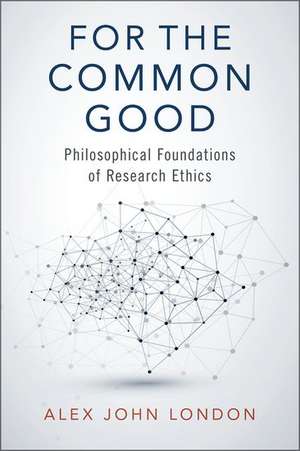
For the Common Good: Philosophical Foundations of Research Ethics
Autor Alex John Londonen Limba Engleză Hardback – 29 apr 2022
Preț: 670.11 lei
Preț vechi: 990.90 lei
-32%
Puncte Express: 1005
Carte disponibilă
Livrare economică 06-17 noiembrie
Livrare prin curier în România Termenul estimat este afișat lângă disponibilitate.
Transport gratuit pentru acest produs Plată online sau ramburs, în funcție de opțiunile comenzii.
Retur gratuit în 14 zile Comandă securizată și suport în română.
Specificații
ISBN-13: 9780197534830
ISBN-10: 019753483X
Pagini: 476
Dimensiuni: 243 x 164 x 39 mm
Greutate: 0.93 kg
Editura: Oxford University Press
Colecția OUP USA
Locul publicării:New York, United States
ISBN-10: 019753483X
Pagini: 476
Dimensiuni: 243 x 164 x 39 mm
Greutate: 0.93 kg
Editura: Oxford University Press
Colecția OUP USA
Locul publicării:New York, United States
V-ar putea interesa
-
 The Oxford Handbook of Research EthicsAna S. Iltis-23%Preț: 1264.78 lei1642.57 lei
 -
 -25%Preț: 506.54 lei674.87 lei
 -
 Oxford Handbook of Clinical and Healthcare ResearchSumantra Ray-17%Preț: 295.75 lei358.39 lei
 -
 How Not to Die (Too Soon)Devi SridharPreț: 159.77 lei
 -
 Don't Burn Anyone at the Stake TodayNaomi AldermanPreț: 121.20 lei
 -
 Good Will CorruptingAdam Moe Fejerskov-5%Preț: 349.17 lei367.55 lei
 -
 The Morality of LawLon L. FullerPreț: 195.53 lei
 -
 -31%Preț: 221.67 lei320.80 lei
 -
 The Common GoodRobert B. Reich-31%Preț: 85.70 lei124.75 lei
 -
 Against the MachinePaul KingsnorthPreț: 193.57 lei
 -
 Universal Methods of Ethical DesignColin Gray-17%Preț: 192.67 lei232.12 lei
 -
 Rethinking Healthcare Improvement: Philosophy and Ethics in PracticeProfessor Alan Cribb-11%Preț: 144.69 lei162.58 lei
 -
 Imagine Doing BetterPaul J. FlemingPreț: 172.80 lei
 -
 Evaluating and Valuing in Social ResearchThomas A. SchwandtPreț: 351.80 lei
 -
 The Rich and the PoorPhilip KitcherPreț: 166.22 lei
 -
 Morality and ResponsibilityT. M. ScanlonPreț: 184.49 lei
 -
 Imperfect OracleCass R. SunsteinPreț: 151.40 lei
 -
 Human Subjects Research: Protecting ParticipantsJustin R Ward-27%Preț: 1600.51 lei2183.78 lei
 -
 Can We Be Great Again?Jeremy HuntPreț: 184.48 lei
 -
 The ImmortalistsAleks KrotoskiPreț: 123.00 lei
Recenzii
An exceptional book that should receive wide attention... much of the field has been groping piecemeal toward what London has done in this book... a philosophical tour de force... this book deserves to be recognized as a vital foundation on which policy progress should-indeed, must-be built.
London's new book is a remarkable achievement. It offers a compelling and coherent vision of the philosophical foundations of research ethics, resituating the research enterprise within the broader activity of creating a just social order.... it provides an attractive, systematic alternative to prominent approaches which neglect this value in favor of the principles of beneficence and respect for persons. Despite his focus on the philosophical foundations of research ethics, moreover, London's analysis is informed by his deep knowledge of the practices of research and ethics oversight. For the Common Good makes a major contribution to the field of research ethics.
While I do not agree with London's overall approach to foundations of human research ethics, I have learned a great deal from reading his book. The book has helped me to see familiar issues in a different way and has prompted me to rethink my own views. London succeeds in showing why it is necessary to expand the scope of human research ethics beyond its current confines to adequately deal with questions of national and international justice. He also succeeds in developing a rigorous and thoughtful approach to the foundations of human research ethics that is likely to stimulate further inquiry and debate. Based on these two accomplishments alone, London's book can be regarded as a major contribution to the literature on human research ethics and its philosophical foundations.
The book is a valuable contribution to a growing body of literature that expresses dissatisfaction with the current state of biomedical research. The recent COVID-19 pandemic has brought matters of research ethics closer to the fore, and not always with favorable results. It may be that now is as good a time as any to rethink our research institutions. London's book is a model for how philosophers can contribute, and if they would like to help, familiarity with his ideas should be part of the table stakes for the conversation.
An outstanding work. London has produced a book that is philosophically rich and practically relevant with deep insights about justice, the common good, and risk in a pluralistic society. It offers a compelling vision of research as a democratic activity that produces an important social good and it will repay careful study from philosophers and policy makers alike.
For the Common Good is a ground-breaking book. Alex John London argues persuasively for an expanded vision of the conception and practice of ethics in research that locates justice at the heart of the research enterprise. The result is a tour de force in moral philosophy and practical ethics.
With this volume, Alex John London makes a major contribution to the research ethics literature. His analysis is broad and deep, delivering new insights on well-studied topics and illuminating neglected concepts such as the social value of research. For the Common Good is destined to become an essential resource for scholars, students, policymakers, and others seeking to develop a just and fair research enterprise
A view has become entrenched that the interests of the tiny proportion of patients who participate in clinical trials addressing treatment uncertainties are more in need of protection than are the vastly greater numbers of patients being offered the same treatments in the 'uncontrolled experiments' of everyday clinical practice. This double standard and other poorly thought-through features of research ethics are brilliantly challenged by Alex John London in For The Common Good. This important book shows how the interests of society and of individual research participants can be promoted concurrently.
Alex John London's recent book is a sustained argument for placing justice at the heart of research. In keeping with Rawls's famous dictum, 'justice is the first virtue of social institutions,' London seeks to elevate justice from its current role as third fiddle-behind beneficence and autonomy-to the central and orienting concept of research ethics...the fact that London succeeds in recasting the core issues of research ethics and moving them into the realm of social and political philosophy is a significant boon for the field. For the Common Good deserves to set the agenda for foundational work in research ethics for years to come.
London is remarkably successful. The book is a singular work of ambition and scope, yielding promising analyses of a wide range of issues, from a comprehensive approach to research riskâassessment, to the ethics of international research, control arms, adaptive designs, learning health systems, and a nonpaternalistic account of research oversight, among others. It is consistently penetrating, combining meticulous argument with illuminating exposition of the historical roots of the discipline and its formative debates...For the Common Good deserves to set the agenda for foundational work in research ethics for years to come.
London's new book is a remarkable achievement. It offers a compelling and coherent vision of the philosophical foundations of research ethics, resituating the research enterprise within the broader activity of creating a just social order.... it provides an attractive, systematic alternative to prominent approaches which neglect this value in favor of the principles of beneficence and respect for persons. Despite his focus on the philosophical foundations of research ethics, moreover, London's analysis is informed by his deep knowledge of the practices of research and ethics oversight. For the Common Good makes a major contribution to the field of research ethics.
While I do not agree with London's overall approach to foundations of human research ethics, I have learned a great deal from reading his book. The book has helped me to see familiar issues in a different way and has prompted me to rethink my own views. London succeeds in showing why it is necessary to expand the scope of human research ethics beyond its current confines to adequately deal with questions of national and international justice. He also succeeds in developing a rigorous and thoughtful approach to the foundations of human research ethics that is likely to stimulate further inquiry and debate. Based on these two accomplishments alone, London's book can be regarded as a major contribution to the literature on human research ethics and its philosophical foundations.
The book is a valuable contribution to a growing body of literature that expresses dissatisfaction with the current state of biomedical research. The recent COVID-19 pandemic has brought matters of research ethics closer to the fore, and not always with favorable results. It may be that now is as good a time as any to rethink our research institutions. London's book is a model for how philosophers can contribute, and if they would like to help, familiarity with his ideas should be part of the table stakes for the conversation.
An outstanding work. London has produced a book that is philosophically rich and practically relevant with deep insights about justice, the common good, and risk in a pluralistic society. It offers a compelling vision of research as a democratic activity that produces an important social good and it will repay careful study from philosophers and policy makers alike.
For the Common Good is a ground-breaking book. Alex John London argues persuasively for an expanded vision of the conception and practice of ethics in research that locates justice at the heart of the research enterprise. The result is a tour de force in moral philosophy and practical ethics.
With this volume, Alex John London makes a major contribution to the research ethics literature. His analysis is broad and deep, delivering new insights on well-studied topics and illuminating neglected concepts such as the social value of research. For the Common Good is destined to become an essential resource for scholars, students, policymakers, and others seeking to develop a just and fair research enterprise
A view has become entrenched that the interests of the tiny proportion of patients who participate in clinical trials addressing treatment uncertainties are more in need of protection than are the vastly greater numbers of patients being offered the same treatments in the 'uncontrolled experiments' of everyday clinical practice. This double standard and other poorly thought-through features of research ethics are brilliantly challenged by Alex John London in For The Common Good. This important book shows how the interests of society and of individual research participants can be promoted concurrently.
Alex John London's recent book is a sustained argument for placing justice at the heart of research. In keeping with Rawls's famous dictum, 'justice is the first virtue of social institutions,' London seeks to elevate justice from its current role as third fiddle-behind beneficence and autonomy-to the central and orienting concept of research ethics...the fact that London succeeds in recasting the core issues of research ethics and moving them into the realm of social and political philosophy is a significant boon for the field. For the Common Good deserves to set the agenda for foundational work in research ethics for years to come.
London is remarkably successful. The book is a singular work of ambition and scope, yielding promising analyses of a wide range of issues, from a comprehensive approach to research riskâassessment, to the ethics of international research, control arms, adaptive designs, learning health systems, and a nonpaternalistic account of research oversight, among others. It is consistently penetrating, combining meticulous argument with illuminating exposition of the historical roots of the discipline and its formative debates...For the Common Good deserves to set the agenda for foundational work in research ethics for years to come.
Notă biografică
Alex John London is the Clara L. West Professor of Ethics and Philosophy and Director of the Center for Ethics and Policy at Carnegie Mellon University. An elected Fellow of the Hastings Center, Professor London's work addresses ethical and philosophical questions at the foundations of medicine, biotechnology and artificial intelligence. His more than 100 published papers or book chapters have appeared in Mind, The Philosopher's Imprint, Science, JAMA, The Lancet, The BMJ, PLoS Medicine, Statistics In Medicine, The Hastings Center Report, and numerous other journals and collections. He has served as an ethics expert in consultations with numerous national and international organizations including the World Health Organization, the World Medical Association, the World Bank, the U.S. National Institutes of Health, and the U.S. National Academy of Medicine. He is also co-editor of Ethical Issues in Modern Medicine, one of the most widely used textbooks in medical ethics.