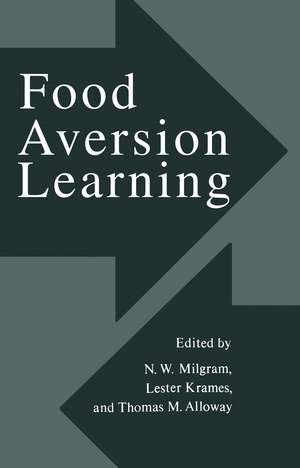
Food Aversion Learning
Editat de N. Milgramen Limba Engleză Paperback – 29 aug 2012
Preț: 355.83 lei
Preț vechi: 374.56 lei
-5%
Puncte Express: 534
Carte tipărită la comandă
Livrare economică 10-24 octombrie
Livrare prin curier în România Termenul estimat este afișat lângă disponibilitate.
Transport gratuit de la 400.00 lei Plată online sau ramburs, în funcție de opțiunile comenzii.
Retur gratuit în 14 zile Comandă securizată și suport în română.
Specificații
ISBN-13: 9781475713015
ISBN-10: 1475713010
Pagini: 280
Ilustrații: XV, 263 p. 30 illus.
Dimensiuni: 152 x 229 x 16 mm
Greutate: 0.41 kg
Ediția:Softcover reprint of the original 1st ed. 1977
Editura: Springer
Locul publicării:New York, NY, United States
ISBN-10: 1475713010
Pagini: 280
Ilustrații: XV, 263 p. 30 illus.
Dimensiuni: 152 x 229 x 16 mm
Greutate: 0.41 kg
Ediția:Softcover reprint of the original 1st ed. 1977
Editura: Springer
Locul publicării:New York, NY, United States
V-ar putea interesa
-
 Deja Review Internal Medicine, 2nd EditionSarvenaz Saadat-5%Preț: 202.94 lei213.62 lei
 -
 Clinical Medicine: A Clerking CompanionDavid Randall-16%Preț: 392.76 lei469.47 lei
 -
 Advances in Molecular OncologyFabrizio D'Adda Di Fagagna-5%Preț: 1367.22 lei1439.18 lei
 -
 How to Listen so Parents Will Talk and Talk so Parents Will ListenJ Sommers–Flanaga-5%Preț: 376.37 lei396.18 lei
 -
 Lymph Node CytopathologyStefan E. Pambuccian-5%Preț: 1030.27 lei1084.49 lei
 -
 Heart Diseases in ChildrenRa-Id Abdulla-5%Preț: 736.01 lei774.75 lei
 -
 Hormonal Regulation of the Menstrual CycleJ. G. Gruhn-5%Preț: 352.59 lei371.15 lei
 -
 Core Concepts in Dialysis and Continuous TherapiesColm C. Magee-5%Preț: 1048.93 lei1104.14 lei
 -
 Antiphospholipid SyndromeDoruk Erkan-5%Preț: 784.79 lei826.10 lei
 -
 -5%Preț: 390.44 lei410.99 lei
 -
 OSCE and Clinical Skills HandbookKatrina F. Hurley-28%Preț: 365.73 lei509.37 lei
Public țintă
ResearchCuprins
1 Learning as a General Process with an Emphasis on Data from Feeding Experiments.- 1. Deficiencies of Traditional Learning Theories.- 2. Neoevolutionary Learning Theories.- 3. Food Aversion Learning Governed by a General Process.- 4. The Epistemic Part of the General Learning Process.- 5. References.- Appendix to Chapter 1 Interference with Progress by the Scientific Establishment: Examples from Flavor Aversion Learning.- 2.1. Sociology of T2.- 2.2. How T2 Is Hidden.- 2.3. Society and T2.- 2 Biological Significance of Food Aversion Learning.- 1. The “Learning-as-a-General-Process” Assumption.- 2. Are the Specialized Features of Food Aversion Learning Adaptive?.- 3. Does Our Understanding of Food Aversion Learning Have Implications Regarding the Mechanisms of Learning in Other Situations?.- 4. References.- 3 Stimulus Characteristics in Food Aversion Learning.- 1. Sensory Modalities.- 2. Parameters of Taste.- 3. Species Differences.- 4. References.- 4 Gustatory Avoidance Conditioning by Drugs of Abuse: Relationships to General Issues in Research on Drug Dependence.- 1. Some General Issues.- 2. Studies of Mechanism: How Does the UCS Work?.- 3. An Area of Conflict: Interpreting the Effects of Prior Exposure to the UCS on Subsequent Conditioning.- 4. Summing Up.- 5. References.- 5 Suppression of Interspecific Aggression Using Toxic Reinforcers.- 1. Introduction.- 2. Muricide, the Mouse-Killing Response of Rats.- 3. Some Species Differences: Suppression of Interspecific Aggression by Food Aversions in Predatory Species.- 4. Conclusions.- 5. References.- 6 Koalas, Men, and Other Conditioned Gastronomes.- 1. Naturalistic and Anthropological Observations on Diet Selection.- 2. Experience and Taste Preference.- 3. Neural Structure and Feeding Function.- 4. Summary: ThePrototypical Gastronome.- 5. References.- 7 Physiological Mechanisms of Conditioned Food Aversion.- 1. Introduction.- 2. Functional Organization of CFA Circuits.- 3. ECS Studies.- 4. Drug Effects.- 5. Developmental Studies.- 6. Electrophysiological Analysis.- 7. Conclusions.- 8. References.