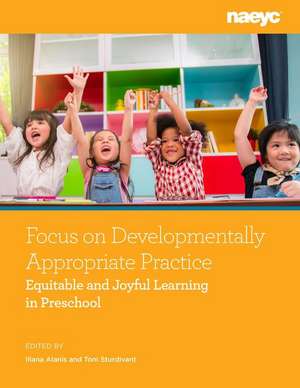
Focus on Developmentally Appropriate Practice: Focus on DAP: Equitable and Joyful Learning
Editat de Iliana Alanís, Toni Sturdivanten Limba Engleză Paperback – 25 apr 2023
În această ediție din seria Focus on DAP: Equitable and Joyful Learning, remarcăm o schimbare de paradigmă în aplicarea conceptului de practică adecvată dezvoltării (DAP) prin accentul pus pe echitate și incluziune. Volumul nu se limitează la teorie, ci introduce capitole noi care adresează direct provocările actuale, precum prevenirea practicilor de disciplină care pot duce la excludere și primirea copiilor cu dizabilități în comunitatea de învățare. Structura este riguros organizată în jurul a șase linii directoare fundamentale, de la documentarea dezvoltării copilului la profesionalismul cadrului didactic.
Recomandăm acest titlu pentru modul în care reușește să transforme conceptele abstracte în realități vizibile. Cartea acoperă aceeași arie tematică precum volumul fundamental Developmentally Appropriate Practice in Early Childhood Programs Serving Children from Birth Through Age 8, Fourth Edition (Fully Revised and Updated) al Naeyc, dar cu o abordare mult mai practică și aplicată. În timp ce textul de referință stabilește cadrul teoretic general, Focus on Developmentally Appropriate Practice funcționează ca un ghid de implementare, oferind exemple concrete pe care educatorii le pot modela și adapta în propriile clase.
Progresia conținutului este logică, începând cu crearea unei comunități de învățare bazate pe grijă și continuând cu parteneriatele reciproce cu familiile. Un element distinctiv este includerea unor articole din revistele de specialitate ale National Association for the Education of Young Children, îmbogățite cu fotografii color ce surprind momente de interacțiune autentică. Credem că această resursă este esențială pentru educatorii care doresc să echilibreze standardele curriculare cu nevoile individuale ale copiilor preșcolari, asigurând un mediu de învățare plin de bucurie.
Preț: 223.38 lei
Carte disponibilă
Livrare economică 23 septembrie-07 octombrie
Specificații
ISBN-10: 1952331102
Pagini: 176
Ilustrații: 4-color, 20-30 photos
Dimensiuni: 208 x 272 x 10 mm
Greutate: 0.45 kg
Editura: National Association for the Education of Young Children
Seria Focus on DAP: Equitable and Joyful Learning
De ce să citești această carte
Această carte este indispensabilă educatorilor din învățământul preșcolar care doresc să aplice principiile DAP în mod intenționat și echitabil. Cititorul câștigă strategii validate pentru gestionarea disciplinei prin ghidare și metode de a construi punți reale cu familiile diverse. Este un instrument practic ce transformă sala de grupă într-un spațiu incluziv, oferind modele clare de urmat pentru o predare de înaltă calitate.
Despre autor
Iliana Alanís și Toni Sturdivant sunt editorii acestei lucrări publicate sub egida National Association for the Education of Young Children (NAEYC). Iliana Alanís este recunoscută pentru expertiza sa în educația timpurie, cu un accent deosebit pe bilingvism și pedagogia critică în primii ani de studiu. Toni Sturdivant aduce o perspectivă valoroasă asupra echității rasiale și a reprezentării culturale în educația preșcolară. Împreună, coordonează această serie pentru a oferi cadrelor didactice resurse care îmbină cercetarea academică cu realitățile de la catedră, promovând standarde de excelență în îngrijirea și educarea copiilor mici.
Notă biografică
Cuprins
- About the Editors
- Focus on Developmentally Appropriate Practice: Equitable and Joyful Learning Book Series
- Developmentally Appropriate Practice: An Introduction
- Developmentally Appropriate Practice in Preschool
- Part 1: Creating a Caring, Equitable Community of Learners
- Chapter 1: The Power of “Good Morning” | Sarah Calzone
- Chapter 2: Every Child Belongs: Welcoming a Child with a Disability | Pamela Brillante
- Chapter 3: Will You Pass the Peas, Please? | Nikki Waldron
- Chapter 4: Instead of Discipline, Use Guidance| Dan Gartrell
- Chapter 5: Preventing Exclusionary Discipline Practices in Early Childhood | Sarah C. Wymer, Amanda P. Williford, and Ann S. Lhospital
- Part 2: Engaging in Reciprocal Partnerships with Families and Fostering Community Connections
- Chapter 6: 5 Rs for Promoting Positive Family Engagement | Bweikia Foster Steen
- Chapter 7: Many Languages, One Community: Engaging All Families | Lorraine Cooke
- Chapter 8: Integrating Families’ Funds of Knowledge into Daily Teaching Practices | Iliana Alanís and Irasema Salinas-González
- Chapter 9: Building Relationships: The Key to Engaging Fathers | Lindsey L. Wilson and Holly S. Schindler
- Chapter 10: Learning with Families About the Contexts of Young Bilingual Children with Disabilities | Cristina Gillanders and Sylvia Y. Sánchez
- Chapter 11: Promoting Linguistic Diversity and Equity: Teaching in Multilingual Learning Spaces | Carola Oliva-Olson, Linda M. Espinosa, Whit Hayslip, and Elizabeth S. Magruder
- Part 3: Observing, Documenting, and Assessing Children’s Development and Learning
- Chapter 12: Practical Approaches to Informal Assessment of STEAM Experiences | Angela Eckhoff and Sandra M. Linder
- Chapter 13: Anecdotal Records: Practical Strategies for Taking Meaningful Notes | Celeste C. Bates, Stephanie Madison Schenck, and Hayley J. Hoover
- Chapter 14: Developmental Moments: Teacher Decision Making to Support Young Writers | Kathryn F. Whitmore and Lori Norton-Meier
- Chapter 15: Authentic and Meaningful Developmental Screening in Early Childhood | Marisa Macy and Stefano J. Bagnato
- Chapter 16: Learning Stories: A Framework for Authentic Assessment and Critical Pedagogy | Isauro M. Escamilla, Linda R. Kroll, Daniel R. Meier, and Annie White
- Chapter 16 Appendix: Ellie’s Learning Story: “種植 Planting”
- Part 4: Teaching to Enhance Each Child’s Development and Learning
- Chapter 17: The Power of Science: Using Inquiry Thinking to Enhance Learning in a Dual Language Preschool Classroom | Leanne M. Evans
- Chapter 18: A Guided, Exploration-Based Visual Arts Program for Preschoolers | X. Christine Wang, Keely Benson, Corinne Eggleston, and Bin Lin
- Chapter 19: Supporting Positive Racial Identity with Literacy-Based Math | Toni Sturdivant
- Chapter 20: Meaningful Talk: The Importance of Using Sophisticated Language at Preschool | Tracy Weippert
- Chapter 21: Using Nature Contact to Support Children Under Stress | Becky L. DelVecchio, Susan Ferguson, and Wesley Knapp
- Chapter 22: Timing Is Everything: Understanding the Importance of Timing, Length, and Sequence of Activities | Monica Lesperance
- Part 5: Planning and Implementing an Engaging Curriculum to Achieve Meaningful Goals
- Chapter 23: Never Too Young to Champion a Cause: Supporting Positive Identity Development Through Social Justice Curriculum in Preschool | Veronica Benavides, Roxanne Ledda, and Maimuna Mohammed
- Chapter 24: Diverse Children, Uniform Standards: Using Early Learning and Development Standards in Multicultural Classrooms | Jeanne L. Reid, Catherine Scott-Little, and Sharon Lynn Kagan
- Chapter 25: Preschool in the Park: Place-Based Learning in Unexpected Spaces | Rachel J. Franz
- Chapter 26: Metamorphosis: Life Cycle in a Box | Sara Starbuck
- Chapter 27: Listen to What We Hear: Developing Community Responsive Listening Centers | Emily Brown Hoffman and Kristin Cipollone
- Chapter 28: Walk with Us: Indigenous Approaches to Developmentally Appropriate Practice | Trisha L. Moquino, Joshuaa D. Allison-Burbank, Rebecca Blum-Martinez, and Katie Kitchens
- Part 6: Demonstrating Professionalism as an Early Childhood Educator
- Chapter 29: Becoming Your Best: Building Professional Competencies | Meghann Hickey
- Chapter 30: Personalized Professional Development: How Teachers Can Use Videos to Improve Their Practice | Rachel E. Schachter and Hope Kenarr Gerde
- Chapter 31: Leading with LOVE: Leveraging Our Value Every Day | Chaz Simmons
- Chapter 32: Beginning (or Continuing) the Journey to a More Equitable Classroom | Janis Strasser and Llariley Coplin
- Chapter 33: Incorporating Anti-Racist Approaches for Asian American Children | Shu-Chen “Jenny” Yen
- References
- Index